

Kefalonia is the largest Ionian island; prioritise Myrtos, Assos, Fiskardo, the Melissani cave and Mount Ainos. Allow a week with a car and two bases, and skip trying to cover the whole island in a single day.
Kefalonia is the largest of the Ionian islands, and its size is the first thing to plan around: distances are long, roads are winding, and you cannot see it all from one base in a short stay. Go for the dramatic west coast around Myrtos and Assos, untouched Fiskardo in the north, the caves near Sami and the fir forest of Mount Ainos. Skip the idea of a whole-island loop in a day, and do not judge the island by Argostoli’s modern look. A week with a car, split between two bases, is the sweet spot.
Quick facts
- Size: about 773 square kilometres, the largest Ionian island, with around 36,000 residents.
- Getting there: the airport is about 10 km south of Argostoli; ferries arrive at Sami, Poros, Fiskardo and Argostoli.
- Highest point: Mount Ainos, 1,628 metres, a national park with its own species of fir.
- Time needed: a week, ideally with two bases, for example Argostoli and Fiskardo or Assos.
- Best time: June and September for warm sea and fewer people; May and October for walking.
- Good for: road trips, beach lovers, walkers, wine and anyone who likes a big island with variety.
Understanding the island
Kefalonia sits between Lefkada to the north and Zakynthos to the south, with Ithaca just across a narrow strait to the east. Its landscape is mountainous: the long ridge of Mount Ainos dominates the south, while the north is a rugged peninsula ending at Fiskardo. To the west, the Paliki peninsula forms the other side of the Gulf of Argostoli, with the town of Lixouri facing the capital across the water.
The island’s look was shaped by the earthquakes of August 1953. The strongest, on 12 August, had a magnitude of about 6.8, destroyed almost every house on the island and lifted the land by roughly 60 centimetres. Most people left in the years that followed. Fiskardo and a cluster of villages around it in the north were the exception, which is why they still have Venetian-era houses while most other towns were rebuilt in a plainer post-war style. Knowing this explains a lot about what you will find.
Where to go
Argostoli
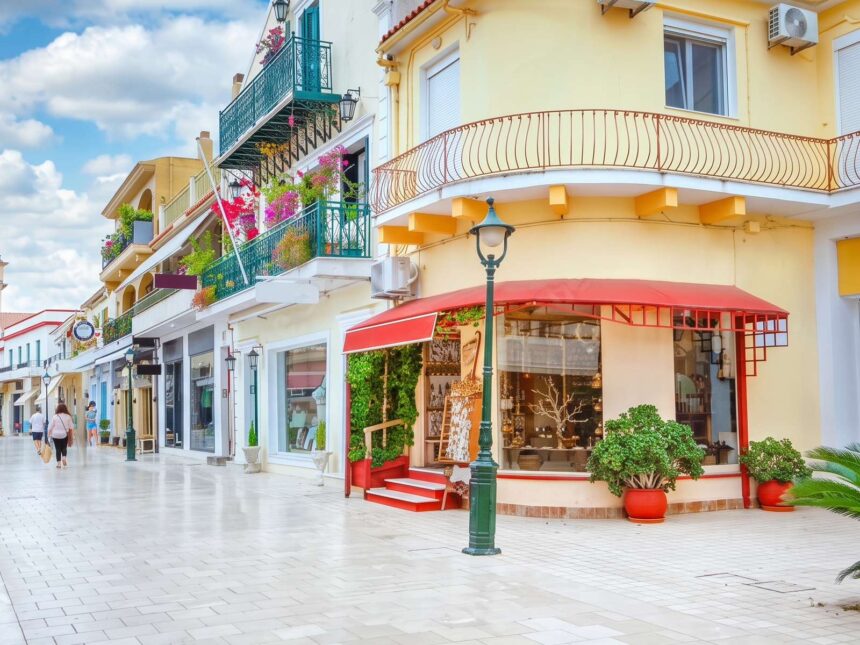
The capital is a lively, working town rather than a postcard. It was almost entirely rebuilt after 1953, so do not expect an old town. What it does have is a long waterfront, a busy pedestrian street (Lithostroto), good shops and restaurants, and loggerhead sea turtles. The turtles feed in the harbour and the Koutavos lagoon, and they often surface near the fishing boats along the quay in the morning. The stone De Bosset bridge, first built under British rule in 1813, crosses the bay; it is closed to traffic and has been under renovation.
A short drive or bike ride round the Lassi peninsula takes you to the Katavothres, sinkholes where seawater flows into the ground, and to the lighthouse of Agioi Theodoroi, a Doric-style rotunda first built in 1829 and reconstructed after the earthquake. Lassi itself is a resort area with small beaches, and Makris Gialos and Platis Gialos are the nearest sandy beaches to town.
Myrtos and Assos
The northwest coast is the island’s showpiece. Myrtos is a long beach of white pebbles under high cliffs, and the view from the road above is one of the best-known in Greece. Down on the beach, the sea shelves steeply and waves can be strong on windy afternoons, so it is better for strong swimmers than small children. A little further north, Assos is a small village of pastel houses on an isthmus below a large Venetian castle, built in the 1590s. The walk up to the castle is steep and best done early or late in the day, and the views back over the village are worth the climb. For routes along this coast, see our guide to walks between Assos and Myrtos.
Fiskardo and the north
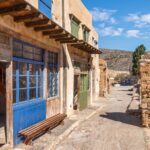
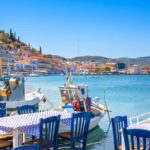
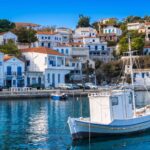
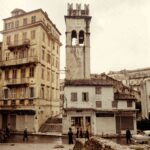
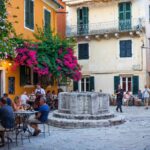
Fiskardo is the prettiest harbour on the island precisely because the 1953 earthquake spared it. Its 18th and 19th-century houses line a small, sheltered port that fills with yachts in summer. It is upmarket and can be crowded at lunchtime when boat trips arrive, but the evenings are lovely. Nearby villages such as Antipata, Vasilikiades and Magganos also kept their old houses. Emplisi, a short walk from Fiskardo, is a good snorkelling cove, and Foki beach is a pretty inlet just south of the village.
Sami, the caves and the east coast
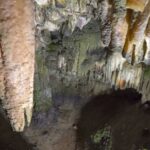
Sami is the main ferry port on the east coast, facing Ithaca. Close by are the island’s two famous caves: the underground lake of Melissani, where small boats glide over water lit from a collapsed roof, and the stalactite chamber of Drogarati. Our guide to visiting Melissani and Drogarati explains how to time it. Over the hill from Sami, Antisamos is a pebble beach in a green bay where parts of the film Captain Corelli’s Mandolin were shot. Agia Efimia, further north, is a small harbour village and a good, quieter base.
Mount Ainos and the Omala valley
The road up Mount Ainos climbs into a forest of the Kefalonian fir, a species found almost nowhere else, with views over Ithaca and Zakynthos on clear days. Wild horses live on the mountain. Below it, the Omala valley is the home of Robola, the island’s lemony white wine, and of the monastery of Agios Gerasimos, the island’s patron saint. We cover the mountain in more detail in our Mount Ainos guide.
Lixouri and the Paliki peninsula
A short car ferry crosses from Argostoli to Lixouri, the island’s second town, which is quieter and more local. The Paliki peninsula beyond has Xi, a beach of reddish clay sand, the dramatic pebbly bay of Petani, vineyards and the Kipoureon monastery on its western cliffs, a fine place for sunset.
What to skip, or at least rethink
- A full island loop in one day. Driving from Fiskardo to Skala or Poros takes far longer than the map suggests on winding roads. Split the island across two bases or two separate days.
- Melissani at midday in August. Late morning brings the best light but also the longest queues and coach groups. Arrive early or accept a wait.
- Myrtos as a family beach. It is spectacular, but steep, pebbly and often wavy. Families will be happier at Antisamos, Skala or Makris Gialos.
- Expecting an old town in Argostoli. Enjoy it for food, turtles and the waterfront, but go to Fiskardo or Assos for traditional architecture.
- Feeding or crowding the turtles. Watch them from the quay without leaning over or throwing food.
Where to stay
Argostoli and Lassi are the most convenient bases, close to the airport and with plenty of restaurants. Assos and Fiskardo are the most atmospheric, but small and pricey in July and August. Sami and Agia Efimia sit in the middle of the island, handy for the caves and ferries to Ithaca. Skala in the south has the longest sandy beach and is popular with families, as we explain in our guide to Kefalonia with kids.
Food and wine
Kefalonia’s signature dish is kreatopita, a meat pie with rice, herbs and often wild greens. Look also for bakaliaropita (salt cod pie), local feta, thyme honey and mandoles, caramelised almonds. Robola is the white wine to try, with other local varieties such as Mavrodaphne and Muscat. More in our guide to Kefalonia food and wine.
Getting there and around
Kefalonia’s airport, about 10 km south of Argostoli, has seasonal flights from many European cities and connections to Athens. By sea, ferries link Sami with Patras and Ithaca, Poros with Kyllini on the Peloponnese, Fiskardo with Lefkada and Ithaca, and in summer Pessada with Zakynthos. These make Kefalonia an easy stop on an Ionian island-hopping route. On the island, a car is close to essential: buses run between the main towns but are infrequent, especially outside the season.
Practical tips
- Book a car early. In July and August rental cars and automatic gearboxes in particular can run out.
- Drive carefully. Mountain roads are narrow, and goats and wandering animals are common on Mount Ainos.
- Check ferry timetables. Summer-only routes such as Pessada to Zakynthos change every year.
- Time your festivals. Agios Gerasimos is celebrated on 16 August and 20 October with processions and village festivities in the Omala valley.
- Bring shoes for pebbles. Many of the best beaches are white pebble rather than sand.
Frequently Asked Questions
How many days do you need in Kefalonia?
A week is ideal for an island this size. It lets you split your stay between two bases, such as Argostoli and Assos or Fiskardo, and see the caves, Mount Ainos and the main beaches without long daily drives.
Where is the best place to stay in Kefalonia?
Argostoli and Lassi are the most convenient, close to the airport and full of restaurants. Assos and Fiskardo are the most attractive villages, Sami and Agia Efimia are central, and Skala in the south suits families.
Do you need a car in Kefalonia?
Practically, yes. Buses connect the main towns but are infrequent, and many beaches, viewpoints and villages are only reachable by road. Book early in summer, especially if you want an automatic.
Why does Fiskardo look different from the rest of Kefalonia?
The earthquakes of August 1953 destroyed almost every settlement on the island, but Fiskardo and some nearby villages in the north were spared. They kept their older houses, while the rest of the island was rebuilt in a modern style.
Can you see turtles in Kefalonia?
Yes. Loggerhead turtles feed in Argostoli harbour and the Koutavos lagoon and often surface near the fishing boats in the morning. Watch quietly from the quay and never feed or touch them.