






The best Kefalonia hiking on the northwest coast is the climb to Assos castle, the longer Drapanitika to Assos route, and short trails to Dafnoudi and Kimilia near Fiskardo. There is no marked footpath from Assos to Myrtos; combine them by car.
Kefalonia hiking on the northwest coast means short, rewarding walks rather than one long coastal trail: there is no continuous marked path from Assos to Myrtos, because the cliffs between them drop straight into the sea. What you do get is a cluster of excellent routes within half an hour’s drive of each other, from the climb to the Venetian castle above Assos and the long approach from Drapanitika, to the viewpoint over Myrtos and the cypress paths down to Dafnoudi and Emplisi near Fiskardo. Here is how to string them together.
Quick facts
- Best time: April to June and mid September to October.
- Difficulty: mostly easy to moderate; the Drapanitika to Assos route is the only long, demanding day.
- Base: Assos, Fiskardo or the villages of the Erisos peninsula; Argostoli is about an hour’s drive from Assos.
- Getting around: a car is close to essential; summer buses from Argostoli are infrequent.
- Time needed: two or three days for the walks below, with swims.
- Good for: walkers who like a castle, a view and a swim in the same morning.
Understanding the northwest coast
The northwest of Kefalonia is the island at its most dramatic. The main road from Argostoli runs high above the sea along the west side of the island, past the village of Divarata (the turning for Myrtos), the turning for Assos and on to the Erisos peninsula and Fiskardo at the northern tip. The coast is a near continuous line of limestone cliffs, which is why the famous beaches here are reached by steep roads or paths, and why walking from one bay to the next along the shore is rarely possible.
The great earthquake of August 1953 destroyed most villages on Kefalonia, and on many walks you pass the ruins of old settlements that were abandoned rather than rebuilt. Fiskardo, in the far north, was largely spared, which is why it still has its old Venetian style houses. For a wider overview of the island, see our Kefalonia travel guide.
Assos and its Venetian castle
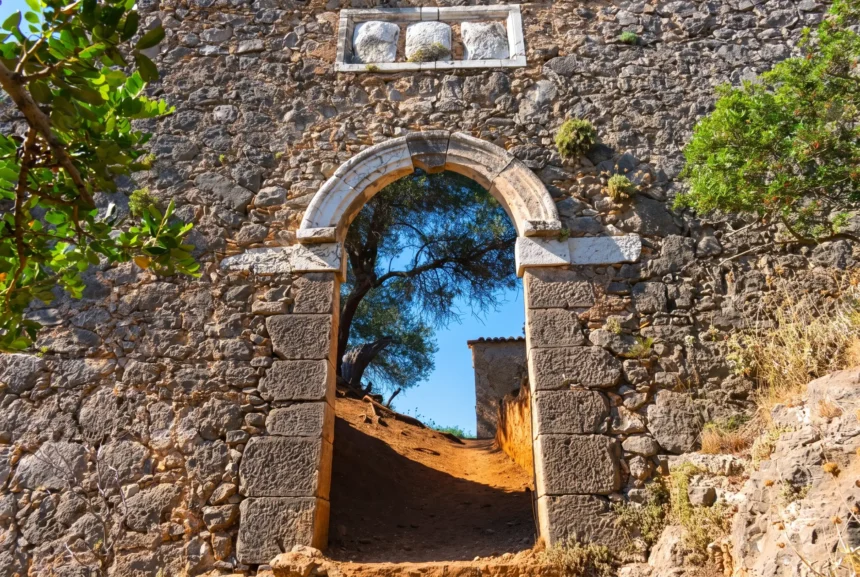
Assos is a small village of pastel houses on a narrow isthmus, with a pebble bay on one side and a pine covered peninsula rising about 170 m on the other. The whole peninsula is enclosed by the walls of a Venetian fortress, begun in 1593 and largely finished within a few years by the engineer Marino Gentilini. The walls run for around 2 km and the area inside covers more than 40,000 square metres. The main gate dates from 1611, according to the inscription on its lintel.
The castle had a long and varied afterlife. The French briefly used it as an administrative seat at the end of the 18th century, it was largely abandoned in the 19th, and from 1927 until the 1953 earthquake it served as a prison, including for political prisoners after the Second World War. Inside you will find the remains of the governor’s residence, the Catholic church of Saint Mark and the buildings of the prison farm, scattered among olive trees and pines.
The walk up
The walk from the village to the castle takes around 30 to 40 minutes each way. It starts opposite the car park and is mostly on a paved track that zigzags up the hillside. At a junction a sign offers two routes, so you can go up one way and come back the other. There is little shade and nothing is sold at the top, so take water and go early in the morning or late in the afternoon. Wander inside the walls for at least an hour: the views back over Assos and south along the cliffs are among the best on the island. Finish with a swim from the pebble beach in front of the village and lunch on the waterfront.


Drapanitika to Assos: the long way in
If you want a proper day on foot, the route from the hamlet of Drapanitika to Assos and back is the big walk of this coast. It is around 13.6 km return and graded moderate to difficult, and it can take most of a day with time in the castle and a swim. The path passes through pine and cypress woodland and old terraced fields, with wide views over the Ionian, before Assos appears below you. It is a route for experienced walkers with good shoes, plenty of water and an early start; in high summer it is too hot for most people. Distances and walking times on this route are not well signposted, so check a current map before you set off and allow generous margins.
Myrtos: the viewpoint and the beach
Myrtos is the most photographed beach on Kefalonia, a long curve of white pebbles between tall cliffs, and the view from above is part of the experience. There is a viewpoint on the main road above the bay, just north of the bridge into Divarata, and it is worth stopping in both directions as the light changes through the day.
To reach the beach you take the turning in Divarata and follow a narrow road with many hairpin bends down to a car park at sea level. It is a road rather than a footpath, and walking it in summer means sharing a narrow road with cars and coaches, so most people drive. What you should know before swimming: the beach shelves steeply, so on windy days the waves can be powerful and getting in and out is hard for small children and weaker swimmers. There is little natural shade, and sunbeds and umbrellas are available to rent. Go early or late in the day in July and August, when the car park fills up.
The honest summary is that Myrtos is a beach to see from above and swim at on a calm day, not a walking destination in itself. Combine it with the Assos castle walk on the same morning, since the two are a short drive apart. Our list of things to do in Kefalonia places it alongside the island’s other highlights.

North of Assos: Erisos and Fiskardo walks
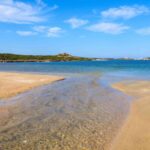
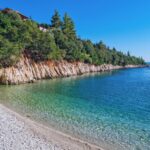
The Erisos peninsula, the green northern tip of Kefalonia, has some of the island’s most pleasant short walks, with cypress woods, old stone villages and very clear water.
Antipata to Dafnoudi beach
From the village of Antipata, a path drops through olive groves and cypress forest to the small pebble cove of Dafnoudi. It is about 2.4 km return and takes an hour or so, plus time for a swim. The water is a startling blue green and there is a small sea cave at one end. There are no facilities, so bring water and snacks, and remember that the walk back is uphill.
Emplisi to Kimilia
Emplisi is a small bay a short way from Fiskardo, and from here a path of about 2.6 km return runs through pine, oak and cypress to Kimilia beach, with natural rock pools along the way. It takes about an hour and is easy enough for most families with older children.
Fiskardo lighthouse and the Foki trail
From Fiskardo harbour a short walk leads out to the Venetian lighthouse at the entrance to the bay, past the remains of an early Christian basilica. The Foki trail starts at Foki bay, south of Fiskardo, and climbs through a cypress forest past abandoned settlements to the church of Agios Gerasimos and some small caves. Both are easy half day outings that combine well with a swim at Foki.
A two-day plan
| Day | Morning | Afternoon |
|---|---|---|
| Day 1 | Early climb to Assos castle, swim in Assos bay | Myrtos viewpoint, then the beach if the sea is calm |
| Day 2 | Antipata to Dafnoudi with a swim | Emplisi to Kimilia or the Fiskardo lighthouse walk, dinner in Fiskardo |
Experienced walkers can swap Day 1 for the full Drapanitika to Assos route. If you want a mountain day as well, add the trails on Mount Ainos and its fir forest, in the centre of the island.
Practical tips
- Timing: in July and August, start walking by 08:00 and be in the shade or the sea by 11:00. Spring and autumn are far better for longer routes.
- Parking: space in Assos is very limited and the road down is steep and winding. Arrive early or expect to park on the approach road.
- Footwear: trainers are fine for the castle track; use walking shoes with grip for Dafnoudi, the Foki trail and the Drapanitika route.
- Water and food: there are no shops on the trails. Stock up in Assos, Fiskardo or the villages on the main road.
- Swimming: the beaches on this coast are pebbly and shelve quickly. Water shoes help, and a snorkel is worth packing.
- Combine with caves and food: the east coast caves near Sami are under an hour away; our guide to Melissani and Drogarati has the details, and our Kefalonia food guide tells you what to order at the end of the day.
Is it worth it?
Yes, with the right expectations. If you are looking for a long distance coastal path, Kefalonia’s northwest is not it. If you want a series of short, varied walks, a Venetian castle with almost no crowds early in the day, and a swim in exceptionally clear water at the end of each one, this is one of the best corners of the Ionian. Families with younger children will find the shorter routes manageable; our guide to Kefalonia with kids suggests calmer beaches for the rest of the trip.
Frequently Asked Questions
Can you walk from Assos to Myrtos beach?
There is no marked coastal footpath between Assos and Myrtos, as the cliffs between them drop straight into the sea. The two are a short drive apart along the main road, so most people combine the Assos castle walk with a stop at the Myrtos viewpoint and beach.
How long is the walk up to Assos castle?
From the village the walk takes about 30 to 40 minutes each way on a mostly paved track. There is little shade and nothing for sale at the top, so take water and go early or late in the day.
What are the best easy hikes in northwest Kefalonia?
Antipata to Dafnoudi beach (about 2.4 km return) and Emplisi to Kimilia (about 2.6 km return) are short, easy and end with a swim. The Fiskardo lighthouse walk is another gentle option.
Is Myrtos beach safe for swimming?
On calm days it is beautiful for swimming, but the beach shelves steeply and waves can be strong in wind, which makes getting in and out difficult. Check conditions and take care with children.
When is the best time for Kefalonia hiking?
April to June and mid September to October offer mild temperatures and clear views. Summer walking is possible only early in the morning or near sunset because of the heat and lack of shade.