

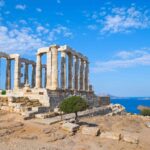

Corfu's best known legends include Pontikonisi, said to be the Phaeacian ship Poseidon turned to stone, the Moros ghost who guards hidden treasure, the House of the Doctors near Ano Korakiana and the haunted British hospital in the Old Fortress.
Corfu’s legends run from Homer to the Second World War. The island claims to be the land of the Phaeacians who carried Odysseus home, Pontikonisi is said to be their ship turned to stone, and alongside these ancient myths Corfiots still tell stories of treasure guarding ghosts, a haunted house in the hills and an abandoned hospital inside the Old Fortress. Here are the best known myths and urban legends, how much truth lies behind them and where you can see the places they are attached to.
Quick facts
- Oldest myths: the nymph Korkyra, the Phaeacians and Odysseus, and Jason and Medea’s wedding.
- Most visited legend: Pontikonisi, the islet off Kanoni said to be a petrified ship.
- Best known ghost: the Moros, a dark figure who guards hidden treasure.
- Most famous haunted building: the old British military hospital in the Old Fortress.
- Good for: evening walks, families with older children and anyone who likes a good story.
Ancient myths
Korkyra and Poseidon
The Greek name of the island, Kerkyra, goes back to a myth. Poseidon fell in love with Korkyra, daughter of the river god Asopos, carried her off to an island in the Ionian Sea and named it after her. Their son Phaiax gave his name to the Phaeacians, the seafaring people who, in Corfiot tradition, were the island’s first inhabitants. The ancient city that grew up on the Kanoni peninsula took the same name; you can read about its ruins in our guide to ancient Kerkyra.
The sickle island
An older name for Corfu was Drepani, the sickle, after the curved shape of the island. Ancient writers explained it with a myth: this was where the sickle that Kronos used against his father Ouranos lay buried, or, in a gentler version, the sickle of Demeter, who taught the islanders to harvest grain. Look at a map of Corfu and the curve is obvious.
Odysseus, Nausicaa and Pontikonisi
In the Odyssey, the shipwrecked Odysseus washes up on the shore of Scheria, the land of the Phaeacians, where Princess Nausicaa finds him and leads him to the palace of her father, King Alkinoos. Corfiots have identified Scheria with their island since antiquity, and several beaches compete for the honour of being the spot where he came ashore, with Ermones on the west coast the most often named.
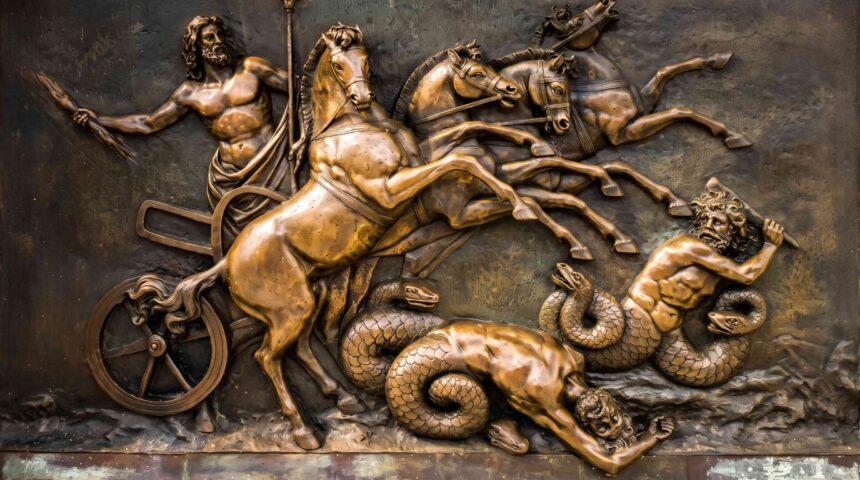
The Phaeacians paid for their kindness. When their ship returned from taking Odysseus home to Ithaca, Poseidon, still furious with the hero, turned it to stone at the entrance to the harbour. Tradition says that ship is Pontikonisi, Mouse Island, the small wooded islet with its Byzantine chapel that lies just off the Kanoni peninsula. Others point instead to a rock off Paleokastritsa. The view of Pontikonisi and the white monastery of Vlacherna below it is the most photographed in Corfu; our guide to Kanoni and Mon Repos explains how to get there.
Jason and Medea
The island also appears in the story of the Argonauts. In the version told by Apollonius of Rhodes, Jason and Medea, pursued by the fleet of her father, reached the Phaeacians on their way home with the Golden Fleece. To prevent Medea being handed back, Queen Arete arranged for the couple to marry at once, and the wedding took place in a sacred cave on the island.
Saint Spyridon’s night walks
The most loved Corfiot stories are not ghosts but miracles. The island’s patron saint, Saint Spyridon, is believed to protect Corfu in person. Tradition credits him with ending famine and plague and with driving off the Ottoman army in 1716, when defenders reported seeing a monk with a sword on the walls. Corfiots also say that he walks the island at night helping those in need, which is why the embroidered slippers on his relics wear out and are replaced from time to time, the old pair being cut up and shared as blessings. You can learn more in our guide to Saint Spyridon church.
Urban legends and folk tales
The Moros
The best known figure of Corfiot folklore is the Moros, a tall, dark, silent man dressed in black who appears at night in old houses and lonely places. The name probably comes from the Italian moro, meaning dark or Moorish, one of many Venetian loans in the Corfiot dialect. According to the stories, a wealthy lord who wanted to hide his gold would kill a servant or captive and bury him beside the treasure, often in the foundations or cellar of the house, so that his spirit would guard it for ever.
The Moros is not usually a threat. Many versions say he wants to be released, and he does so by leading a chosen passer-by to the hidden treasure. Once the gold is found, his task is over and his soul is free. Stories like this were told all over the Ionian Islands, and they explain why older Corfiots are wary of digging under old mansions.
The House of the Doctors
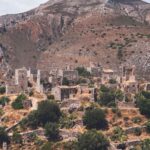
On the road up to the village of Ano Korakiana, in the hills about 19 km northwest of Corfu Town, stands an old building that Corfiots know as the House of the Doctors. The story says that in the 1830s two young Italian doctors, refugees from the failed uprisings for Italian unification, settled here and used the house as a meeting place for members of the secret society Young Italy. What happened to them is unclear: one version says they returned to Italy and were arrested and executed, another that they took their own lives in the house. Either way, the house gained a dark reputation. Locals later claimed that bandits exploited it, rattling chains in the dark so that frightened villagers abandoned their carts and goods on the road. It is private property, so view it only from the road.
Argyro of Valanio
In the north of the island, near the village of Valanio, a story is told about a place called Paleokastro, the old castle. A rich lord built a watchtower there to warn of pirate raids. His daughter, Argyro, loved to walk in the woods and swim in the river below. One day she saw smoke rising from the tower and understood that raiders had reached her family. Rather than be captured, she blindfolded herself and her mule and rode over the edge of a cliff. Versions differ in the details, but villagers still point out the spot.
The old British hospital
The most famous haunted building in Corfu stands inside the Old Fortress, on the northern side between the two peaks: the British military hospital. It was built in 1835 for the British garrison, enlarged in 1858 and could treat more than a hundred patients. In the First World War it cared for wounded Allied soldiers. After the Italian occupation of 1941 it became a headquarters for the occupying forces, and wartime accounts speak of prisoners being interrogated in its rooms and executions in its yard. On 14 September 1943, during the German bombardment of Corfu, the building caught fire with people still inside.
The Greek army later repaired it and used it as a hospital and military school, but it was abandoned in the 1980s. Since then it has collected ghost stories: shadows at the windows, voices calling for help, footsteps, chains and the sound of gunfire. Much of this is easily explained by wind howling through broken windows and a crumbling roof. The Ministry of Culture listed it as a modern monument in 2020 and has been studying a restoration for cultural use, but for now the building is closed and unsafe. You can see it from the paths of the fortress.
Where to see the legends
- Pontikonisi and Vlacherna: from the viewpoint at Kanoni, about 4 km south of the old town.
- The Old Fortress: the British hospital from the outside, plus the views that made the island’s name.
- Saint Spyridon church: the saint’s relics in the heart of the old town.
- Ermones and Paleokastritsa: two of the beaches linked with Odysseus’s landing.
Practical tips
- Evening walking tours of Corfu Town that focus on ghost stories and dark history run in season. They are a good way to hear local versions of these tales.
- Do not try to enter the British hospital or other abandoned buildings. They are unsafe and access is not permitted.
- Kanoni is busy at sunset. Go early in the morning for a quieter view of Pontikonisi, and note that the boat to the islet usually runs only in summer.
- The Old Fortress keeps seasonal hours and charges admission. Check current times before you visit.
Frequently Asked Questions
What is the legend of Pontikonisi?
According to tradition, Pontikonisi is the Phaeacian ship that carried Odysseus home to Ithaca. Poseidon, angry that the Phaeacians had helped his enemy, turned it to stone as it returned to Corfu.
What is the Moros in Corfu folklore?
The Moros is a ghost in the form of a tall dark man dressed in black. Legend says he is the spirit of someone killed and buried beside hidden treasure to guard it, and he is freed only when he leads a living person to the gold.
Is the British hospital in Corfu’s Old Fortress haunted?
It has a strong reputation for ghost stories because of its wartime history, including its use by the occupying forces and the fire of September 1943. The building is abandoned, closed and unsafe, so it can only be seen from outside.
Was Corfu the island of the Phaeacians?
Corfiots have identified their island with Scheria, the land of the Phaeacians in Homer’s Odyssey, since ancient times. There is no archaeological proof, but the tradition is strong and several beaches claim to be where Odysseus landed.
Why are Saint Spyridon’s slippers replaced?
Corfiots believe the saint walks the island at night helping people, so his embroidered slippers are said to wear out. They are replaced from time to time, and pieces of the old ones are given as blessings.