


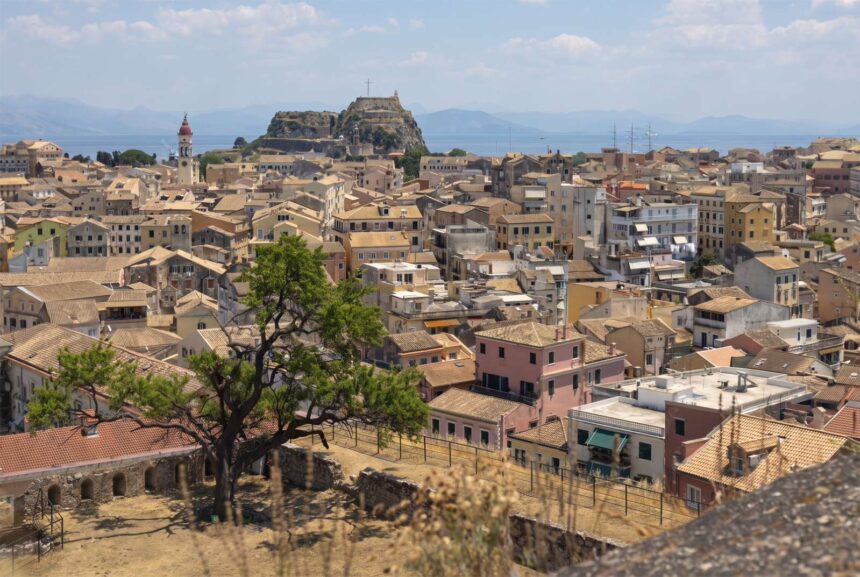
Corfu Old Town is the UNESCO-listed historic centre of Corfu Town, shaped by four centuries of Venetian rule and later French and British additions. Its highlights are the Spianada and Liston, the Church of Saint Spyridon, the Campiello quarter and the Old and New Fortresses.
Corfu Old Town is the historic centre of Corfu Town, a dense grid of Venetian lanes, Georgian-era public buildings and Parisian-style arcades squeezed between two fortresses, and a UNESCO World Heritage Site since 2007. It is compact enough to explore on foot in a day, yet layered enough to reward a second and third visit. This guide explains what makes it special, which buildings matter and how to see it without the crowds.
- Quick facts
- Why the Old Town is on the UNESCO list
- The Spianada and the Liston
- Palace of St Michael and St George
- The Church of Saint Spyridon
- Campiello and the kantounia
- Town Hall Square and the Catholic Cathedral
- The Jewish quarter
- Museums worth your time
- The two fortresses
- Practical tips
- Frequently Asked Questions
Quick facts
- Status: UNESCO World Heritage Site, inscribed in 2007
- Time needed: one full day for the main sights, two if you add museums and the fortresses
- Best time: early morning and evening, especially when cruise ships are in port
- Getting there: a short taxi or bus 15 ride from the airport; the cruise and ferry port is a walk away
- Good for: architecture, history, cafés, people-watching
Why the Old Town is on the UNESCO list
UNESCO inscribed the Old Town of Corfu for its fortifications and urban fabric, describing a fortified Mediterranean port town whose defences were designed by Venetian engineers and used for around four centuries against the Ottoman Empire. Venice held Corfu from 1386 to 1797 and made it the key to the Adriatic. The town’s walls held out against major Ottoman sieges in 1537 and 1571, and again in 1716, a victory Corfiots still credit to their patron saint.
Later rulers added their own layers. The French, who held the island in 1797 to 1799 and again in 1807 to 1814, built the Liston. The British, who ran the United States of the Ionian Islands as a protectorate from 1815 to 1864, demolished much of the outer fortification system but added neoclassical public buildings, including the Palace of St Michael and St George. Corfu was never ruled by the Ottomans, which is why the Old Town looks closer to Venice or Dubrovnik than to most Greek towns.
The Spianada and the Liston
The Spianada, the vast open space between the Old Town and the Old Fortress, was originally cleared by the Venetians as a firing field. It is regularly described as the largest square in Greece. The lower part is a cricket ground, a legacy of British rule, and matches are still played here in summer. The upper part has gardens, the bandstand where the town’s philharmonic bands play, and the circular Maitland Rotunda, built in honour of the first British Lord High Commissioner.
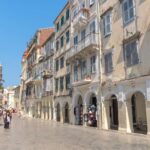
Along the western edge runs the Liston, an arcaded terrace built under French rule and modelled on the Rue de Rivoli in Paris. Its name is traditionally linked to the list of noble families once allowed to stroll here. Today it is a row of cafés and bars facing the Spianada. Prices are higher than in the backstreets, but a coffee or a local ginger beer under the arcades is part of the experience, especially in the evening when families come out for their volta.
Palace of St Michael and St George
At the northern end of the Spianada stands the colonnaded Palace of St Michael and St George, built by the British as the residence of the Lord High Commissioner and seat of the Ionian Senate. It now houses the Museum of Asian Art, a surprisingly rich collection of Chinese, Japanese, Indian and other Asian art built around donations from Corfiot and Greek collectors. The palace interiors, especially the throne room and the state rooms, are worth seeing in their own right. Opening hours vary through the year, so check before you go.

The Church of Saint Spyridon
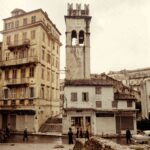
A few lanes west of the Liston, the red-domed bell tower of Agios Spyridon rises above the rooftops and works as a landmark when you get lost. The church was completed in 1589 and the bell tower followed in 1620. Inside, under an ornate painted ceiling and a forest of silver votive lamps, lies the relic of Saint Spyridon, the island’s patron saint, kept in a silver casket made in Vienna in the 19th century.
The relic is carried through the town in procession four times a year, each date marking a miracle attributed to the saint:
- Palm Sunday: deliverance from plague in 1629
- Holy Saturday: deliverance from famine in the 16th century
- 11 August: the lifting of the Ottoman siege of 1716
- First Sunday of November: deliverance from a second plague in 1673
The processions are led by the town’s philharmonic bands and draw huge crowds. If you are in town on one of these dates, find a spot along the route early. Dress modestly to visit the church at any time, and remember it is an active place of worship.
Campiello and the kantounia
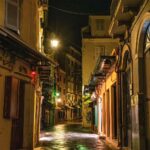
North of Saint Spyridon, toward the old harbour, lies Campiello, the oldest and most atmospheric quarter of the Old Town. Its lanes, the kantounia, are often barely wider than outstretched arms, flanked by four- and five-storey houses with washing lines strung between the balconies. Small squares open up around churches and old stone wellheads, a reminder that these neighbourhoods once depended on cisterns. The building at Filellinon 18 is considered the oldest surviving in the town, dating to around 1497.
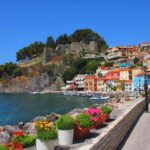
Campiello is best explored without a fixed plan. Head uphill and inland from the seafront and you will come out sooner or later by the Mouragia, the walk along the old sea walls with views over to the Albanian coast and the islet of Vidos. Our separate Corfu Town walking route links these streets into a single loop.
Town Hall Square and the Catholic Cathedral
One of the Old Town’s most elegant spaces is the sloping square in front of the Town Hall. The building began life in 1693 as a meeting place for the Venetian nobility and was converted into a theatre, the Nobile Teatro di San Giacomo, in 1720. In 1733 it staged what is regarded as the first opera performance in Greece. It later became the Town Hall, the role it still holds. Facing it across the square is the Catholic Cathedral of Saints James and Christopher, a reminder of the island’s long Catholic community.
The Jewish quarter
West of the town centre, near the New Fortress, the streets of the former Jewish quarter (Evraiki) are quieter and less polished. The synagogue on Velissariou Street is the surviving place of worship of a community that lived in Corfu for centuries and was almost entirely deported by the Nazis in 1944. A Holocaust memorial in the town remembers the victims. It is a sobering but important part of the town’s story.
Museums worth your time
- Museum of Asian Art: in the Palace of St Michael and St George, described above.
- Antivouniotissa Museum: a collection of Byzantine and post-Byzantine icons housed in a church above the Mouragia.
- Archaeological Museum of Corfu: just outside the Old Town in Garitsa. Its highlight is the Gorgon pediment from the Temple of Artemis, dated to around 590 to 580 BC and considered the oldest surviving stone pediment in Greece.
- Corfu Reading Society: one of the oldest cultural institutions in modern Greece, with a library and exhibitions in a building just off the Spianada.
The two fortresses
The Old Fortress occupies the rocky promontory east of the Spianada, cut off by a sea moat, while the New Fortress rises above the ferry port on the western side. Both are part of the UNESCO listing, and the Old Fortress, with its British-built Church of St George and its views from the lighthouse summit, is a highlight of any visit. We cover both in detail in a separate guide to Corfu’s fortresses.
Practical tips
- Go early or late: on days when several cruise ships are in port, the lanes between the Liston and Saint Spyridon are packed from late morning to mid-afternoon.
- Walk, do not drive: the historic core is largely car-free. Use the paid car parks around the port or on the edges of the centre.
- Wear proper shoes: the stone paving is uneven and slippery when polished or wet.
- Look up: Venetian lions, coats of arms and carved doorways are easy to miss at eye level.
- Eat in the backstreets: the tavernas a few lanes from the Liston are usually better value than those facing the Spianada.
- Check processions and holidays: Easter and the Saint Spyridon processions transform the town but also close streets and fill hotels.
Frequently Asked Questions
Is Corfu Old Town worth visiting?
Yes. It is one of the best preserved historic towns in Greece and the only one shaped mainly by Venice, France and Britain rather than the Ottomans. Even beach-focused visitors usually find a day here the highlight of their trip.
How long do you need in Corfu Old Town?
A full day covers the Spianada, Liston, Saint Spyridon, Campiello and one fortress. Allow a second day if you want to visit the Museum of Asian Art, the Archaeological Museum and both fortresses at a relaxed pace.
When did Corfu Old Town become a UNESCO site?
The Old Town of Corfu was inscribed on the UNESCO World Heritage List in 2007. The listing recognises its Venetian fortifications and the urban fabric that grew up around them over four centuries.
What is the Liston in Corfu?
The Liston is an arcaded row of buildings on the western edge of the Spianada, built during French rule in the early 19th century and modelled on the Rue de Rivoli in Paris. Its ground floor is lined with cafés and bars.
When are the Saint Spyridon processions?
The relic of Saint Spyridon is carried through Corfu Town on Palm Sunday, Holy Saturday, 11 August and the first Sunday of November. Each procession commemorates a miracle attributed to the saint, from plague and famine to the Ottoman siege of 1716.