


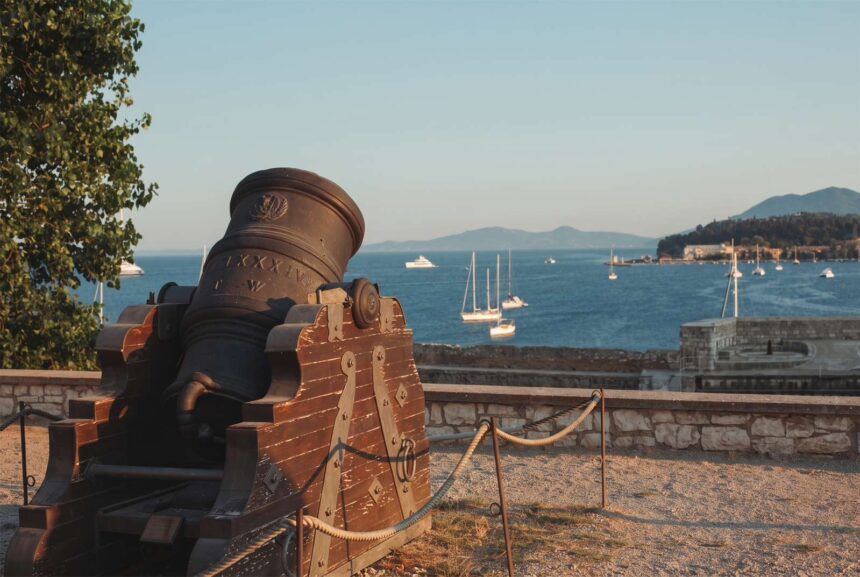
The Old Fortress of Corfu is a Venetian citadel on a headland east of Spianada Square, part of the UNESCO listed Old Town, with bastions, a sea moat, a British era church and a summit lighthouse. Allow about two hours; the smaller New Fortress above the old port opens April to October.
The Old Fortress of Corfu is the Venetian citadel on the rocky headland east of Spianada Square, and it is the single best place to understand why Corfu Town looks the way it does. Give it two hours, climb to the lighthouse on the higher of its two peaks, and walk back along the sea walls. The New Fortress, on the hill above the old port, is smaller, quieter and only open in the warmer months, but its bastions give the best view over the rooftops of the Old Town.
Quick facts
- Where: Old Fortress on the promontory east of Spianada; New Fortress on the hill of Agios Markos above the old port
- Tickets (2026): around 10 euros for the Old Fortress and around 5 euros for the New Fortress, with reduced fares; check the official Hellenic Heritage site before you go
- Time needed: 1.5 to 2 hours for the Old Fortress, about 1 hour for the New Fortress
- Best time: opening time in summer, or the last two hours before closing for softer light
- Good for: history lovers, photographers, anyone wanting the classic view over Corfu Town
Why Corfu has two fortresses
Corfu Town grew on a narrow peninsula with two rocky peaks, and the name Corfu is generally traced to the Greek word koryfo, meaning peak. The Byzantines fortified those peaks first. When Corfu came under Venetian rule in 1386, the headland became the core of the defences that guarded the entrance to the Adriatic, and over the next two centuries Venice turned it into one of the strongest fortresses in the Mediterranean.
The Ottomans attacked repeatedly, with major sieges in 1537, 1571 and 1716, and the fortifications held each time. The 1537 siege, however, showed Venice that the old citadel could not protect the growing town outside its walls. The answer was a second stronghold, the New Fortress, begun in the 1570s on the hill of Agios Markos (Saint Mark) at the other end of town. Sources disagree on exact dates, but work started around 1576 or 1577 and continued in phases until well after 1645. Around 2,000 houses in the suburb of San Rocco are said to have been demolished to make room for the new walls.
The two fortresses were once linked by a continuous ring of walls enclosing the town. The British, who ruled the Ionian Islands as a protectorate from 1815 to 1864, rebuilt much of the interior and then demolished large parts of the outer defences before handing the islands to Greece in 1864. Together with the Old Town, both fortresses were inscribed on the UNESCO World Heritage List in 2007.
The Old Fortress: what to see
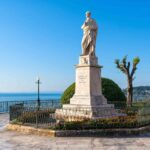
You enter from Spianada, the big open square that the Venetians cleared as a firing range in front of the walls. Before crossing, look at the statue of Count Johann Matthias von der Schulenburg, the German commander who led the defence during the 1716 siege. The statue is by the Venetian sculptor Antonio Corradini and was put up while Schulenburg was still alive, which tells you how much that victory mattered to Venice.
The Contrafossa and the main gate
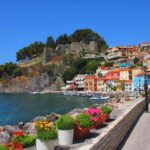
The first thing you cross is the Contrafossa, the sea moat the Venetians cut across the neck of the peninsula to turn the citadel into an artificial island. Small fishing boats are moored along its length, and the view along the water to the walls is one of the most photographed in Corfu. A steel bridge has replaced the old wooden drawbridge. The main gate sits between two bastions and still has its vaulted passage and stone pillars. The Lion of Saint Mark that once marked Venetian authority was replaced by a Greek coat of arms after union with Greece.
The Savorgnan and Martinengo bastions
The two pentagonal bastions that face the town, named Savorgnan (north) and Martinengo (south), were built in the mid sixteenth century after the 1537 siege. They are a textbook example of the Venetian bastioned front designed to deflect cannon fire and cover every approach with crossfire. Each has three levels connected by stairs and vaulted corridors. You get the best sense of their scale from the bridge and from the ramparts above.
The British barracks and the library
Once inside, the large building at the end of the bridge is a British infantry barracks. It now houses the Corfu branch of the General State Archives and the public library, and other old buildings in the fortress are used by the Ionian University, notably its music department. That mix of working institutions and ruins is part of the character of the place: this is not a cleaned up open air museum but a living corner of the town that happens to be 600 years old.
Church of Saint George
The building most visitors remember is the Church of Saint George on the southern side, which looks like a Doric temple dropped onto the shore. The British built it in the 1840s as an Anglican church for the garrison. After 1864 it became an Orthodox church. Inside it is plain, and outside it is the best place to sit in the shade and look across Garitsa Bay towards the Mon Repos estate.
The Land Tower, the lighthouse and the view
The highlight is the climb to the summit of the western and higher peak, the Land Tower (Castel a Terra to the Venetians), which was strengthened in 1501 and rebuilt by the British. A lighthouse, one of the first British works in the fortress, sits on top. The climb is steep in places on worn stone, but it is short, and the reward is a 360 degree view: the red roofs and bell towers of the Old Town, the New Fortress on its hill, Vido island in the harbour and the Albanian and Epirus mountains across the strait. The eastern peak, the Sea Tower, is the older of the two summits and was used as a powder magazine.
What you will not see
Much of what stood inside the walls has gone. A gunpowder explosion in 1718 destroyed many buildings, and bombing during the Second World War badly damaged most of what survived of the Venetian interior. Expect ruins, open ground, British era buildings and a few Venetian survivors rather than a complete Renaissance town. A short walk along the northern sea walls brings you to the small Mandraki harbour, the artificial harbour the Venetians created in the first phase of their rule.
The New Fortress: what to see
The New Fortress (Neo Frourio) crowns the hill on the western side of the Old Town, above the old port. It is a late Renaissance fortress designed by the military engineer Ferrante Vitelli, and it was built to hold the line where the town was most exposed from the land and the northern harbour.
The gates and the winged lion
The walls on the approach are the most impressive part. Look for the relief of the winged Lion of Saint Mark dated 1728 on the eastern gate, and for the Venetian inscription on the Skarponas rampart, which records building work under the Doge Alvise Mocenigo. This is one of the best preserved Venetian lions in Corfu.
Tunnels, galleries and bastions
Inside, the fortress is a warren of vaulted chambers, galleries, ramps and stairways, with cisterns and powder magazines cut into the hill. The British built the barracks lower down, which today host exhibitions and events. At the top, the Bastion of the Seven Winds (Epta Anemoi) and the Skarponas bastion look straight over the Old Town and across to the Old Fortress. In the late afternoon the light falls across the town from this side, which is why photographers tend to prefer it.
The very top is still in military use as part of the Corfu naval station, so some areas are closed. That also means the New Fortress feels less visited and less maintained than its older sibling. If you have time for only one, choose the Old Fortress. If you like quiet and views, add the New Fortress.
Old vs New Fortress at a glance
| Old Fortress | New Fortress | |
|---|---|---|
| Built | Byzantine origins, Venetian form from the 15th and 16th centuries | Begun around 1576, finished after 1645 |
| Main sights | Contrafossa, bastions, Saint George, lighthouse summit | Venetian gates, tunnels, Seven Winds bastion |
| Season (2026) | Open all year, shorter hours in winter | Usually April to October only |
| Crowds | Busy late morning in summer | Usually quiet |
| Best for | History and the classic view | Views over the Old Town rooftops |
Practical tips
- Opening hours change with the season. In 2026 the official ticketing site lists the Old Fortress as open daily from 08:00 to 20:00 between April and August, closing progressively earlier from September and at 15:30 in winter. The New Fortress is listed as open 08:00 to 16:00 from April to October and closed in winter. Both close on major public holidays. Check before you go, as hours can change at short notice.
- Buy tickets at the gate or online. Free entry days apply at both sites, including the last weekend of September, 28 October and the first and third Sunday of the month from November to March.
- Go early in summer. There is little shade on the upper levels of either fortress, and the stone reflects heat. Carry water.
- Wear proper shoes. The paths to the Old Fortress summit are polished stone and can be slippery. Neither site is fully accessible for wheelchairs, although the lower parts of the Old Fortress are manageable.
- Combine with a town walk. The Old Fortress is a few minutes on foot from the Liston arcades, and the New Fortress is a short climb from the old port, so both fit easily into a walking route through town.
- Do not drive in. Parking in the centre is limited. Use the paid car parks near the old port or arrive by city bus.
Is it worth it?
Yes, especially the Old Fortress. Corfu Town is the reason many people come to the island, and the fortress is the reason the town exists in the form it does: it explains the Venetian layout, the open space of Spianada, the British buildings and the Italian feel of the streets. Even if fortifications are not your thing, the summit view alone justifies the ticket. Keep your expectations realistic about the interior, which is more open space and ruins than intact palaces, and you will not be disappointed.
Frequently Asked Questions
How much does it cost to visit the Old Fortress of Corfu?
In 2026 the official Hellenic Heritage ticketing site lists a full ticket at around 10 euros and a reduced ticket at around 5 euros. There are several free entry days each year. Prices change, so check the official site before your visit.
How long do you need at the Old Fortress?
Plan on 1.5 to 2 hours to cross the moat, see the Church of Saint George, climb to the lighthouse and walk part of the sea walls. Allow longer if you want to take photos in the late afternoon light in summer.
Is the New Fortress in Corfu open in winter?
The official ticketing site lists the New Fortress as open from April to October only, from 08:00 to 16:00, and closed from November to March. Check current hours before you go, as they can change.
Which is better, the Old Fortress or the New Fortress?
If you only have time for one, choose the Old Fortress for its history, the Contrafossa moat and the summit view. The New Fortress is quieter and has an excellent view over the Old Town rooftops, so it suits people who have already seen the main sights.
Is the climb to the top of the Old Fortress difficult?
It is short but steep in places, on worn and sometimes slippery stone. Most people with reasonable mobility manage it easily in good shoes. Avoid the midday heat in summer, as there is very little shade at the top.