



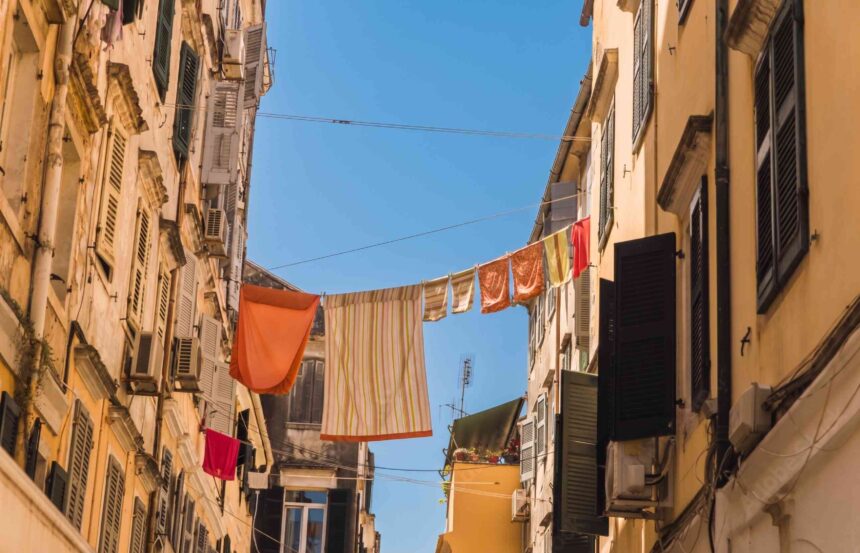
Kantounia are the narrow stone lanes of Corfu Old Town, some barely wider than a person, squeezed between tall Venetian era houses. The best are around Campiello and Agios Spyridon, and the only way to see them is on foot.
The kantounia (singular kantouni) are the narrow lanes that thread through Corfu Old Town, running between houses of four and five storeys so close together that in places you can touch both walls at once. They are the real fabric of the UNESCO listed town: the big squares and the Liston get the photographs, but daily life in Corfu Town has always happened in these alleys. If you only do one thing in town, put the map away for an hour and get lost in them.
Quick facts
- What: the network of narrow stone lanes inside Corfu Old Town; kantouni is the local word for one of them.
- Where: the whole historic centre, densest in the Campiello quarter between the Old Port and Agios Spyridon.
- Time needed: one to two hours for an aimless wander, longer if you stop for coffee.
- Best time: early morning before the cruise crowds, or late afternoon when the light drops between the houses.
- Good for: walkers, photographers, anyone interested in how an old town actually works.
- Cost: free; the lanes are public streets.
What a kantouni is
The word comes from the Venetian Italian spoken on the island for centuries and survives in everyday Corfiot speech; it is one of many Italian loanwords you will hear in town, alongside words such as volta for an arched passage. A kantouni is not just any street. It is the kind of passage that a car cannot enter, often stepped, often turning at a sharp angle, with laundry lines crossing overhead and front doors opening straight onto the paving. Some are a couple of metres wide; the tightest are so narrow that two people coming from opposite directions have to turn sideways to pass.
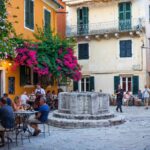
Many of the same lanes appear in the oldest villages of the Corfu countryside, where houses were also packed together for shelter and defence, but the town is where the network is most complete. Walking through it is the easiest way to understand why Corfu Old Town looks nothing like a typical Greek island town of white cubes. Here the houses are tall, ochre and rose coloured, with green shutters, and they lean towards each other across the lanes. For the background to the whole district, start with our guide to Corfu Old Town.
Why the lanes are so narrow
For most of the Middle Ages the town of Corfu lived inside the Old Fortress on its rocky promontory. As the population grew, a settlement spread onto the land outside its walls, the area the Venetians called the Borgo, and after the Ottoman sieges of the 16th century it was enclosed by new walls and bastions. Space inside those walls was limited, so the town grew upwards rather than outwards, which explains the unusual height of the houses.
The tight, winding plan also had a defensive logic that is often repeated in Corfu: an enemy who broke into the town would find no straight, open avenues, only a confusing tangle in which troops could not move quickly or in large numbers, and in which defenders knew every corner. Shade was a further benefit. On a July afternoon the kantounia stay several degrees cooler than the open Spianada, because the sun barely reaches the paving.
Kantounia worth finding
Part of the pleasure is stumbling on lanes by accident, but a few are well known to locals and have names that are used in conversation even if they do not appear on street signs.
The Kantouni of Bizi
The best known of all is the Kantouni tou Bizi, a sloping lane that climbs off busy Nikiforou Theotoki Street towards the Campiello quarter. Its name comes from the Bizi family, a noble Corfiot house whose mansion stands at number 22. Look for the family’s stone volta, the vaulted arched passage, with a carved stone head on the outside and the family coat of arms in relief on the inside. Carved heads of this kind were placed above doorways in Venetian Corfu to ward off evil and unwanted visitors. Today the lane is lined with small cafes, a long established pastry shop and a few restaurants and galleries, so it is a good place to stop. Businesses change from year to year, so treat any recommendation you read as a starting point.
The lane of the Saint
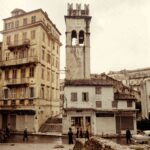
Corfiots sometimes simply say “the Saint” when they mean Saint Spyridon, the island’s patron, and the lanes around his church are among the busiest in town. Agiou Spyridonos Street runs from the arcades of the Liston inland past the church, whose tall bell tower with its red dome is the landmark you will use to find your bearings all day. On one side the lanes lead towards Campiello, on the other towards the Liston and the Spianada. This is the souvenir shopping strip of the old town, with olive wood, kumquat liqueur and religious icons, so it is lively rather than quiet. Read more in our guide to Saint Spyridon Church.
Platy Kantouni
The name means “wide lane”, which is a joke only a Corfiot would make: by the standards of the old town it is broad, but anywhere else it would be a modest one way street. It lies in the Porta Remounda part of town, and in the past it housed shops and services that the neighbourhood depended on. Today it is mainly a route lined with tavernas and small businesses, useful as a reference point when you are trying to work out where you are.
Campiello
Campiello is not a single lane but the oldest quarter of the town, on the high ground above the Old Port, and it is where the kantounia are at their most tangled. Stepped passages drop towards the sea walls, tiny squares open up around old churches, and some houses still have their stone water cisterns. It is also where the bombing of September 1943 left gaps that were never rebuilt. Our dedicated guide to the Campiello quarter covers it in detail.
The kantouni as a way of life
Because the houses sit so close together, the kantouni was never just a passage. Neighbours talked across from balcony to balcony, children played on the steps, women sat outside their doors in the evening, and everyone knew everyone else’s business. Corfiots have a word for this kind of easy street chat, kalambouri, and the lanes were where it happened. Friendships, rivalries and family feuds all played out within a few metres.
That world is still visible in the island’s carnival tradition. The Petegoletsa, a satirical street performance of the Corfu Carnival that recreates the gossip of the old neighbourhood, is traditionally staged in a kantouni, with residents shouting their news and accusations from window to window. If you are on the island at carnival time, before Orthodox Lent, it is worth asking locally whether a performance is planned. The same lanes fill with people and music at Easter, when processions and philharmonic bands squeeze through them; see our guide to Easter in Corfu.
How to walk the kantounia
There is no official route, and that is the point. The old town is small enough that you cannot really get lost for long: walk downhill and you will hit the sea, the Spianada or the Old Port within ten minutes. A loose plan that works well is to start at the Spianada, take Agiou Spyridonos past the church, cut north into Campiello, wander downhill towards the Old Port, then climb back through the lanes around Nikiforou Theotoki and the Bizi lane. If you prefer a structured walk that links the major sights, use our Corfu Town walking route and leave gaps for detours.
Practical tips
- Footwear: the paving is polished smooth by centuries of feet and can be slippery, especially after rain. Wear shoes with grip, not flat sandals.
- Timing: when several cruise ships are in port, the lanes around Agios Spyridon and the Liston become crowded from late morning to mid afternoon. Early morning and early evening are calmer.
- Respect: these are residential streets. People live behind those shutters, so keep voices down at night and do not photograph into open doorways or windows.
- Navigation: phone maps often struggle between tall buildings. Use the bell tower of Agios Spyridon and the slope of the land to orient yourself.
- Accessibility: many kantounia have steps, so pushchairs and wheelchairs are difficult in Campiello. The flatter streets near the Liston and Nikiforou Theotoki are easier.
- Heat: in July and August the lanes are the coolest part of town, which makes them the best place to be in the middle of the day.
Nearby
Every kantouni eventually leads somewhere worth seeing: the Old Port and the New Fortress to the west, the Spianada and the Old Fortress to the east, and the Palace of St Michael and St George to the north. Combine an hour in the lanes with a coffee on the Liston and a walk around the Old Fortress for a well rounded half day in town.
Frequently Asked Questions
What does kantouni mean in Corfu?
Kantouni is the Corfiot word for a narrow lane or alley, usually too tight for cars, running between tall houses. The plural is kantounia. The word reflects the long Venetian influence on the local dialect.
Why are the streets in Corfu Old Town so narrow?
The town grew inside defensive walls, so space was scarce and houses were built tall and close together. The tangled layout also made it harder for any invading force to move through the town. A side effect is shade, which keeps the lanes cool in summer.
Where is the Kantouni of Bizi?
It is a sloping lane that leads off Nikiforou Theotoki Street up towards the Campiello quarter. It takes its name from the noble Bizi family, whose mansion with a carved stone head above the arch stands at number 22. Today it has cafes and small shops.
How long do you need to explore the kantounia?
One to two hours is enough for a relaxed wander through Campiello and the lanes around Agios Spyridon. If you want to stop for coffee, browse the shops and see the main sights as well, allow half a day.
Are the kantounia safe to walk at night?
Yes, Corfu Old Town is generally safe at night and the lanes around the Liston and Agios Spyridon stay busy until late in summer. The quieter residential corners of Campiello are dimly lit, so watch your footing on the steps.