

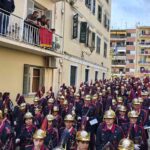

Corfu's philharmonic bands are amateur wind bands and music schools, the oldest founded in 1840, that teach music free and play at religious processions, national holidays and concerts. The best time to hear them is Easter week in Corfu Town, when all the bands march through the old town.
Corfu is the most musical island in Greece, and its philharmonic bands are the reason. Around 17 amateur wind bands, three in Corfu Town and the rest in villages, teach music free of charge and march in uniform at every religious procession and national holiday. The oldest, the Philharmonic Society of Corfu, was founded in 1840 and is the oldest institution of its kind in the country. If you visit at Easter, the bands are impossible to miss; at other times of year you need to know where to look.
Quick facts
- Number of bands: around 17, three in town and about 14 in villages.
- Oldest: Philharmonic Society of Corfu, known as the Palaia, founded 12 September 1840.
- Best time to hear them: Easter week, the Saint Spyridon processions, and summer evening concerts.
- Where: the streets of the old town, the bandstand on Spianada, and village festivals.
- Cost: processions and most open-air concerts are free.
How Corfu became an island of bands
The roots go back to the Venetian period. Italian opera reached Corfu early, and the town’s theatre, the San Giacomo (today’s town hall), staged opera seasons from the 18th century. Corfiots of all classes grew attached to Italian melody, and the island produced its own composers trained in the Italian tradition.
The British Protectorate, from 1814 to 1864, added the military band. British regiments stationed in Corfu brought uniformed bands that played in the square and, for a while, at Orthodox religious processions, including the processions of Saint Spyridon’s relic. Corfiots loved them. In the late 1830s, however, the British authorities stopped their army bands from taking part in Orthodox religious events. The town was left without music for its most important ceremonies, and local people set out to create their own.
The result was the Philharmonic Society of Corfu, founded on 12 September 1840. It was conceived not just as a band but as a music school, open to students regardless of social class, and its first artistic director was Nikolaos Mantzaros, the Corfiot composer who set Dionysios Solomos’s Hymn to Liberty to music. That hymn later became the Greek national anthem. Mantzaros directed the society until his death in 1872, and later Corfiot composers such as Spyridon Xyndas and Spyridon Samaras are closely linked with its history. For more on this period, see our article on the French and the British in Corfu.
The three town bands
Philharmonic Society of Corfu (the Palaia)
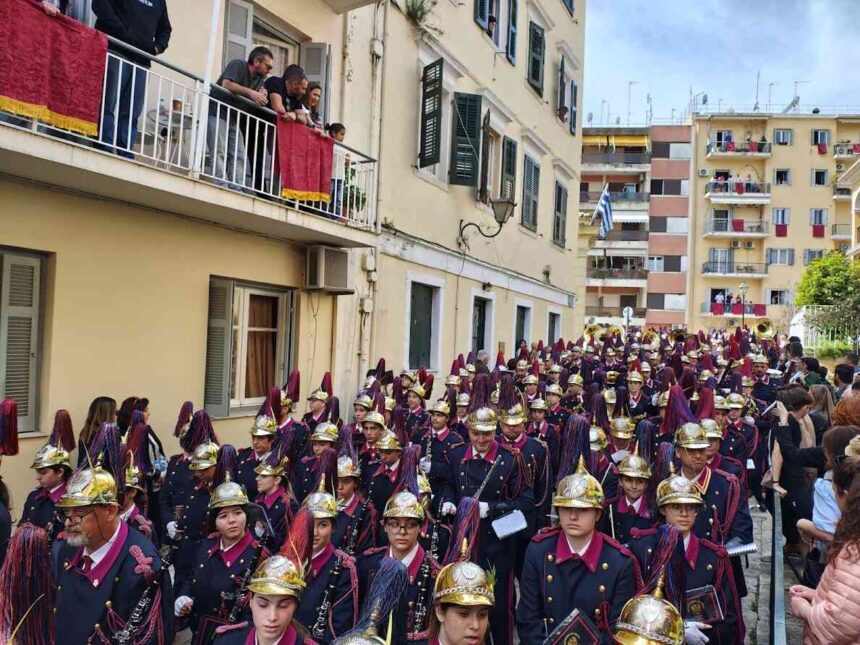
Locals simply call it the Palaia, the Old One. Its musicians wear dark blue uniforms with maroon trim, and it has hundreds of members across its band, choirs and school. The society keeps a small museum of scores, instruments and photographs in its building in the old town, which is worth asking about if you are interested in the island’s musical history.
Mantzaros Philharmonic Society
Founded in 1890 and named after the composer, Mantzaros is the second of the historic town bands. Its uniforms are dark blue with light blue and white details. The rivalry between the Palaia and Mantzaros is old and friendly, and Corfiot families often support one or the other for generations, a little like football clubs.
Kapodistrias Philharmonic Union
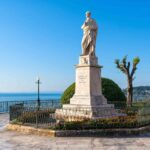
The youngest of the three, founded in 1980, Kapodistrias marches in red uniforms and has grown quickly into a large school and band with a strong following among young people.
The village bands
Outside the town, Corfu has around fourteen more bands, an extraordinary number for an island of this size. Some are more than a century old: Gastouri’s band, Omonoia, dates from 1898, Skripero’s from 1909, and Lefkimmi in the south has two rival bands from the early 20th century. Ano Korakiana’s band, founded in 1958, is named after the composer Spyridon Samaras. Others, such as Sinarades, Kinopiastes, Lakones, Liapades and Avliotes, have their own colours and loyal villages behind them.
Village bands play at the local panigyria, saints’ day festivals, through the summer, and these are one of the most enjoyable ways to hear them: a procession around the village followed by food, wine and dancing in the square.
Free music for everyone
The core idea of the philharmonics has not changed since 1840: anyone can learn music, without paying. The bands run schools where children start on recorder or theory and move on to wind and percussion instruments, many joining the marching band in their teens. A large share of Corfiots have passed through a philharmonic at some point, which partly explains why the island has produced so many professional musicians and why, at Easter, there are hundreds of players in each town band.
Easter: the bands at their best
Corfu’s Easter is built around the bands, and this is when the visitor sees the tradition at full strength. Read our full guide to Easter in Corfu for the timetable; the main moments for music are these:
- Rehearsals in Holy Week: in the evenings before Easter the bands hold public rehearsals of their funeral marches in the town, which draw large and very quiet crowds.
- Good Friday: from the afternoon until late evening, the Epitaph processions of the town’s churches wind through the old town, each accompanied by a band playing funeral marches. The Cathedral procession, late in the evening, brings together all the town bands.
- Holy Saturday morning: the procession of the relic of Saint Spyridon, held since the 16th century, leaves the church around 9:00 with the three town bands. The Palaia traditionally plays the funeral march from Franco Faccio’s opera Amleto, and Albinoni’s Adagio is among the pieces heard during these days.
- Holy Saturday at 11:00: as clay pots crash onto the streets at the first Resurrection, the bands switch from mourning to joyful marches and parade through town. The best place to experience this is around the Liston and Spianada.
Other times to hear them
Outside Easter, the town bands march in the four annual processions of Saint Spyridon, on Palm Sunday, Holy Saturday, 11 August and the first Sunday of November. They also parade on the national holidays of 25 March and 28 October, and on 21 May, the anniversary of the union of the Ionian Islands with Greece. On summer evenings concerts are often held at the bandstand on Spianada, and villages host band festivals and saints’ day celebrations from June to September.
Practical tips
- Check programmes locally: concert and procession times are announced in Greek in the local press and on posters, sometimes only a few days ahead. Ask at your hotel or at a café on the square.
- Easter crowds: for Good Friday and Holy Saturday, choose a spot along the route early and be ready to stand for a long time. The old town lanes are narrow, so the bands pass very close.
- Behave as in church: during the funeral marches the crowd is silent. Avoid flash photography in the faces of musicians and do not cross between the band and the Epitaph.
- Village festivals: the panigyria are a relaxed way to hear a village band with local food and wine; they are listed locally each summer.
- Combine with the old town: processions pass the main churches and squares of the Corfu Old Town, so a walking day there often coincides with music on feast days.
The philharmonic bands are not a show put on for visitors. They are the island’s own institutions, run by volunteers and supported by families, and they carry a tradition that has survived occupation, war and economic crisis. Hearing them march through the lanes on Good Friday night is one of the most moving things you can experience in Greece.
Frequently Asked Questions
How many philharmonic bands are there in Corfu?
There are around 17, depending on how you count recent and inactive groups: three in Corfu Town and around fourteen in villages and small towns across the island. No other Greek island comes close.
What is the oldest philharmonic in Greece?
The Philharmonic Society of Corfu, known locally as the Palaia (the Old One), founded on 12 September 1840. Its first artistic director was Nikolaos Mantzaros, who composed the music of the Greek national anthem.
When can I hear the Corfu philharmonic bands?
Easter week is the highlight, with the bands playing funeral marches on Good Friday and leading the Holy Saturday procession. They also march in the processions of Saint Spyridon, on 25 March and 28 October, and give open-air concerts in summer on Spianada and at village festivals.
Are the band members professional musicians?
Most are amateurs, including many children and teenagers, who learn through the bands’ free music schools. Some go on to professional careers, and the standard of the best bands is high.
What music do they play at Easter?
Mainly funeral marches by Italian and Corfiot composers, plus pieces such as Albinoni’s Adagio. On Holy Saturday the Old Philharmonic traditionally plays the funeral march from Franco Faccio’s opera Amleto, and after the 11:00 pot smashing the mood switches to cheerful marches.