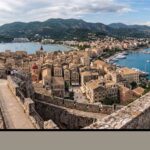


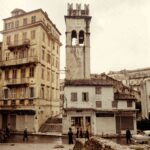
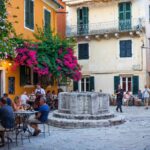

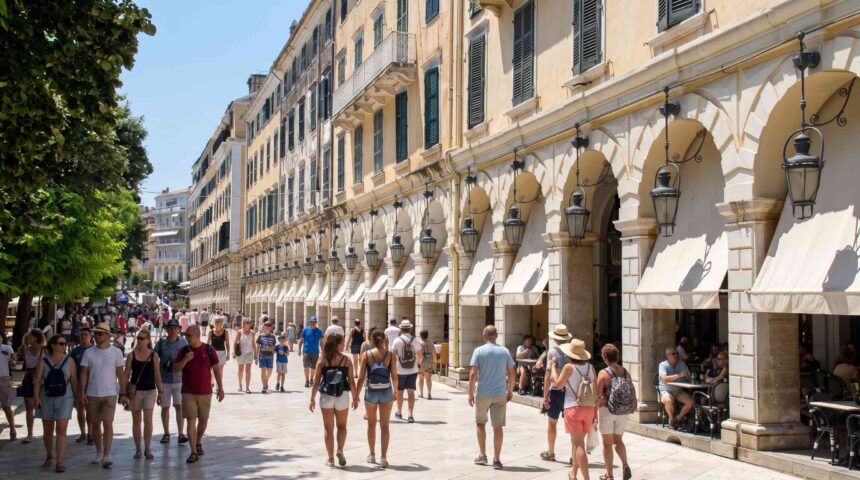
The Liston is an arcaded street of cafés built by the French in Corfu Town around 1807, facing Spianada, the huge open square between the old town and the Old Fortress. Together they are the social heart of Corfu Town, best enjoyed with an evening coffee or during Easter.
The Liston and Spianada are where Corfu Town comes to meet itself. The Liston is a row of arcaded buildings with cafés beneath, built by the French in the early 19th century, and it faces Spianada, a vast open square that the Venetians cleared for defence and the British turned into a cricket pitch. If you only have an hour in town, spend it here with a coffee; if you have a week, you will end up passing through every day anyway.
Quick facts
- Where: the eastern edge of the old town, between the historic centre and the Old Fortress.
- Built: Spianada cleared from the 16th century; the Liston arcade begun during French rule, around 1807.
- Time needed: 30 minutes to walk around, much longer if you sit down.
- Best time: early evening for the volta, Easter week for the customs, a spring weekend for cricket.
- Cost: free to walk; café prices on the Liston are higher than elsewhere in town.
How Spianada came to be
Spianada exists because of artillery. After the Ottoman siege of 1537, the Venetians decided they needed a clear field of fire between the Old Fortress of Corfu and the town that had grown up in front of it. Houses were demolished and the ground levelled so that attackers approaching the fortress would have nowhere to hide. The work went on in stages for a long time, and the open ground only took on its present tidy, tree-lined form in the 19th century.
The name records that origin. It comes from the Italian spianata, a levelled or flattened area, from the verb spianare, to flatten. Corfiots shortened and softened it to Spianada, and in everyday speech most people simply call it the Square, as if there were no other.
Today it is usually described as the largest square in Greece and one of the largest in the Balkans. It is divided into an upper part, with gardens, monuments and the bandstand, and a lower part, which is mostly the grass of the cricket ground. On one side are the houses of the old town, on the other the moat and the fortress, to the north the Palace of St Michael and St George, and to the south the curve of Garitsa Bay.
The Liston: a piece of Paris on the Ionian
When the French took control of the Ionian Islands for the second time, from 1807 to 1814, they set about giving Corfu Town a proper promenade. The design is credited to Mathieu de Lesseps, the French imperial commissioner on the island, and the model was the arcaded Rue de Rivoli, then being built in Paris. The result is a single long block, about 150 metres from end to end, with a continuous row of arches at street level and tall, shuttered floors above. Upper storeys were added and completed after the British took over, which is why the building is often described as French in idea and British in completion.
The arcade is the point of the whole thing. It gives shade in summer and shelter in winter rain, and it turns the ground floor into one continuous terrace of cafés. Tables spill out across the pedestrian street towards the square, so you sit between the arches on one side and the trees of Spianada on the other. Over the 19th and 20th centuries some of the town’s grand hotels and clubs occupied the upper floors.
Where the name comes from
In the cities of the Venetian mainland, from Padua to Ferrara and Rovigo, a liston was the main stretch of street or square where townspeople took their evening walk. The Venetians used the expression far el liston for going out to stroll along it. Corfu, under Venice for four centuries, inherited the word along with the habit. A popular local story adds that only families listed in the Libro d’Oro, the golden book of the nobility, were allowed to walk there, which would make it a street for those “on the list”. It is a good tale and you will hear it often, but the Venetian promenade meaning is the better supported one.
What to look for around the square
The Maitland Rotunda
The round colonnaded pavilion in the upper square is the Maitland Monument, built in 1821 in honour of Sir Thomas Maitland, the first British Lord High Commissioner of the Ionian Islands. It was designed by George Whitmore of the Royal Engineers, the same officer who designed the palace at the north end of the square, and like the palace it was built of limestone brought from Malta. Twenty Ionic columns stand in a ring over an underground Venetian cistern, which is why some older Corfiots still call it the Sterna, the cistern.
The bandstand
In the middle of the upper square stands the bandstand, known locally as the Palko. This is where the town’s philharmonic bands of Corfu give open-air concerts on summer evenings and on holidays. If you see chairs set out and musicians in uniform gathering, stay: these concerts are free and the standard is high.
The cricket ground
The lower square is a cricket pitch, a direct inheritance from the British Protectorate of 1814 to 1864. Corfu is one of the very few places in Greece where the game survived, and local clubs still play on the Spianada grass, mostly from spring to autumn. Watching a match from a Liston café, with the fortress walls behind the boundary, is one of the stranger and more pleasant experiences the island offers. For the wider story of this period, see our article on the French and British in Corfu.
Monuments, lamps and the fountain
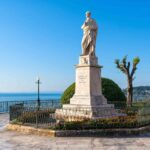
Around the upper square you will also find the monument to the Union of the Ionian Islands with Greece, which took place in 1864, a fountain donated by the physician Georgios Vagianos, and several statues of notable figures. At one end of the Liston stands the Pentofanaro, an old cast-iron lamp-post with five lanterns that serves as a meeting point; “see you at the Pentofanaro” is a phrase every Corfiot understands.
The Liston at Easter
Corfu celebrates Easter more theatrically than anywhere else in Greece, and the Liston is front row. From the middle of Holy Week the street lamps here and around the palace are lit purple, the colour of mourning, and the square takes on a hushed, slightly unreal look at night. On Good Friday the Epitaph processions pass with the bands playing funeral marches.
The most famous moment comes at 11:00 on Holy Saturday, the so-called first Resurrection. As the church bells ring, people throw botides, large clay pots filled with water, from balconies and windows across the old town, and they smash on the street below with a crash meant to chase away evil and welcome the Resurrection. The buildings along and near the Liston draw the biggest crowds, so arrive at least an hour early if you want to see anything. Read our full guide to Easter in Corfu before you plan the week.
A day on the Liston
The Liston changes character through the day. Mornings are for locals reading the papers over a freddo espresso before work. Around midday it fills with visitors from the cruise ships, and the shade under the arches becomes precious. Late afternoon is quieter, the light softens over the fortress, and then from about 19:00 the evening volta begins: families, couples and groups of teenagers walking slowly up and down the square, stopping to greet friends. Join it, even if you are only walking from one end to the other.
Spianada is also the natural starting point for exploring the town. West of the Liston the lanes of the Corfu Old Town begin immediately; north is the palace and the Asian Art Museum; east is the bridge to the Old Fortress; south, a seafront walk leads around Garitsa Bay towards Mon Repos and Kanoni. Our Corfu Town walking route begins here for good reason.
Practical tips
- Coffee prices: the Liston cafés charge for the view. Have one coffee or drink here for the experience, then eat in the lanes behind, where prices drop.
- Shade: in July and August the open square is very hot at midday. The arcade and the trees of the upper square are your friends.
- Easter crowds: on Holy Saturday morning the streets around the Liston fill hours ahead. Keep valuables close and stay back from the balconies when the pots fall.
- Cricket: match days are not always advertised in English; ask at a café or simply look for the white kit on a weekend afternoon.
- Getting there: the square is a short walk from the old port and from the bus stations. Driving into the centre is not worth it; use the car parks near the New Fortress or the old port.
- With children: the gardens of the upper square have benches and room to run, which makes Spianada a good break for families between museums.
Most people walk through the Liston on their first day and treat it as a backdrop. It deserves more than that. Sit down, order something cold, and watch the square for a while: few places in Greece show so clearly how Venetian, French and British rule left their marks on daily Greek life.
Frequently Asked Questions
Why is it called the Liston?
The word comes from the Venetian liston, used in towns of the Veneto for the main promenade where people strolled to see and be seen. A popular local explanation links it to the list of noble families in the Libro d’Oro, who alone were allowed to walk there, but that story is more tradition than documented fact.
Is it expensive to have a coffee on the Liston?
You pay a premium for the setting, so expect prices noticeably higher than in the back streets of the old town. For one coffee or a drink while watching the square it is worth it; for a full meal the lanes behind usually offer better value.
Can you watch cricket in Corfu?
Yes. Cricket has been played on the lower part of Spianada since the British period, and local clubs still play matches there, mainly from spring to autumn, often on weekend afternoons. Watching is free from the edge of the pitch or a Liston café.
What happens on the Liston at Easter?
From the middle of Holy Week the street lamps glow purple, and the Good Friday processions with the philharmonic bands pass by. At 11:00 on Holy Saturday residents throw clay pots full of water from balconies across the old town, including the buildings around the Liston, which is the most crowded spot to watch.
How big is Spianada Square?
Spianada is usually described as the largest square in Greece and one of the largest in the Balkans. It is made up of an upper and a lower section and covers the whole open space between the old town houses and the moat of the Old Fortress.