


Corfu's Venetian fortifications include the Old and New Fortresses plus a ring of town walls, gates and bastions built from the 1570s and outer forts added after the 1716 siege. Much was demolished by the British in 1864 and later, but bastions and gates still survive in the town.
Corfu Town is famous for its two great fortresses, the Old Fortress on its promontory and the New Fortress above the Old Port, but they were only the strongest points of a much larger defensive system. For about three centuries, a ring of walls, bastions and gates enclosed the whole town, and outer forts guarded the hills behind it. Much of this was torn down in the 19th century, yet enough survives, often hidden in plain sight, to make a fascinating walk for anyone interested in how Corfu earned its reputation as one of the strongest fortress cities in the Mediterranean.
Quick facts
- What: the Venetian town walls, gates, bastions and outer forts of Corfu Town, later modified by the French and British.
- Main period: from the 1570s, with major additions after the Ottoman siege of 1716.
- Status: part of the UNESCO World Heritage listing of the Old Town of Corfu.
- Time needed: half a day to see both fortresses and the surviving traces in town.
- Good for: history and military architecture enthusiasts, walkers.
Why Corfu was so heavily fortified
Corfu sits at the mouth of the Adriatic, a few kilometres off the coast of Epirus. Whoever held it controlled shipping in and out of Venice’s home sea, and the Venetians, who took the island in 1386, treated it as the gateway to their empire. For most of the Middle Ages the town lived inside the walls of the Old Fortress. As the population grew, houses spread onto the land outside, into the area the Venetians called the Borgo, and that unprotected suburb suffered badly in the Ottoman sieges of 1537 and 1571. After 1571 Venice decided to enclose the Borgo itself and to build a second fortress on the hill of San Marco to the west. For the wider story of Venetian rule, see our guide to Venetian Corfu.
The New Fortress and the town walls
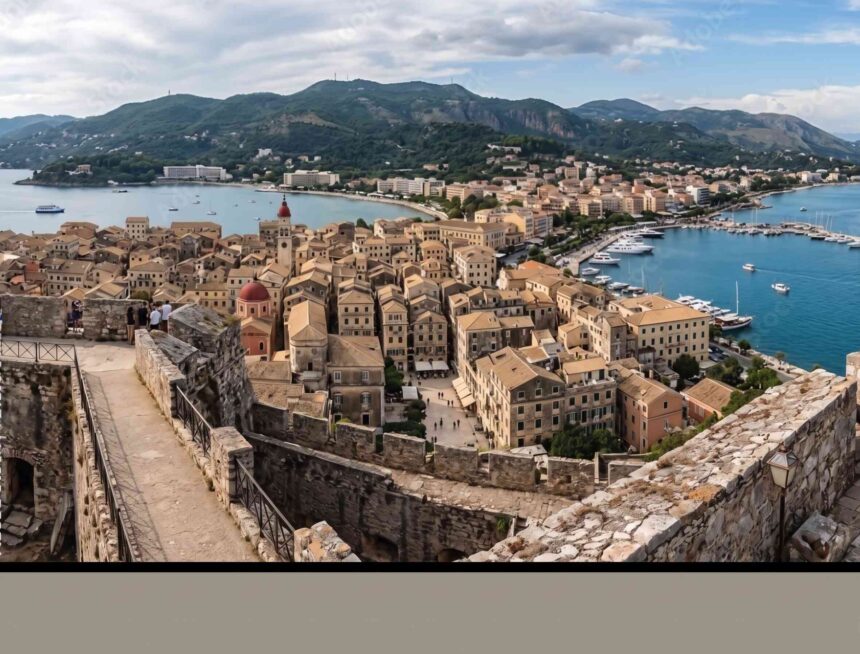
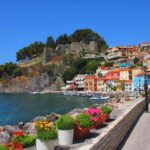
The New Fortress was built from 1576 to 1588, with later additions, to plans revised by the Venetian military engineer Ferrante Vitelli. It anchored the western end of a line of walls that swept around the landward side of the new town, punctuated by angled bastions designed so that defenders could rake any attacker with crossfire. To the east, the walls met the Spianada, the open ground deliberately left clear in front of the Old Fortress. The result was a town enclosed between two citadels, with every approach covered by cannon.
The system was strong enough that Corfu was never taken by the Ottomans, a record few places in the region could claim. Visitors and enemies alike knew it as a fortress city, and the reputation lasted long after Venice fell in 1797.
Gates
Porta Reale
The Royal Gate was the main land entrance to the walled town, standing on the landward side where the old town meets the streets of the 19th century town. It survived the British period but was levelled by the town council in 1893, in an era when many European cities were removing their walls to let traffic and air in. The decision was bitterly contested at the time; the young Corfiot writer Konstantinos Theotokis published a furious protest against it. Recent works uncovered the gate’s foundations, and their outline is now marked in the paving, so look down as you pass.
Spilia and Porta Remounda
On the harbour side, the Spilia gate gave access from the waterfront below the New Fortress into the town, and the district around it still carries the name; see our guide to Spilia. In the south, a gate known as Porta Raimonda gave its name, in Corfiot form, to the Porta Remounda quarter, even though the gate itself has long gone.

Bastions that survive
Sarantaris
The best known of the town bastions is the Sarantaris bastion, at the foot of the New Fortress. It is often assumed to be part of the fortress itself, but it belonged to the town wall; today the fortress is entered through a gate just north of it. Parts of the structure have been absorbed into the urban fabric over the years, and it receives far less attention than its size and age deserve.
Agios Athanasios and Raimondo
South of Sarantaris, the platform shaped bastion of Agios Athanasios continued the line of the walls, and close to it stood the Porta Reale. Further round, the Raimondo bastion protected the southern end of the defences on the Garitsa side, towards the low hill where the Ionian Academy later stood. It is tucked behind later buildings near the Corfu Palace hotel and is not open to the public, so you can only glimpse it.
The outer forts after 1716
The great test came in the summer of 1716, when a large Ottoman army landed on the island and besieged the town from early July. During the fighting the attackers captured the hills of Avrami (Monte Abramo) and San Salvatore to the west of the town, the high ground from which the walls could be bombarded. The defence, led by Count Johann Matthias von der Schulenburg, held out, and on the morning of 22 August the Ottomans were found to have abandoned their lines. Corfiots credit the deliverance to Saint Spyridon, and a procession still commemorates it every August.
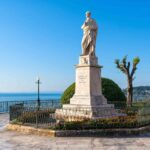
The lesson was clear: the hills had to be held. In the years after the siege, the Venetians built permanent forts on Avrami and San Salvatore, as well as the fort of San Rocco in the area now known as Saroko, close to today’s Ionian University buildings. Schulenburg himself was honoured with a marble statue at the entrance to the Old Fortress, which you can see beside the Boschetto garden. The islet of Vido, opposite the Old Port, was also fortified to cover the northern approaches.
Demolition and decline
The French and then the British, who held Corfu from 1814 to 1864, modernised parts of the system, adding barracks and gun positions to the fortresses. But the British also regarded much of the town wall as obsolete and an obstacle to building. Curtain walls between the bastions were taken down, and when Britain handed the Ionian Islands to Greece in 1864, the treaty required the destruction of key fortifications. The forts on Vido and Avrami were blown up, along with sea defences of the New Fortress; the explosion on Vido was strong enough to break windows across the channel in town. Later municipal improvements, including the removal of Porta Reale, completed the process. Our guide to French and British Corfu covers this period.
The tunnel legends
Ask around in the old town and sooner or later someone will tell you about secret tunnels linking the fortresses, the bastions and even the islet of Vido under the sea. These stories are a cherished part of local folklore, but there is no map, plan or record of any tunnel to Vido, and historians treat them as legend. The real underground spaces are the galleries and cisterns inside the two fortresses, some of which you can walk through.
Practical tips
- Where to start: the two fortresses are the only parts with a formal visit. The Old Fortress has a ticketed entrance; check current hours and prices locally, as both change by season.
- New Fortress: the eastern part is a naval base and closed to the public; the visitable section has excellent views over the Old Port and the town roofs.
- Walking the walls: combine the New Fortress, the Sarantaris bastion, the marked outline of Porta Reale and the Spianada in a loop of about two hours.
- Outer forts: the hills of Avrami and San Salvatore are now built up, and only fragments of masonry remain. They are of interest to specialists rather than casual visitors.
- Footwear: fortress paths are steep and uneven; wear proper shoes and bring water in summer.
Frequently Asked Questions
Did Corfu have city walls?
Yes. From the 1570s the Venetians enclosed the town with walls and angled bastions that ran between the Old and New Fortresses. Most of the curtain walls were demolished in the 19th century, but several bastions and gate sites survive.
When was Porta Reale in Corfu demolished?
The Royal Gate was demolished by the town council in 1893, despite strong local protest. Its foundations were uncovered during recent works and its outline is now marked in the paving.
Was Corfu ever captured by the Ottomans?
No. Corfu Town withstood Ottoman sieges in 1537, 1571 and 1716. The 1716 siege, defended by Count Schulenburg, was lifted in August and is still commemorated with a procession of Saint Spyridon.
Why were Corfu’s fortifications demolished?
The British considered many walls obsolete and removed curtain walls to make room for building. When the Ionian Islands joined Greece in 1864, the treaty required the destruction of key forts, including Vido and Avrami. Later municipal works removed more.
Is there a tunnel from Corfu to Vido?
No evidence supports it. The tunnel to Vido is a popular local legend, but no map or record of such a tunnel exists.