



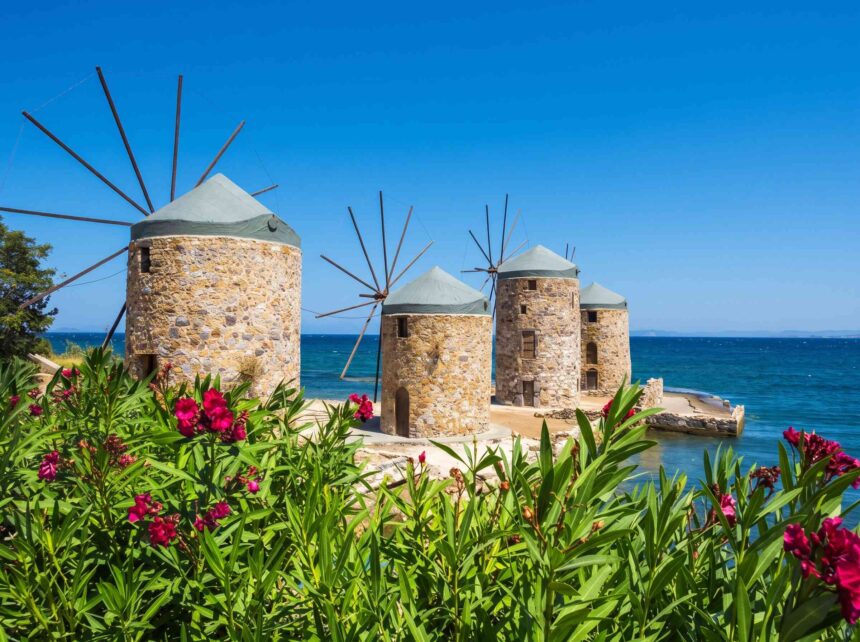
Chios is a large North Aegean island known for mastic, the fortified medieval villages of Pyrgi and Mesta, the UNESCO listed Nea Moni monastery and the citrus mansions of Kampos. Fly from Athens and plan at least five days with a car.
Chios is a large, lived in island in the northeast Aegean, a few kilometres off the Turkish coast, and it is unlike anywhere else in Greece. The south is the only place in the world where mastic is produced, and its fortified medieval villages, Pyrgi with its black and white patterned houses and Mesta with its maze of vaulted lanes, are among the most remarkable in the country. Add a UNESCO listed Byzantine monastery, the citrus mansions of Kampos and black pebble beaches, and you need at least five days with a car.
Quick facts
- Where: North Aegean, between Lesvos and Samos, about 8 km from the Turkish coast at its closest point.
- Getting there: flights from Athens to Chios airport in under an hour, or overnight ferries from Piraeus that take roughly 7 to 10 hours.
- Time needed: 5 to 7 days; the island is big and the roads are slow.
- Best time: May, June and September; Easter for the rocket war of Vrontados; July and August for the mastic harvest season and village festivals.
- Good for: history, architecture, food lovers, road trips, travellers who want an island with few package tourists.
Mastic and the mastic villages
Mastic is the aromatic resin of the mastic tree, a variety of the lentisk shrub that only produces the resin in the south of Chios. Farmers scratch the bark in summer, the resin drips and hardens into clear “tears”, and they collect and clean it by hand in a slow process that the whole family once took part in. The traditional know how of mastic cultivation on Chios is on the UNESCO list of Intangible Cultural Heritage, and the product itself has protected designation of origin status. You will taste it in chewing gum, liqueur, ice cream, the white spoon sweet called ypovrichio, bread and pastries, and it is also used in cosmetics.
The wealth that mastic brought explains the mastic villages, the Mastichochoria, about two dozen settlements in the south. Under Genoese rule from the 14th to the 16th century, and later under the Ottomans, who prized mastic for the sultan’s court, these villages were built as fortresses: the outer houses form a continuous wall, the lanes are narrow and vaulted, and a defensive tower stands at the centre.
Pyrgi
Pyrgi is the largest mastic village and the most famous, because almost every house is covered in xysta, geometric black and white patterns scratched into the plaster. The technique is thought to date back to the Genoese period and has been renewed in recent decades, so the village looks freshly drawn. Walk to the main square, look into the small Byzantine church of Agioi Apostoloi with its frescoes, and then simply wander the side lanes, where every façade is different.
Mesta
Mesta is the best preserved of the fortified villages, a near perfect pentagon from above, with only a few gates into the walled core. Inside, the lanes are so narrow and covered that you can walk across rooftops, and it is easy to get pleasantly lost. The big church of the Taxiarchis dominates the main square, where a couple of cafés and tavernas set out tables in the evening. Mesta is about 45 minutes by car from Chios town and is the most atmospheric place to stay in the south. The small port of Limenas Meston, a few kilometres away, has fish tavernas and a quieter beach nearby.
Olympi and Vessa
Olympi, between Pyrgi and Mesta, is a smaller fortified village with a central tower, and near it is the Olympi cave, discovered in 1985, with stalactites and stalagmites in several chambers. Vessa is a quieter mastic village with a classic grid plan. A circuit linking Pyrgi, Olympi and Mesta with a stop at the beach makes a perfect day.
The Chios Mastic Museum
Before you visit the villages, stop at the Chios Mastic Museum, a modern museum on a hill near Pyrgi run by a Greek cultural foundation. It explains how mastic is grown, harvested and processed, the history of the trade and how it shaped life in the south, with a walk through mastic groves outside. Allow at least an hour and a half; check opening days and prices before you go, as they vary by season.
Chios town and Kampos
Chios town, the capital and main port, is a busy working town rather than a postcard. Its most interesting corner is the Kastro, the old walled quarter by the harbour, first built by the Byzantines and strengthened by the Genoese, where Ottoman era houses, a former mosque, old baths and narrow lanes survive inside the walls. The town also has a good Byzantine museum and the Korais Library, one of the oldest public libraries in Greece. The waterfront is lined with cafés, and in the evening the whole town comes out for a walk.
Just south of town, Kampos is a flat district of walled citrus orchards where wealthy Genoese and Chiot families built stone mansions from the 14th century on. High walls of reddish stone line the lanes, behind them are gardens of mandarins, oranges and lemons, old water wheels and cisterns. Several mansions have become guesthouses, and there is a small citrus museum that is usually open in summer. Mandarin from Chios is another local speciality, so look for mandarin spoon sweets and juice.
Nea Moni and Anavatos
In the hills west of Chios town, the 11th century monastery of Nea Moni is one of the masterpieces of Byzantine art, listed by UNESCO together with Daphni near Athens and Hosios Loukas in central Greece. It was founded with the support of the emperor Constantine IX Monomachos, and the gold background mosaics in the main church are among the finest of their period. The monastery suffered badly in the 1822 massacre, when Ottoman troops crushed the island’s part in the Greek War of Independence, and again in an earthquake in 1881. Dress modestly and check visiting hours.

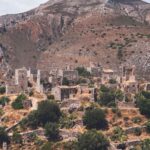
A few kilometres further west, Anavatos is an abandoned village on a sheer rock pinnacle, built in Byzantine times and left almost empty after the events of 1822 and the 1881 earthquake. Its stone houses climb the rock like a fortress, and walking its silent lanes is one of the most haunting experiences on the island. The path is steep and uneven in places, so wear proper shoes.
The north and Volissos
The north of Chios is mountainous, wilder and far less visited. Vrontados, just north of the capital, is home to the Daskalopetra, a rock seat that local tradition calls the stone of Homer, and to the Easter rocket war, the rouketopolemos, when two parishes fire thousands of homemade rockets at each other’s church bell towers on Easter Saturday night. It is loud, chaotic and unforgettable, but book accommodation months ahead. Further northwest, Volissos is a hill village under a Genoese era castle, one of the places that claims to be the birthplace of Homer, with quiet beaches such as Managros and Lefkathia below.
Beaches
Chios is not mainly a beach island, but it has some memorable swims. Mavra Volia, near Emporios in the south, is a bay of large, smooth black volcanic pebbles and deep blue water, with little in the way of facilities. Agia Dynami, near Olympi, is a pretty sandy cove with turquoise water and tamarisks for shade. Komi on the southeast coast is a long sandy beach with tavernas, good for families. Karfas, close to the airport and town, is the island’s main resort beach, with hotels and sunbeds. On the west coast, Lithi has a sandy beach and fish tavernas, and the coves around Trachili are quiet and wild.
Food and drink
Chiot cooking draws on the mastic villages, the citrus gardens of Kampos and a long tradition of trade with Asia Minor. Try mastelo cheese grilled, the local pasta kouskousi, stuffed vegetables and courgette flowers, mastiha liqueur as an aperitif and the island’s ouzo, often flavoured with a hint of mastic. In the south, look for the mastic and almond sweets of the villages; in town, the old shops near the market sell mandarin and bergamot spoon sweets. Our Greek food guide gives the wider picture.
Getting there and around
There are daily flights from Athens to Chios, which take less than an hour, and summer flights from Thessaloniki. Ferries from Piraeus usually sail overnight and take roughly 7 to 10 hours depending on the route and stops; others connect Chios with Lesvos, Samos, Ikaria, Limnos and Kavala, and short crossings link it with Çeşme on the Turkish coast. Timetables change by season, so check the current schedule. Our guide to ferries in Greece explains booking and routes.
A car is essential if you want to see the island properly: buses connect the capital with the main villages but run only a few times a day. Distances are deceptive, as mountain roads are winding, so plan one area per day. Our guide to renting a car in Greece has the practical details.
Combining Chios with other islands
Chios fits easily into a trip through the northeast Aegean. To the north, the island of Lesvos is known for ouzo, olive groves and its petrified forest; to the southwest, long lived Ikaria is a short ferry ride away. Both are linked to Chios by regular ferries in summer.
Practical tips
- Base yourself twice: spend a few nights in Kampos or Chios town and a few in Mesta or Pyrgi to cut down on driving.
- Mastic shopping: buy mastic products from the growers’ cooperative shops or village producers rather than airport outlets.
- Easter: the rocket war of Vrontados is spectacular but noisy and crowded; stay at a safe distance and follow local guidance.
- Summer harvest: in July and August you can see mastic being collected and cleaned in the southern villages, but it is hot, so plan visits for early morning or evening.
- Turkey trip: the short crossing to Çeşme makes a day trip possible; carry your passport and check entry requirements.
Chios asks a little more effort than the Cyclades: longer journeys, a car and fewer English menus. In return you get an island with its own history, its own crop and some of the most extraordinary villages in Greece, still lived in by the families who built them.
Frequently Asked Questions
What is Chios famous for?
Chios is famous for mastic, an aromatic resin produced only in the south of the island, and for the fortified mastic villages of Pyrgi and Mesta. It also has the UNESCO listed Byzantine monastery of Nea Moni and the citrus mansions of Kampos.
How do you get to Chios from Athens?
The fastest way is a flight from Athens, which takes less than an hour. Ferries from Piraeus usually sail overnight and take roughly 7 to 10 hours depending on the route. Check current schedules, as they change by season.
How many days do you need in Chios?
Plan at least five days, ideally a week. Chios is a large island with winding roads, and you will want separate days for the mastic villages, Chios town and Kampos, Nea Moni and Anavatos, and the north.
Do you need a car on Chios?
Yes, if you want to see more than the capital. Buses connect Chios town with the main villages but only a few times a day, so a rental car makes it far easier to explore the mastic villages, the beaches and the north.
Can you visit Turkey from Chios?
Yes. Short ferry crossings connect Chios town with Çeşme on the Turkish coast, making a day trip possible. Take your passport and check the current entry rules for your nationality before you go.
What are the best beaches on Chios?
Mavra Volia, a bay of black volcanic pebbles near Emporios, is the most striking. Agia Dynami is a pretty sandy cove, Komi and Karfas are good for families, and Lithi on the west coast has fish tavernas by the sand.