


Choose north Corfu for mountain scenery, clear pebbly coves and walking; choose south Corfu for long sandy beaches, quieter villages and lower prices. Avoid Kavos in the far south unless you want heavy nightlife.
If you want green mountains, pebbly coves with clear water, walking and a quieter, more polished feel, base yourself in the north of Corfu. If you want long sandy beaches, shallow water for children, lower prices and flatter, sleepier countryside, the south suits you better, with the single loud exception of Kavos. Corfu Town sits between the two, and nowhere on the island is much more than an hour and a half from anywhere else by car.
Quick facts
- Choose the north for: scenery, coves, hiking on Mount Pantokrator, upmarket villas on the northeast coast.
- Choose the south for: sandy beaches, the Korission Lagoon, families on a budget, a slower village pace.
- Driving time: roughly an hour from Corfu Town to Kassiopi or Sidari, a little more to Kavos, traffic permitting.
- Sunsets: west coast in both halves (Paleokastritsa and Arillas in the north, Agios Gordios and Glyfada in the centre and south).
- Calmest water: the northeast coast, sheltered by Pantokrator and facing the Albanian mainland.
How Corfu divides up
Corfu is long and narrow, shaped a little like a sickle, and the split between north and south is about more than a line on the map. The north is dominated by Mount Pantokrator, which at 906 metres is the island’s highest point. Its slopes push the landscape into steep olive terraces, cypress-lined ridges and stone villages, and they drop straight into the sea along the northeast coast. The south is lower and gentler: wide valleys, the long lagoon at Korission, vineyards, vegetable plots and fishing harbours that feel a long way from the tourist strips.
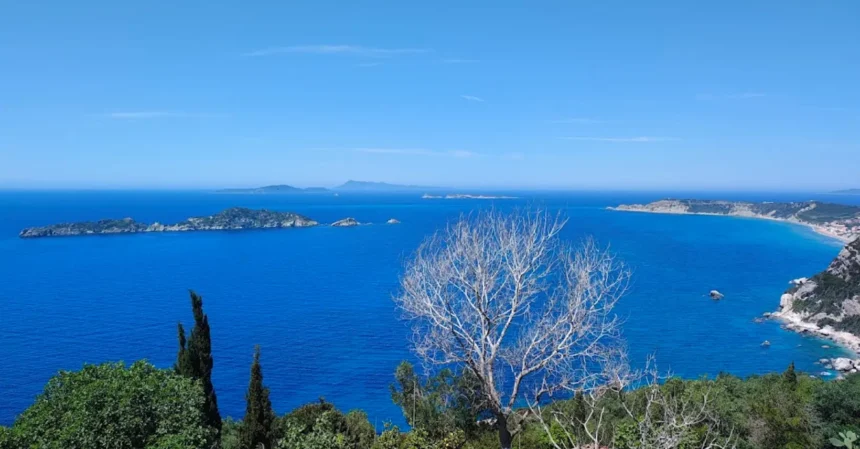
It also helps to think in coasts as well as halves. The east coast faces the Greek and Albanian mainland across a narrow channel, so the sea is usually calm and the light softer in the evening. The west coast faces open sea, which brings bigger beaches, livelier waves on windy afternoons and the island’s best sunsets. A traveller choosing between north and south is really choosing one of four corners, plus the central belt around Corfu Town.
The north: mountains, coves and polish
Northeast coast
The stretch from Nissaki through Agni, Kalami, Kouloura and Agios Stefanos to Kassiopi is the most photographed part of the island. The road winds above small bays where the water is glassy in the morning and the beaches are shingle or pebble rather than sand. Many properties here are private villas rather than hotels, and the tavernas at the water’s edge in Agni and Kalami have been serving yacht crews and villa guests for decades. Lawrence Durrell lived in the White House at Kalami in the 1930s, and the coast still trades gently on that literary connection.
Kassiopi is the largest village on this side, with a working harbour, a ruined castle on the headland and enough restaurants and bars to stay lively without becoming rowdy. If you like swimming off rocks with a mask, taking a small boat out to empty coves and eating well in the evening, this is the most rewarding part of Corfu. The trade-off is price: the northeast is generally the most expensive area on the island, and sandy beaches are rare.
North coast
Further west, Acharavi and Roda sit on a long, flat strip of sand and shingle with shallow water. They are practical, family-friendly resorts with supermarkets, apartments and an easy pace. Sidari, on the northwest corner, is busier and built around its sandstone formations, including the Canal d’Amour. It is cheaper than the northeast and has plenty of nightlife, but it lacks the charm of the villages on the slopes behind it.
Northwest coast
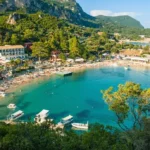
Arillas, Agios Stefanos (the western one, not to be confused with its northeastern namesake), Agios Georgios Pagon and Paleokastritsa make up the dramatic northwest. Cliffs, deep bays and sunsets are the draw here. Paleokastritsa is the best known, with its monastery on the headland and small coves reachable by boat. Arillas has a relaxed, slightly alternative feel and long sandy beach. The northwest is the right choice if you want scenery and evening light without the cost of the northeast.
The south: sand, lagoons and space
Southeast coast
Heading south from Corfu Town, Benitses, Moraitika and Messonghi form a chain of older resorts along the east coast. The beaches are narrow and mostly shingle, but the water is calm and the villages are set up for families and older couples who return year after year. Beyond Messonghi the road climbs away from the coast and the small harbours of Boukari and Petriti feel genuinely quiet, known mainly for fish tavernas on the waterfront.
Southwest coast
This is where Corfu’s best sand is. The Korission Lagoon, protected under the Natura 2000 network, is separated from the sea by a long bar of beach and dunes that rise above 15 metres in places. Behind the dunes grows an unusual forest of prickly juniper that locals call “cedar”, and more than 126 bird species have been recorded around the lagoon, flamingos among them. Halikounas, on the sea side of the lagoon, and Issos, just to the south, are wide, open beaches popular with windsurfers and kitesurfers. Further south, Agios Georgios Argyradon has a long sandy bay with a scattering of hotels and tavernas.
The far south
Lefkimmi is the agricultural heart of the south, a real working town with a river running through it, and it rarely sees many tourists. Its port has ferry links with Igoumenitsa on the mainland, which can be useful if you are arriving by car. At the very tip of the island sits Kavos, which is a different world: a strip of bars and clubs aimed at young British holidaymakers. If you want peace, do not book in Kavos. If you want nightlife above all else, this is the most intense on the island.
The middle ground
Many travellers solve the north versus south question by staying in the middle. Gouvia, Dasia and Ipsos, just north of Corfu Town, have marinas, hotels and quick access to town. On the west coast, Pelekas, Glyfada and Agios Gordios give you sandy beaches and sunsets while keeping both halves of the island within reach. Staying central makes most sense if you plan to hire a car and explore widely rather than settle in one place.
Side by side
| Factor | North | South |
|---|---|---|
| Landscape | Mountainous, green, steep olive terraces | Flatter, lagoons, farmland, dunes |
| Beaches | Mostly pebble coves in the northeast, sand at Acharavi, Roda and Arillas | Long sandy beaches in the southwest, shingle on the east |
| Atmosphere | Polished in the northeast, lively in Sidari | Quiet villages, with Kavos as the party exception |
| Cost | Generally higher, especially villas | Generally lower |
| Walking | Excellent: Pantokrator, Old Perithia, coastal paths | Good flat walks around Korission |
| Boat trips | Small boat hire to coves, trips towards Albania | Closest departures for Paxos and Antipaxos |
Which side for which traveller
Couples
The northeast coast is the classic choice for couples who want good food and calm, clear water. If the budget is tighter, the northwest around Arillas or Agios Georgios Pagon offers the same romance with sunsets and slightly lower prices.
Families with young children
Shallow, sandy water matters most here, which points to Acharavi and Roda in the north, or Agios Georgios Argyradon and the beaches near Korission in the south. The east coast resorts south of town, such as Moraitika and Messonghi, are also gentle, though the beaches are narrower.
Walkers and nature lovers
The north wins clearly. Mount Pantokrator, the abandoned village of Old Perithia and the northern sections of the long-distance Corfu Trail are all within easy reach of Kassiopi and Acharavi. Birdwatchers, however, should look south to the Korission Lagoon.
Nightlife
Kavos in the south and Sidari in the north are the two nightlife centres. Kavos is the more extreme. For a more grown-up evening, Corfu Town’s Liston and Old Town are better than either.
Independent travellers without a car
Buses run from Corfu Town to most resorts, but services thin out in the evening and in the shoulder season. If you will not drive, staying in or close to Corfu Town, or in a self-contained resort such as Kassiopi, Acharavi or Moraitika, keeps you less dependent on timetables.
Season matters too
In July and August the whole island is busy, but the busiest beaches tend to be the famous ones, Paleokastritsa, Sidari and Glyfada among them. The far south and the smaller northeast coves stay calmer. In May, June, September and early October, the sea is warm enough for swimming on both sides, and the north’s mountain villages are at their most pleasant for walking. In the low season some resorts, Kavos especially, close down almost completely, while larger villages such as Kassiopi and Lefkimmi keep living year round.
Practical tips
- Hire a car if you can. Corfu’s road network is slow and winding, but distances are short. A car turns any base into a launch pad for the whole island.
- Do not judge distance by the map. The northeast coast road and the climb over Pantokrator are narrow and twisty. Allow more time than a sat nav suggests, especially in summer traffic.
- Check the beach type. Listings that say “beachfront” in the northeast usually mean pebbles or a concrete platform. If sand matters, look southwest or at Acharavi, Roda and Arillas.
- Think about the wind. West coast beaches can be wavy in the afternoon; the northeast is usually the calmest place to swim on a windy day.
- Split your stay. On a two-week holiday, a week in the north and a week in the south or centre lets you see two very different Corfus without long day drives.
Frequently Asked Questions
Is north or south Corfu better?
Neither is better overall. The north has more dramatic scenery, calmer coves and better walking, while the south has the best sandy beaches, quieter villages and generally lower prices. Pick the north for landscape and the south for sand.
Which part of Corfu has the best sandy beaches?
The southwest has the longest sandy beaches, including Halikounas, Issos and Agios Georgios Argyradon near the Korission Lagoon. In the north, Acharavi, Roda and Arillas also have sand, while the northeast coast is mostly pebble.
Is the south of Corfu quiet?
Most of the south is quiet, with farming villages around Lefkimmi and small harbours such as Boukari and Petriti. The exception is Kavos at the southern tip, which is built around bars and clubs for young holidaymakers.
Which side of Corfu is best for families?
Families usually do best on shallow, sandy beaches: Acharavi and Roda in the north, or Agios Georgios Argyradon and the Korission area in the south. Moraitika and Messonghi on the southeast coast are also calm and well set up for children.
Do I need a car to explore Corfu from the north or south?
A car is strongly recommended if you want to see both halves. Buses link Corfu Town with most resorts, but evening and shoulder-season services are limited, and roads are slow and winding.