


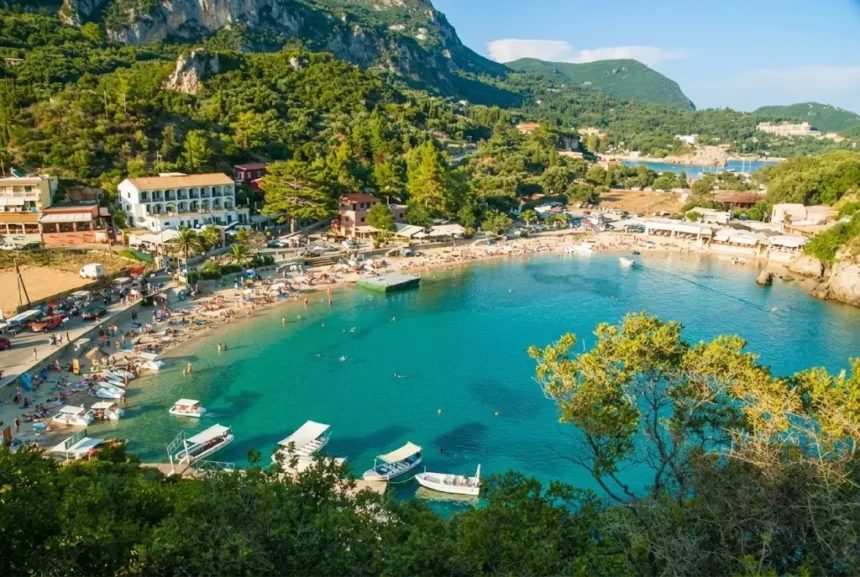
Paleokastritsa is a group of bays on Corfu's north-west coast, about 25 km from Corfu Town. Spend a day swimming at its beaches, taking a boat to the sea caves, visiting the 13th-century monastery and climbing to Angelokastro.
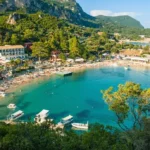
Paleokastritsa is a cluster of small bays on Corfu’s north-west coast, about 25 kilometres from Corfu Town, where green headlands drop into unusually clear, cool water. A good day here combines a swim at one of its six beaches, a boat trip into the sea caves, a visit to the 13th-century monastery on the headland and, if you have the energy, the ruined castle of Angelokastro. It is one of the most beautiful places on the island and also one of the busiest, so timing matters.
Quick facts
- Location: north-west coast of Corfu, about 25 km from Corfu Town
- Getting there: by car in roughly 30 to 45 minutes, or by green KTEL bus A9 from Corfu Town
- Time needed: a full day for beach, boat trip, monastery and Angelokastro
- Best time: May, June and September; arrive before 10:00 in July and August
- Good for: swimming, snorkelling, boat trips, views, history
Understanding the layout
Paleokastritsa is less a village than a stretch of coast. The road from Corfu Town descends through olive groves and arrives at a series of coves separated by wooded promontories. The largest bay, with the main beach of Agios Spyridon, lies at the end of the road below the monastery. Smaller beaches sit on either side, and the little harbour of Alipa, on the eastern side, is where most boat trips start. Hotels and tavernas are scattered along the road and on the slopes rather than gathered into a single centre.
The name means roughly “old little castle” and refers to Angelokastro, the Byzantine fortress on the cliffs to the north. In local tradition, the bay is the land of the Phaeacians in Homer’s Odyssey, where the shipwrecked Odysseus met Princess Nausicaa, and a rock off the coast is said to be the Phaeacian ship that was turned to stone after carrying him home.
The beaches
The water at Paleokastritsa is noticeably colder than at beaches on Corfu’s east coast, even in August, thanks to deep water close to shore and cold springs. Most people find it refreshing in high summer; early in the season it can be a shock.
Agios Spyridon
The main beach, at the head of the largest bay, is the busiest, with fine sand and some pebbles, sunbeds, tavernas and the large car park behind. Shallow entry makes it the most family-friendly of the beaches. In peak season it fills quickly from late morning.
Agios Petros and Ampelaki
To the west, Agios Petros is a pebble beach with rocks either side, good for snorkelling; bring water shoes. Further on, Ampelaki is a mix of sand and pebbles with a small jetty and is usually a little quieter than the main beach.
Agia Triada and the eastern coves
On the eastern side, Agia Triada has light pebbles and very clear water but also heavy boat traffic in summer and limited space. Beyond it, small coves reached by steep steps tend to be less crowded simply because of the climb.
Alipa
The small harbour at Alipa is mainly a departure point for boats rather than a place to swim, though there is a narrow beach beside the quay.
Boat trips and the sea caves
The cliffs on either side of Paleokastritsa are riddled with caves and grottoes that can only be reached by sea, and a boat trip is the single best thing to do here. Small boats leave Alipa harbour from around May to October for short circuits of the caves, including the cave associated with Nausicaa and the Blue Eye cave, where light reflecting off the sandy floor turns the water an intense blue. Longer trips continue along the coast to beaches that have no road access.
You can also hire a small motorboat and explore at your own pace. In Greece, boats with engines up to 30 horsepower can be rented without a licence, which is enough for the coves around Paleokastritsa on a calm day. The west coast can get choppy in the afternoon when the wind picks up, so go in the morning. Our Corfu boat rental guide covers prices and rules in more detail.
Paleokastritsa Monastery
The Monastery of the Virgin Mary (Theotokos) occupies the headland above the main beach. Tradition dates its foundation to 1225, making it one of the oldest monasteries on Corfu, although it was destroyed and rebuilt several times, including after the Ottoman raid of 1537. Most of what you see today, the church, the arcaded courtyard and the monks’ cells, dates from the 18th century. It is still a working monastery for men.
Inside the complex, a small museum displays Byzantine and post-Byzantine icons, old books and vestments, along with the skeleton of a large whale. On the lower level there is an old olive press and a shop selling oil, kumquat liqueur and preserves. The terraces behind the church have wide views along the coast, and a short path leads west to a further viewpoint.
Entry is free, with donations welcome. Shoulders and knees must be covered, and wraps are provided at the entrance for those who need them. The monastery closes for a few hours in the early afternoon, so aim for the morning or late afternoon. The road up is steep and narrow with very limited parking, so most visitors walk up from the main beach in about 10 to 15 minutes.
Angelokastro
A few kilometres north, near the village of Krini, the ruins of Angelokastro crown a rock about 300 metres above the sea. The castle’s exact founding date is uncertain, but it is usually attributed to the Despots of Epirus in the 13th century. It was one of Corfu’s main strongholds against the Ottomans: during the sieges of 1537 and 1571, villagers sheltered inside and the garrison held out.
From the ticket office it is about a 15-minute walk uphill on a stepped path to the summit, where a small chapel and the remains of walls and cisterns sit above sheer drops. The views over Paleokastritsa and the west coast are among the finest on Corfu. Angelokastro is a ticketed site run by the Ministry of Culture, open in the main season and closed on Tuesdays and over the winter. Check the current hours before driving up, and wear proper shoes.
Lakones and the scenic road
The village of Lakones sits on the hillside above the bays, about 6 kilometres by road from the beach. The road up through Lakones and on toward Makrades is narrow and winding, but the cafés and viewpoints along it look straight down on the coves and the monastery, and it is the classic place for the postcard view of Paleokastritsa. Drive it in the late afternoon when the light is softer, and take care on the bends.
How to spend a day in Paleokastritsa
- 08:30 to 09:30: arrive early, park near the main beach and walk up to the monastery while it is quiet.
- 10:00 to 11:30: take a boat trip from Alipa to the caves, or hire a small boat if the sea is calm.
- 11:30 to 14:30: swim at Agios Petros or Ampelaki and have lunch at one of the tavernas above the bays.
- 15:00 to 17:00: rest in the shade, or swim again as the tour coaches leave.
- 17:00 to 18:30: drive to Krini for Angelokastro, then return via Lakones for the view at sunset.
Getting there and parking
From Corfu Town, the main road runs west via Gouvia or through the interior, and the drive usually takes 30 to 45 minutes depending on traffic. Green KTEL buses on route A9 connect Corfu Town with Paleokastritsa several times a day in summer, fewer outside the season; check the current KTEL timetable. Taxis are an option but expensive for a return trip.
There is a large paid car park behind the main beach, which in July and August often fills by late morning. Parking at Alipa harbour and at the monastery is very limited. Coaches and rental cars can make the narrow road jammed in the middle of the day.
Practical tips
- Avoid the midday peak: tour coaches arrive from late morning to mid-afternoon; early morning and late afternoon are far calmer.
- Bring water shoes and a mask: the pebble beaches and rocky edges are excellent for snorkelling.
- Expect cold water: it is a pleasure in August but bracing in May.
- Dress for the monastery: carry a light layer if you plan to visit straight from the beach.
- Check the wind: boat trips may be cancelled when the sea is rough on the west coast.
- Consider staying a night: once day visitors leave, the bays are quiet and the evenings are lovely; see where to stay in Corfu.
Frequently Asked Questions
Is Paleokastritsa worth visiting?
Yes. It is one of the most scenic parts of Corfu, with clear water, sea caves, a historic monastery and Angelokastro nearby. It does get very busy in July and August, so arrive early or visit in May, June or September.
How do you get from Corfu Town to Paleokastritsa?
By car it is about 25 km and usually takes 30 to 45 minutes. Green KTEL buses on route A9 run from Corfu Town, with more frequent services in summer. Taxis are also available but costly for a return trip.
Is the Paleokastritsa monastery free to visit?
Entry to the monastery is free and donations are welcome. Visitors must cover their shoulders and knees, and wraps are provided at the entrance. It closes for a period in the early afternoon.
Can you swim at Paleokastritsa?
Yes, at Agios Spyridon, Agios Petros, Ampelaki and Agia Triada. The water is very clear but colder than on the east coast, and some beaches are pebbly, so water shoes help.
Which is the best beach in Paleokastritsa?
Agios Spyridon is the easiest, with sand, facilities and shallow water for children. For snorkelling and fewer people, Agios Petros and Ampelaki are better choices, and boat trips reach coves with no road access.