


The Achilleion is the palace Empress Elisabeth of Austria built at Gastouri, about 10 km south of Corfu Town, completed in 1891. Its interior is closed for restoration until at least 2029, but the gardens with the Dying Achilles statue and terrace views are open to visitors.
The Achilleion is the neoclassical palace that Empress Elisabeth of Austria, known as Sisi, built at Gastouri, about 10 kilometres south of Corfu Town, in the early 1890s. Before you go, know this: the palace interior has been closed for restoration for several years, and only the gardens, terraces and outdoor statues are open. Works are not expected to finish before 2029. The gardens are still worth an hour, for the statues of Achilles, the views and one of the most curious stories on the island.
- Quick facts
- Why an empress built a palace on Corfu
- Sisi’s brief years at the Achilleion
- Kaiser Wilhelm II and the giant Achilles
- A century of changing roles
- What you can see today
- The restoration: what is happening and when
- Is the Achilleion worth visiting now?
- Combining the Achilleion with nearby sights
- Getting there
- Practical tips
- Frequently Asked Questions
Quick facts
- Location: Gastouri village, about 10 km south of Corfu Town
- What is open: the gardens, terraces and outdoor areas only; the palace interior is closed for restoration
- Hours (2026): 08:00 to 20:00 from 1 April to 31 October, 08:00 to 16:00 from 1 November to 31 March, according to the official site
- Tickets (2026): around €7 general and €5 reduced; check the official site before visiting
- Getting there: blue city bus 10 from Corfu Town, or 20 to 30 minutes by car
- Time needed: 1 to 1.5 hours
Why an empress built a palace on Corfu
Elisabeth of Austria, wife of Emperor Franz Joseph, was famously restless and uncomfortable with life at the Viennese court. She travelled constantly and loved Corfu, which she first visited in the 1860s. In 1888 she chose a hillside estate at Gastouri, the former villa of the Corfiot statesman Petros Vrailas-Armenis, with views over the sea toward the mainland. The following year her only son, Crown Prince Rudolf, died at Mayerling, and the project became a retreat from grief as much as a summer home.
The palace was designed by the Italian architect Raffaele Caritto and completed in 1891. Elisabeth was devoted to Homer and to the hero Achilles, whom she saw as embodying strength and defiance of fate, and the whole house was conceived around him. The name Achilleion comes from that obsession, and the design deliberately evokes the palace of the Phaeacians, the mythical islanders of the Odyssey whom many identify with Corfu.
Sisi’s brief years at the Achilleion
For all the effort, Elisabeth spent relatively little time here. After the spring of 1896 she rarely returned, and she even considered selling the property; much of the furniture was shipped to Vienna. In September 1898 she was assassinated in Geneva by the Italian anarchist Luigi Lucheni. The Achilleion passed to her daughter, Archduchess Gisela, who made little use of it.
Kaiser Wilhelm II and the giant Achilles
In 1907 the German Emperor, Kaiser Wilhelm II, bought the Achilleion and made it his summer residence. His visits turned the palace into a stage for European diplomacy, and he brought his own interests to the island: he took part in excavations at the ancient Temple of Artemis near Corfu Town, whose Gorgon pediment is now in the Archaeological Museum, and he hired the botanist Carl Ludwig Sprenger to work on the gardens.
Wilhelm also made his own mark on the estate. He removed a statue of the poet Heinrich Heine that Elisabeth had installed, and commissioned a colossal bronze Achilles from the sculptor Johannes Götz, shown standing in full armour with a Gorgon on his shield, gazing north toward the town. Its original inscription, roughly “to the greatest of the Greeks from the greatest of the Germans”, was removed after the Second World War. The Kaiser’s summers on Corfu ended with the outbreak of the First World War in 1914.
A century of changing roles
After 1914 the Achilleion went through a string of uses that reflect Corfu’s turbulent 20th century:
- First World War: French and Serbian forces used it as a military hospital. After the war it became Greek state property under the peace treaties.
- 1921 to 1924: it housed an orphanage for Armenian children.
- Second World War: occupying Axis forces used it as a headquarters.
- 1962 to 1983: a private company leased it, running a casino on the upper floors and a museum below. The casino scene in the James Bond film For Your Eyes Only (1981) was shot here.
- 1994: it hosted a summit of European Union leaders.
Today the Achilleion belongs to the Greek state and is managed by the Hellenic Public Properties Company (ETAD).
What you can see today
With the interior closed, a visit focuses on the gardens and outdoor spaces, which hold the most famous parts of the estate anyway.
The Dying Achilles
The centrepiece of the gardens is Ernst Herter’s marble Dying Achilles, created in Berlin in 1884 and bought by Elisabeth. It shows the hero sitting on the ground, trying to pull the arrow from his heel. It is a moving piece and the one sculpture every visitor remembers.
The Kaiser’s Achilles
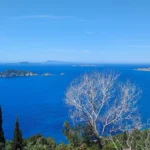
At the far end of the gardens towers Wilhelm’s bronze Achilles, a deliberate contrast to the empress’s suffering hero. The terrace around it looks over the coast toward Corfu Town and the mainland mountains.
The colonnade and statues
The visitor route passes along the colonnade beside the palace, lined with statues of the Muses and busts of classical philosophers and poets, and through the formal gardens with a statue of Elisabeth herself. Lower down, a restored statue of Lord Byron stands among the trees. In 2025 ETAD added digital installations in the gardens, with short films presenting the palace’s history and its closed interiors.
The restoration: what is happening and when
A restoration contract signed in 2021 was terminated in April 2024, leaving work on the main palace incomplete. A new tender with a budget of about €14.2 million has since been launched. According to local reporting in September 2026, ETAD expects to sign the new works contract in early 2027, with around 28 months for studies, approvals and construction, pointing to completion in mid-2029 at the earliest. Until then, expect to visit the outdoor areas only, and treat any reopening date with caution.
Is the Achilleion worth visiting now?
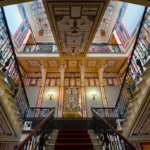
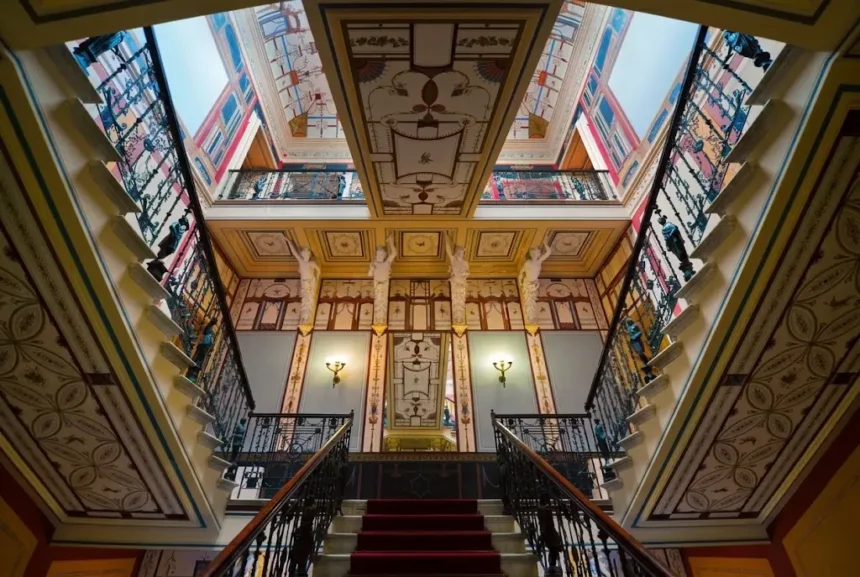
Honestly, it depends on your expectations. If you come hoping to see Sisi’s private rooms, the painted chapel and the grand staircase, you will be disappointed. If you are interested in the story, enjoy sculpture and gardens, or want a short, shady stop on a day exploring the south of the island, it is still a worthwhile visit at a modest price. It pairs well with Kanoni and the Mon Repos estate, or with a seafood lunch in Benitses, about 3 kilometres away on the coast.
Combining the Achilleion with nearby sights
The Achilleion sits in the hills of central-eastern Corfu, a short drive from several places that fill out a half-day or full day:
- Kanoni and Mouse Island: the classic view over Vlacherna monastery and Pontikonisi, about 15 minutes’ drive north, with planes landing alongside.
- Mon Repos: the wooded estate where Prince Philip was born in 1921, with the Museum of Palaiopolis and paths past ancient remains, just south of Corfu Town.
- Benitses: a former fishing village on the coast below Gastouri with a small harbour, a waterfront lined with tavernas and the remains of a Roman bath house in the old village.
- Corfu Old Town: 20 to 30 minutes away, and the natural place to finish the day with dinner.
A sensible order is the Achilleion at opening time, Kanoni in late morning, Mon Repos after lunch and the Old Town for the evening, which keeps you out of the worst of the coach traffic at each stop.
Getting there
By car, follow the road south from Corfu Town toward Perama and Gastouri; the drive takes 20 to 30 minutes. There is roadside parking near the entrance, which fills when tour coaches are in. Drive carefully on the approach road, where the regional authority has warned of ground subsidence. Blue city bus 10 runs from Corfu Town to the Achilleion; check the current timetable, as services are reduced outside summer. Many organised island tours also include a stop here.
Practical tips
- Go early or late: coach groups arrive mid-morning, and the gardens are much calmer at opening time or in the late afternoon.
- Check before you go: confirm hours, ticket prices and what is open on the official Achilleion website, as arrangements can change during works.
- Reduced tickets: concessions for students, under-18s and over-67s are sold only at the ticket office on site, with ID.
- Bring water and a hat: the upper terrace around the Kaiser’s statue has little shade.
- Look around Gastouri: the village itself, with its old houses and olive groves, is worth a short walk.
Frequently Asked Questions
Is the Achilleion Palace open?
The gardens, terraces and outdoor statues are open, but the palace interior is closed for restoration. Works are expected to continue until at least 2029, so check the official site for current arrangements before visiting.
How much does it cost to visit the Achilleion?
In 2026 the official site lists general admission at around €7 and a reduced ticket at €5, with free entry for children under six. Prices can change, especially while restoration continues, so confirm before you go.
Who built the Achilleion in Corfu?
Empress Elisabeth of Austria, known as Sisi, built the Achilleion as a private retreat. It was designed by the Italian architect Raffaele Caritto and completed in 1891. Kaiser Wilhelm II of Germany bought it in 1907.
How do you get to the Achilleion from Corfu Town?
The Achilleion is in Gastouri, about 10 km south of Corfu Town. Blue city bus 10 runs there, and by car the drive takes 20 to 30 minutes. Many island tours also stop there.
How long do you need at the Achilleion?
With only the gardens and outdoor areas open, an hour to an hour and a half is enough. Combine it with Kanoni, Mon Repos or lunch in nearby Benitses to make a half-day.