



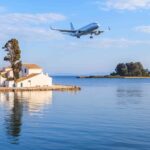




The best Greek island hopping routes stay within one island group, such as Paros, Naxos and Santorini in the Cyclades or Rhodes, Symi, Kos and Patmos in the Dodecanese. Plan three or four nights per island and keep a buffer day before flying home.
The best Greek island hopping routes follow the ferry lines rather than the map: islands in the same group are linked by frequent boats, while jumping between groups costs you a day. Pick one group, plan three or four nights per island, and keep each hop under about three hours. Below are five itineraries that work in practice, from the classic Cyclades loop to quieter routes in the Dodecanese, the western Cyclades, the Saronic Gulf and the Ionian.
- Quick facts
- How to plan a route that works
- Itinerary 1: The classic Cyclades (Paros, Naxos, Santorini)
- Itinerary 2: The quiet western Cyclades (Sifnos, Milos, Folegandros)
- Itinerary 3: The Dodecanese from Rhodes (Rhodes, Symi, Kos, Patmos)
- Itinerary 4: The short Saronic hop from Athens (Aegina, Hydra)
- Itinerary 5: The Ionian (Corfu, Paxos, Lefkada, Kefalonia)
- Routes to avoid
- Practical tips
- Frequently Asked Questions
Quick facts
- Best season: late May to June and September to early October, when all routes run and seas are calmer than in the August meltemi.
- Ideal pace: 3 to 4 nights per island; 2 nights only for small islands close together.
- Main gateways: Piraeus and Rafina for the Cyclades, Rhodes for the Dodecanese, Corfu for the Ionian.
- Booking: book July and August ferries and any car deck space well ahead; timetables are usually published in the spring.
- Good for: 10 days to three weeks; with a week, choose two islands, not four.
How to plan a route that works
Greek ferries run mostly on spokes from Piraeus and along chains of islands. Within the central Cyclades (Paros, Naxos, Ios, Santorini, Mykonos) there are several boats a day in summer. Between island groups, for example from the Cyclades to the Dodecanese or to Crete, connections exist but are fewer and longer. Before you fix anything, check the actual timetable for your dates, not last year’s, because routes are re-awarded each season.
Three rules save most trips. First, build in a buffer night before any international flight, because strong winds can cancel smaller and faster boats. Second, prefer large conventional ferries when the sea is rough: they are slower but more stable and less likely to be cancelled than catamarans. Third, finish where you can fly out, or close to Athens, rather than at the far end of a chain. Our Greek ferry guide covers tickets, ports and the different types of boat.
Itinerary 1: The classic Cyclades (Paros, Naxos, Santorini)
Length: 10 to 12 days. Best for: first-timers.


- Athens to Paros (3 nights). Ferries from Piraeus take roughly 3 to 5 hours depending on the vessel. Paros is a comfortable first island: Naoussa for the harbour and evenings, Parikia for practicality, Lefkes for walking. Antiparos is a short local boat away. See our Paros travel guide.
- Paros to Naxos (4 nights). The shortest crossings take around 30 to 45 minutes, and there are several a day in summer. Naxos has the longest sandy beaches in the Cyclades (Agios Prokopios, Plaka) plus mountain villages such as Halki, Filoti and Apiranthos. Read the Naxos island guide.
- Naxos to Santorini (3 nights). Fast boats take around 1.5 to 2 hours; conventional ferries longer. Stay away from the caldera rim if your budget is tight, and walk from Fira to Oia. Our Santorini travel guide explains how to avoid the worst crowds.
- Fly home from Santorini, or take a ferry back to Piraeus (around 5 to 8 hours), or continue to Crete.
Variation: swap Santorini for Ios or Amorgos for a quieter end, or add two nights on Mykonos between Athens and Paros. Avoid trying to fit all five big names into ten days.
Itinerary 2: The quiet western Cyclades (Sifnos, Milos, Folegandros)
Length: 10 to 14 days. Best for: walkers, food lovers, return visitors.
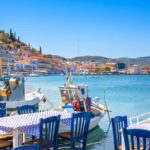
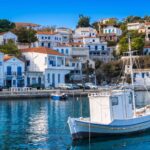
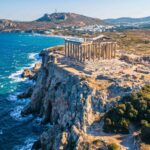
- Athens to Sifnos (3 to 4 nights). Sailings from Piraeus take roughly 2.5 to 5 hours depending on the boat. Sifnos is known for its cooking (chickpea revithada baked in clay pots), pottery workshops and a network of marked footpaths between Apollonia, Artemonas and Kastro.
- Sifnos to Milos (4 nights). The crossing is short, often around an hour. Milos is the island of volcanic coastline: Sarakiniko, Kleftiko by boat, the fishing village of Klima with its boathouses.
- Milos to Folegandros (3 nights). Connections are less frequent here, so check the days. Folegandros has one of the most striking cliff-top choras in Greece and very little else, which is the point.
- Return to Piraeus from Folegandros or via Milos; allow a full travel day.
Variation: add Serifos as a first stop (close to Piraeus) or Kimolos as a day trip from Milos. These islands run fewer boats outside June to September, so this route is a summer plan.
Itinerary 3: The Dodecanese from Rhodes (Rhodes, Symi, Kos, Patmos)
Length: 12 to 14 days. Best for: history, varied islands, travellers who want to fly in and out of the same airport region.
- Rhodes (4 nights). Fly direct to Rhodes from many European cities. Stay in or near the medieval Old Town, and give a day to Lindos and its acropolis.
- Rhodes to Symi (2 to 3 nights). The crossing takes under an hour on the faster boats, and there are usually at least two sailings a day in high season. The harbour of Gialos with its neoclassical houses is the reason to come. See the Symi travel guide.
- Symi or Rhodes to Kos (3 nights). High-speed boats from Rhodes take around 2 hours; connections from Symi run less often. Kos is flat and good for cycling, with the Asklepieion and a lively town.
- Kos to Patmos (3 nights). The fastest catamarans take about 1.5 to 2.5 hours, slower conventional ferries 3 to 4 hours, often in the evening. Patmos has the Monastery of Saint John and the Cave of the Apocalypse above a calm, well-kept island.
- Return to Kos to fly out, or take the long ferry from Patmos to Piraeus.
Variation: add Leros or Lipsi, both small and quiet, between Kos and Patmos; the catamaran line stops at most of them.
Itinerary 4: The short Saronic hop from Athens (Aegina, Hydra)
Length: 4 to 6 days. Best for: a short break, travellers with only a few days after Athens, spring and autumn trips.
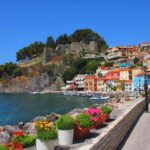

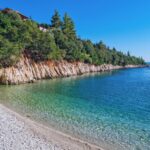
- Athens to Aegina (2 nights). The closest island of any size to Piraeus: fast boats take around 40 minutes, conventional ferries a little over an hour. See the Temple of Aphaia, the abandoned hilltop town of Paleochora and taste the island’s pistachios.
- Aegina to Hydra (2 to 3 nights). Direct sailings exist but are limited; otherwise return via Piraeus or go through Poros. Hydra has no cars and no scooters, only donkeys, water taxis and stone lanes around a perfect harbour. Read our Hydra travel guide.
- Return to Piraeus, around 1.5 to 2 hours by fast boat, or cross to the Peloponnese coast for Nafplio.
This is the one route that works well out of season, since the Saronic boats run all year.
Itinerary 5: The Ionian (Corfu, Paxos, Lefkada, Kefalonia)
Length: 10 to 14 days. Best for: green landscapes, sailing, travellers who like to drive.
The Ionian is different: inter-island ferries are fewer, and the trick is to combine boats with a rental car on the mainland or with Lefkada’s road bridge. Start in Corfu (3 to 4 nights), take the boat to Paxos (around an hour on the fast service, 2 to 3 nights), return to the mainland at Igoumenitsa or Parga and drive south to Lefkada, which is linked to the mainland by a causeway and floating bridge (3 nights). From the south of Lefkada, seasonal ferries cross to Kefalonia (3 to 4 nights), which has its own airport. Our full guide to Ionian island hopping routes covers the ferry links in detail.
Routes to avoid
- Too many islands in too few days. Each hop costs at least half a day once you add packing, checking out, getting to the port and waiting.
- Zig-zagging between groups, for example Santorini to Rhodes to Mykonos. The connections exist, but they are slow, infrequent or need a change in Piraeus.
- Relying on one daily boat on the last day before a flight.
- Bringing a rental car on every hop. It is expensive and most rental contracts forbid it; hire a car on each island instead.
Practical tips
- Buy tickets online for peak dates and save the e-ticket or QR code on your phone; port agencies sell them too.
- Arrive at least 30 to 45 minutes before departure, longer with a car. Boats leave on time even if they arrive late.
- Fast boats cost more and are worse in rough seas; take seasickness tablets on catamarans when the wind is up.
- Pack light. You will carry your bags on ramps, along quays and up village steps.
- Check the weather forecast for wind (Beaufort 7 and above often means cancellations on smaller vessels).
- June and September give you nearly every connection with fewer crowds and lower prices than July and August.
Frequently Asked Questions
How many islands should I visit in 10 days?
Two or three. With ten days, three islands at three nights each is the comfortable maximum, because every hop takes at least half a day. Four islands is possible only if they are very close together.
What is the easiest Greek island hopping route?
Athens, Paros, Naxos and Santorini. These islands have several daily connections in summer, short crossings between Paros and Naxos, and an airport at Santorini for the flight home.
Do I need to book Greek ferries in advance?
For July and August, yes, especially for popular sailings, cabins and car spaces. In spring and autumn you can usually buy a day or two ahead, but booking online is still easy and secures your seat.
When is the best time for island hopping in Greece?
Late May to June and September to early October. All summer routes are running, the sea is warm enough to swim, and the strong August meltemi wind is less of a problem.
Can I island hop in winter?
Only on a limited scale. Big islands and the Saronic Gulf keep year-round ferries, but many smaller routes stop and many hotels and tavernas close from November to April.