


Kalamata is a lively seaside city in Messinia, about two and a half to three hours from Athens, with a castle, an old town and a long city beach. It is also the best base for Ancient Messene, the Mani and the southwest Peloponnese.
Kalamata is the second largest city of the Peloponnese and one of the most likeable: a working Greek city with a long beach right in town, a castle on the hill, a compact old quarter and some of the best olives and olive oil in the country. Most visitors pass through on their way to the Mani or the southwest coast, but it deserves a night or two of its own. It sits about two and a half to three hours by car from Athens and has its own international airport, which makes it the natural gateway to Messinia.
Quick facts
- Where: at the head of the Messinian Gulf, southwest Peloponnese.
- Getting there: about 240 km from Athens by motorway; KTEL buses from Kifissos terminal; seasonal flights to Kalamata airport.
- Time needed: 1 to 2 days for the city, longer as a base for day trips.
- Best time: April to June and September to October; the olive harvest runs from late autumn into winter.
- Good for: food lovers, road trippers, families, travellers who like real cities rather than resorts.
The city at a glance
Kalamata has two halves. The old town lies inland, around the castle hill and the cathedral, with narrow streets, churches and the main shopping streets. The seafront, about 2 km south, is a long, straight promenade along Navarinou street, lined with cafés, bars and fish tavernas facing a pebble and sand beach. Between them runs Aristomenous street, the main artery, with Central Square (Plateia 23 Martiou) halfway along. Much of the city was rebuilt after a strong earthquake in 1986, so modern buildings stand beside restored neoclassical houses.
What to see in Kalamata
The castle
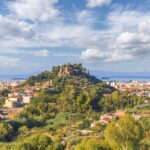
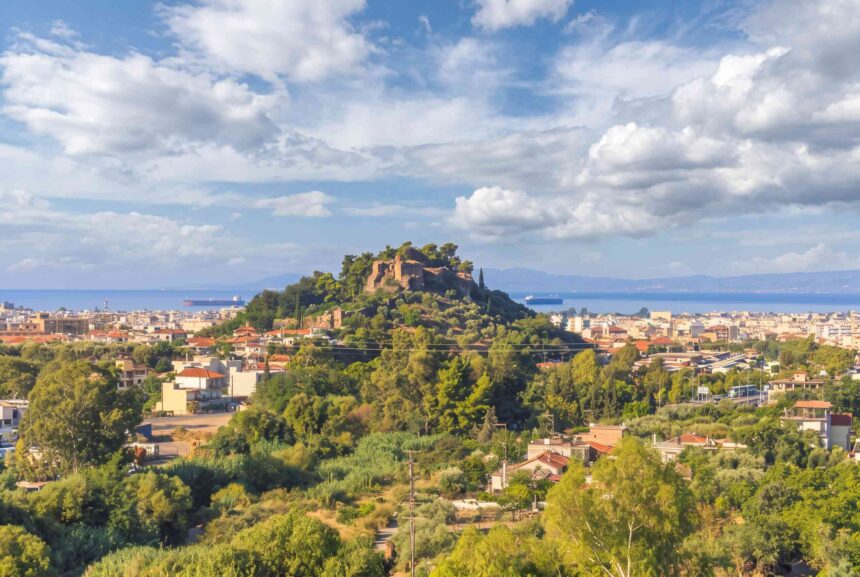
The castle of Kalamata stands on a low hill at the northern edge of the old town. It was built in the 13th century, begun by the Byzantines and completed by the Frankish lords of the Morea, and later held by the Venetians and the Ottomans. What survives is mainly an outer wall and an inner keep set among pine trees, with good views over the rooftops to the gulf and the Taygetos mountains. In summer, the open air theatre inside the walls hosts concerts and performances. Opening hours vary through the year, so check locally.
The old town
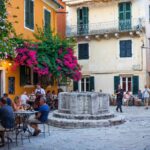
Below the castle, the old town is a pleasant place to wander. Look for the Church of the Holy Apostles, a small Byzantine church where, according to tradition, the revolution in Kalamata was declared in March 1821, and the large Metropolitan Church of Ypapanti, the city’s cathedral. Nearby is the Convent of Agioi Konstantinos and Eleni, where the nuns have long woven silk, a reminder of Kalamata’s historic silk industry. The streets around Ypapantis are full of small shops, bakeries and cafés.
Museums
The Archaeological Museum of Messinia, beside the central market in the old town, covers the region from prehistory to Byzantine times, with finds from across Messinia arranged by area. The Historical and Folklore Museum, in the 19th century Kyriakou mansion near the castle, displays costumes, household objects and memorabilia from the 1821 revolution. Both are small and make a good hour each.
The Railway Park
The Municipal Railway Park, near the old station between the old town and the port, is an open air museum of old steam locomotives and carriages set in a large green space. Children can climb on some of the trains, and it is a pleasant shady stop on a hot afternoon.

The market
The central market, by the river close to the KTEL bus station and the castle, is the place to see what Messinia produces. Stalls sell olives, oil, honey, figs, cheese, herbs and fresh vegetables, and the busiest days are the weekly farmers’ market days. It is the best place in the city to buy edible souvenirs.
Beaches
The city beach runs for around 2.5 km along Navarinou street and has held a Blue Flag. It is a mix of pebbles and sand, with sunbeds, beach bars and shallow water, and it is genuinely good for a swim between sightseeing. To the east of the city, Almyros and Santova are longer beaches with beach bars and water sports, popular with local families. Heading south on the road to the Mani, Mikri Mantineia and Avia have pebble beaches and fish tavernas with views back across the gulf.
Food and local products
Kalamata gives its name to one of the most famous olives in the world. The dark, almond shaped Kalamata olive, from trees around the city, is protected as a PDO product, and the Koroneiki olive grown across Messinia produces excellent extra virgin oil. Other local specialities include pasteli (a sesame and honey bar), lalagia (fried dough strips, eaten as a snack or with cheese and honey), diples (fried pastry spirals with honey and walnuts) and sfela, a salty, spicy white cheese. In the tavernas, look for pork with orange, wild greens, and fresh fish on the seafront. Our Greek food guide has more on regional dishes.
Events
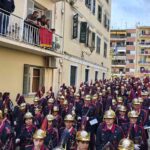
The Kalamata Dance Festival, held every July, brings international and Greek companies to the city and is one of the leading contemporary dance festivals in Greece. On 23 March the city celebrates the anniversary of its liberation in 1821 with parades.
Day trips from Kalamata
Ancient Messene
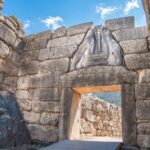
About 30 km northwest, Ancient Messene is one of the most impressive and least crowded ancient cities in Greece, with a theatre, a vast stadium surrounded by colonnades, an agora, temples and long stretches of city walls. Allow at least half a day and visit in the morning or late afternoon. It pairs well with a longer loop to the sanctuary at Ancient Olympia, about two hours to the north.
The Mani
South of Kalamata the road climbs into the Outer Mani, reaching Kardamyli in about an hour, and continues to Areopoli, Limeni and the Diros caves. You can sample it in a long day, but it deserves several; see our guide to a road trip through the Mani peninsula.
Pylos, Methoni and Koroni
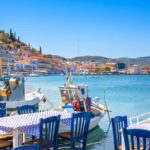
To the southwest, about an hour away, Pylos sits on Navarino Bay, with the beautiful horseshoe beach of Voidokilia and the Gialova lagoon nearby. Methoni and Koroni, on the southern tip of Messinia, both have large Venetian castles by the sea. Combine two of them in a day.
Polylimnio and the Neda gorge
Inland, the Polylimnio waterfalls are a series of green pools and small falls reached on a short walking trail, and the Neda gorge further north offers longer walks and wild swimming. Both are best from spring to early summer, when the water is flowing.
Getting there and around
By car, Kalamata is around 240 km from Athens on the motorway via Corinth and Tripoli, roughly two and a half to three hours, with tolls of around 12 euros each way in 2026. KTEL Messinias buses run from the Kifissos terminal in Athens several times a day and take around three hours; fares were around 25 euros one way in 2026. The Kalamata bus station is next to the market, close to the old town. Kalamata airport, about 10 km west of the city, has domestic flights from Athens and seasonal international flights from many European cities, mostly in summer. Check current schedules and fares before you travel.
The city centre is walkable, and city buses link the old town with the seafront. For day trips you will want a car; our guide to renting a car in Greece explains the basics.
Practical tips
- Where to stay: the seafront is best for beach holidays and evening walks; the old town suits sightseeing and is closer to the bus station.
- Combine regions: Kalamata is a good start or end point for a Peloponnese road trip that includes Nafplio and the Argolid and the fortress town of Monemvasia.
- Heat: summers are hot; plan sightseeing for the morning and swim in the afternoon.
- Olive season: from late autumn the harvest is in full swing, a good time to visit an oil mill or buy fresh oil.
- Year round: as a real city, Kalamata stays open all year, with cafés and tavernas busy in winter too.
Kalamata will not overwhelm you with famous sights, and that is part of its appeal. It is a comfortable, lived in city with a beach on its doorstep, good food and some of the finest landscapes of the Peloponnese within an hour’s drive.
Frequently Asked Questions
Is Kalamata worth visiting?
Yes, especially as a base. The city itself has a castle, an old town, a long beach and excellent food, and it puts Ancient Messene, the Mani, Pylos and Voidokilia within easy reach.
How do you get from Athens to Kalamata?
By car it is around 240 km and two and a half to three hours on the motorway. KTEL Messinias buses leave from the Kifissos terminal several times a day and take around three hours. There are also flights from Athens to Kalamata airport.
Does Kalamata have a beach?
Yes. The city beach runs for about 2.5 km along Navarinou street, a mix of pebbles and sand with sunbeds and bars. Almyros and Santova to the east are longer and quieter.
How many days do you need in Kalamata?
One or two days is enough for the city, the castle, the market and the beach. Add several more if you use it as a base for the Mani and the southwest Peloponnese.
Where can you buy Kalamata olives and oil?
The central market near the castle and bus station is the best place, with stalls selling olives, oil, honey and local cheese. Delicatessens in the old town also sell packaged products to take home.