


Monemvasia is a car-free medieval town on a rock off the south-east Peloponnese, about four hours by car from Athens; explore the Lower Town, climb to Agia Sofia and stay one night if you can.
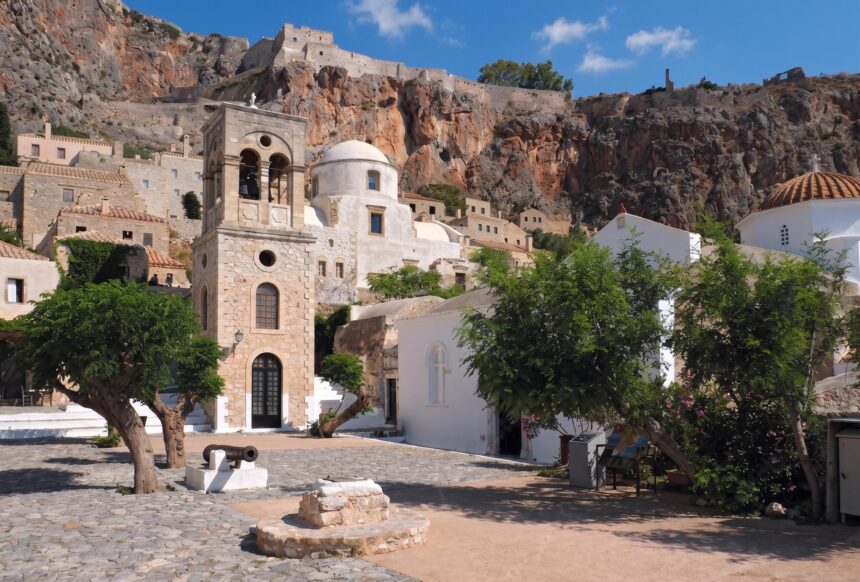
Monemvasia is a medieval walled town built on the seaward side of a huge rock off the south-east coast of the Peloponnese, joined to the mainland by a short causeway. You cannot see the town from land, cars cannot enter it, and its lanes of stone houses, Byzantine churches and sea walls make it one of the most memorable places in Greece. One night inside the walls is the ideal way to experience it, but even a long day trip is worthwhile.
Quick facts
- Where: Laconia, south-east Peloponnese, about 300 km from Athens.
- Getting there: around four hours by car from Athens, or by long-distance bus via Sparti.
- Time needed: half a day for the Lower Town, a full day with the climb to the Upper Town, ideally one night.
- Best time: April to June and September to October; midsummer days are very hot on the exposed rock.
- Good for: history lovers, couples, photographers and road trippers touring the Peloponnese.
Why it is called Monemvasia
The name comes from the Greek moni emvasis, meaning single entrance. The rock is about 1,500 metres long and almost 200 metres high, and the only way in was, and still is, through one gate in the western wall. An earthquake in AD 375 separated the headland from the mainland, and in the late 6th century people from Laconia took refuge here from raids and founded the town.
A short history
Under the Byzantines, Monemvasia became one of the most important ports in the Peloponnese. At its peak in the 13th and 14th centuries it had several thousand inhabitants and dozens of churches. After the Fourth Crusade it resisted the Franks for decades before surrendering on negotiated terms after a three-year siege. Later it passed between the Venetians and the Ottomans: Venetian rule from 1463 to 1540 and again from 1690 to 1715, Ottoman rule in between and until 1821.
The town also gave its name to a wine. The sweet wine shipped from its harbour became famous across Europe as Malvasia or Malmsey, and the name survives today in grape varieties grown around the Mediterranean. Local producers in Laconia have revived a Monemvasia-Malvasia wine in recent decades.
In July 1821, during the War of Independence, Monemvasia became the first fortress in the Peloponnese to be taken by the Greek fighters. In the 20th century most residents moved to the new village of Gefyra across the causeway, and the old town slowly emptied before being restored, house by house, in recent decades. The poet Yiannis Ritsos was born here in 1909 and is buried in the town cemetery; his family house just inside the gate is marked by a bust but is not open to visitors.
The Lower Town
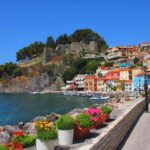
Walking through the tunnel-like main gate is the moment that makes Monemvasia special: one step takes you from a bare rock face into a lane of shops, cafés and stone houses. The Lower Town is enclosed by walls on three sides and the cliff on the fourth. Its main street runs east to the central square, with side lanes climbing up and down to small chapels, courtyards and viewpoints over the sea.
What to see
- Church of Christ Elkomenos: the cathedral on the central square, founded in the 13th century and altered in later periods. It holds important Byzantine icons and is still the heart of the town’s religious life.
- The Archaeological Collection: housed in a former mosque opposite the cathedral, it displays finds from the town, including carved marble, ceramics and objects of daily life. Hours are limited and it is often closed one day a week, so check before you go.
- Panagia Chrysafitissa: a 17th-century church on a square at the eastern end, built on the edge of the rock above the sea.
- Panagia Myrtidiotissa and Agios Nikolaos: two of the many smaller churches that mix Byzantine and Venetian elements, found along the lanes.
- The sea walls: walk along the southern walls towards the lighthouse at the eastern tip for the classic views back over the rooftops.
- Portello: a small sea gate in the southern wall where steps and a ladder lead into the water. Swimming here is a local tradition on calm days, but the sea can be choppy and there is no beach.
The Upper Town and Agia Sofia
A zigzag stone path climbs from the Lower Town to the flat top of the rock, where the Upper Town once stood. It was the fortified administrative centre, and most of it is now ruins among wild herbs: house foundations, cisterns and fortifications, with huge views along the coast. The climb takes around 20 to 30 minutes, the steps are uneven and polished smooth, and there is no shade.
The prize at the top is the church of Agia Sofia, built in the 12th century on the edge of the cliff. It served as a Catholic church under the Venetians and as a mosque under the Ottomans, and still has fragments of Byzantine frescoes. Opening days and hours for the church are limited and change by season, so ask at the Archaeological Collection or your accommodation before climbing if seeing the interior matters to you. Even when the church is closed, the walk is worth it for the views.
If you enjoy fortified medieval towns, compare Monemvasia with the Old Town of Rhodes or with Nafplio and its fortresses, which is a natural stop on the same road trip.
Gefyra and the beaches nearby
Gefyra, at the mainland end of the causeway, is the modern village. It has the supermarkets, banks, most of the parking, cheaper accommodation and a strip of tavernas along the harbour. Walking from Gefyra to the main gate takes about 20 minutes along the causeway and the road around the rock. There is a small shuttle bus between the causeway and the gate in summer.
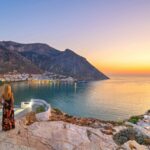
Monemvasia itself has no beach. The closest swimming is at the beach in Gefyra and at Pori, a sandy beach a few kilometres north. Further south, the island of Elafonisos, reached by a short ferry from Pounta, has the famous Simos beach and makes a good day trip.
Getting there
From Athens, the drive takes around four hours on the motorway via Corinth and Tripoli, then the national road through Sparti and Molai. Several daily buses run from Athens with a change or stop in Sparti, but schedules are reduced out of season. A car gives you far more freedom to combine Monemvasia with Mystras, Sparti, the Mani peninsula and Nafplio. Read our guide to renting a car in Greece before you go, and if you are starting in the capital, our Athens travel guide covers the city before or after the drive.
A circular Peloponnese road trip often links Monemvasia with Nafplio in the north-east and Ancient Olympia in the west. Allow at least a week to do it without rushing.
Where to stay
Staying inside the walls is the real experience. The town is quiet after the day visitors leave, the lanes are lit and you can walk the walls at sunrise. Accommodation is mostly in restored stone houses run as small hotels and guesthouses. Rooms are often reached by steps and have character rather than space. Gefyra has more choice and lower prices, and is easier with a lot of luggage or a car.
When to visit
Spring and autumn are the best seasons, with pleasant temperatures for the climb and fewer crowds in the narrow lanes. July and August bring heat and many day visitors, especially at weekends. Easter is a special time, as the town’s churches hold traditional services and the lanes fill with Greek visitors. Monemvasia is open all year, and winter visits can be atmospheric, though some hotels and restaurants close. For a wider seasonal picture, see our guide to the best time to visit Greece.
Practical tips
- Wear proper shoes: the lanes are paved with polished stones and steps that are slippery, especially on the path to the Upper Town.
- Park outside: cars cannot enter the old town. Use the free parking near the causeway or in Gefyra, as the roadside spaces near the gate fill up quickly.
- Climb early or late: go up to Agia Sofia in the morning or late afternoon, with water and a hat.
- Pack light: if you stay inside the walls, you will carry your luggage from the gate along stone lanes and up steps.
- Check opening times: the Archaeological Collection and Agia Sofia keep limited and changing hours.
- Visit in the evening: even if you stay in Gefyra, return to the old town for dinner and a walk when the day crowds have gone.
Frequently Asked Questions
Is Monemvasia worth visiting?
Yes. It is one of the best-preserved medieval towns in Greece, with no cars, Byzantine churches, sea walls and dramatic views. It is a long drive from Athens, so it is best combined with a wider Peloponnese road trip.
How long should you spend in Monemvasia?
Half a day covers the Lower Town, and a full day allows the climb to the Upper Town and Agia Sofia. Staying one night inside the walls is ideal, as the town is quiet and atmospheric after the day visitors leave.
Can you drive into Monemvasia?
No. Cars cannot enter the old town. You can drive across the causeway to drop passengers near the gate, but you must park in the parking areas near the causeway or in Gefyra.
Is there a beach in Monemvasia?
The old town has no beach, though people swim from the Portello sea gate on calm days. The nearest beaches are in Gefyra and at Pori just north, and Elafonisos with Simos beach is a day trip away.
How do you get to Monemvasia from Athens?
The drive takes around four hours via Corinth, Tripoli and Sparti. Buses also run from Athens via Sparti, though there are fewer services outside summer, so check schedules in advance.