


Nafplio is a Venetian and Ottoman old town in the Peloponnese, about two hours from Athens, and the first capital of modern Greece. Spend two or three nights to see the Palamidi fortress, the Bourtzi and nearby Mycenae and Epidaurus.
Nafplio is the most handsome small town in mainland Greece: a Venetian and Ottoman old town on a peninsula in the Argolic Gulf, watched over by the Palamidi fortress on its hill and the little Bourtzi castle in the harbour. It sits about 140 km from Athens, roughly two hours by car, and it works equally well as a weekend escape or as a base for Mycenae, Epidaurus and Tiryns. Two nights is the sweet spot; three if you want the ancient sites without rushing.
Quick facts
- Where: Argolida, northeast Peloponnese, on the Argolic Gulf.
- Getting there: about 2 hours by car from Athens via the Corinth Canal, or KTEL Argolida buses from Athens (Kifissos terminal).
- Time needed: 2 to 3 nights, including day trips.
- Best time: April to June and September to October; it is also a lively winter weekend town for Athenians.
- Good for: couples, history lovers, slow walkers, families with older children.
Why Nafplio matters
Nafplio was the first capital of the modern Greek state, from the late 1820s until the court of King Otto moved to Athens in 1834. Ioannis Kapodistrias, the first governor of independent Greece, was assassinated on the steps of the church of Agios Spyridon in 1831, and you can still see the mark of a bullet in the wall beside the door. Before that the town had changed hands repeatedly between the Venetians and the Ottomans, and both left their stamp: Venetian lions above gateways, Ottoman fountains, a former mosque that housed the first Greek parliament (the Vouleftiko), and neoclassical mansions added in the 19th century.
The result is a town that feels lived in rather than preserved. Locals still shop on Amalias and Vasileos Konstantinou streets, children play football in Syntagma Square in the evening, and the cafés along the waterfront fill with Greek families at weekends.
The old town
Syntagma Square and the lanes
Start in Syntagma Square, paved in marble and framed by the former Venetian arsenal, which now holds the Archaeological Museum of Nafplio. The museum is small but strong on Mycenaean finds, including the bronze Dendra panoply, one of the oldest suits of armour in Europe. From the square, wander uphill along Kapodistriou and Staikopoulou streets, where bougainvillea hangs over wooden balconies and the stepped lanes climb towards Akronafplia. Look for the Catholic church (a former mosque, then a church for Bavarian officers) and the Peloponnesian Folklore Foundation museum, which has an excellent collection of regional costume and textiles.
The waterfront and the Arvanitia walk
The harbour promenade, Akti Miaouli, runs from the port to the end of the peninsula with views of the Bourtzi. Keep going and a flat path wraps around the base of Akronafplia, above the sea, to the pebbly beach of Arvanitia. It is an easy 15 to 20 minute walk, best at sunset or early morning, and one of the nicest short walks in the Peloponnese. From Arvanitia a longer path continues to Karathona beach, a long sandy bay about 3 km away that is the town’s main summer swimming spot.
The fortresses
Palamidi
The Palamidi fortress crowns the hill above the town. It was built by the Venetians between 1711 and 1714, a remarkably fast job for a complex of eight interlinked bastions, each self-contained so that one could hold out if another fell. The bastions were later given the names of ancient heroes such as Miltiades, Leonidas and Themistocles. Theodoros Kolokotronis, the great general of the War of Independence, was imprisoned in a cell in the Miltiades bastion, and you can step inside.

Locals say there are 999 steps from the town up to the gate; the real count is well under that, at around 860, and it is still a stiff climb in full sun. Go early in the morning with water, or drive or take a taxi up the road to the upper entrance and walk down the steps afterwards. In 2026 the full entrance ticket was around 8 euros (reduced in winter), and opening hours ran from about 08:00 to 20:00 in high summer, shorter from November to March. A combined Argolida ticket valid for three days, covering Palamidi and several other sites in the area, was also available at around 20 euros. Check current prices and hours before you go.
Akronafplia
Akronafplia is the older, lower fortress on the rocky peninsula itself, with walls that go back to ancient times and were extended by the Byzantines, Franks, Venetians and Ottomans. Much of it is now covered by a hotel complex and pine trees, so it is more something you walk through and around than a site with a ticket. The clock tower at the top of the old town gives a good view over the rooftops.
Bourtzi
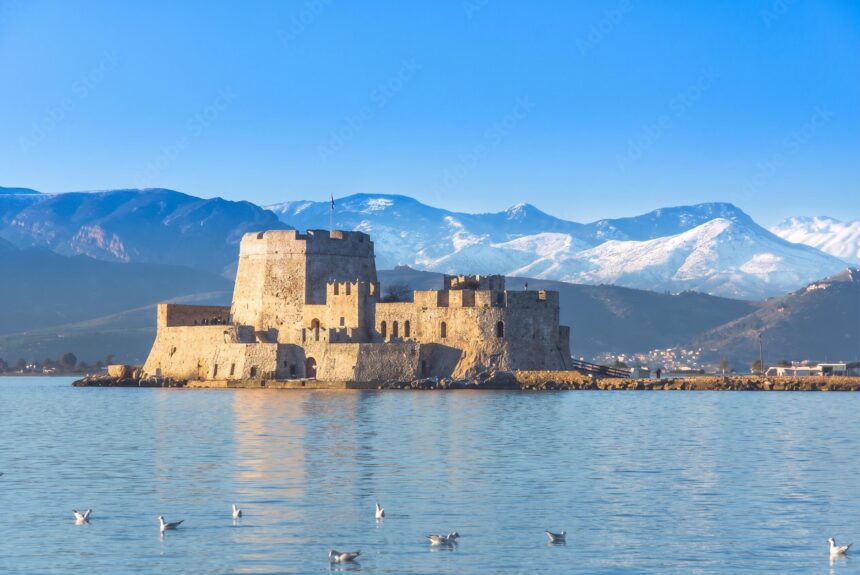
The Bourtzi is the small Venetian castle on an islet in the harbour, built in the 15th century to control the entrance to the port with a chain. It has served as a fortress, a home for executioners and briefly a hotel. After restoration it reopened to visitors in 2023, and small boats run the short crossing from the port in season. The trip itself is pleasant, but the real joy of the Bourtzi is looking at it from the waterfront at dusk, when it is lit up.
Day trips from Nafplio
Nafplio sits at the centre of one of the densest clusters of ancient sites in Greece, and none of the big ones is more than 40 minutes away by car. Having a car makes life much easier here; our guide to renting a car in Greece covers what you need.

Mycenae
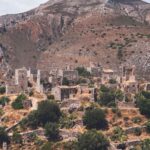
About 25 km north, Mycenae was the citadel of Agamemnon in Homer’s telling and the heart of the Late Bronze Age civilisation that takes its name. Walk through the Lion Gate, climb to the palace for the view over the Argolid plain, and do not miss the Treasury of Atreus, a beehive tomb a short way down the road with a stone dome that is still astonishing after more than 3,000 years. The site museum explains the finds; the famous gold mask is in Athens. Allow two to three hours and arrive at opening time in summer, as there is little shade.
Epidaurus
The sanctuary of Asklepios at Epidaurus, about 30 km east, was the most famous healing centre of the ancient world. Its 4th century BC theatre is the best preserved in Greece, with acoustics so good that a coin dropped in the orchestra can be heard from the upper rows. In July and August the theatre hosts the Epidaurus Festival of ancient drama, which is one of the great experiences of a Greek summer if your dates line up.
Tiryns and Argos
Tiryns, just 5 km from Nafplio, is a Mycenaean citadel famous for its massive Cyclopean walls and quieter than Mycenae. Both sites are listed together by UNESCO. Argos, a few kilometres further, has an ancient theatre and a lively market town feel. Combine them into a half day.
Nemea and the coast
Wine lovers should head to Nemea, about 45 minutes north, where the Agiorgitiko grape makes some of Greece’s best red wines and many wineries welcome visitors. For beaches, the coast south of Tolo and around the Porto Heli area is a good escape on hot afternoons.
Where to eat and stay
Staikopoulou street is lined with tavernas aimed squarely at visitors; some are good, many are average. Walk a little further for better value, or look for places in the side lanes near the Agios Spyridon church and towards the Pronia neighbourhood. Order local dishes such as gogges (small hand-rolled pasta with tomato and cheese), grilled fish from the Argolic Gulf and oranges from the surrounding plain in season. For dessert, Nafplio is known for its ice cream shops on the waterfront and in Syntagma Square.
The old town has dozens of small boutique hotels in restored mansions, which are the most atmospheric choice but often involve steps and no car access. Pronia, just outside the old town, is easier with a car. Many visitors also stay in Tolo, a beach resort 10 km away, but you lose the evening walks that make Nafplio special.
How to combine Nafplio with other places
Nafplio is the natural first stop on a Peloponnese road trip. From here many travellers head south to the rock town of Monemvasia, about two and a half hours away, then west to Ancient Olympia. Others pair it with a visit to Delphi on a mainland loop from the capital. If you are flying in, spend a couple of days in the capital first; our Athens travel guide and our list of things to do in Athens will help you plan.
Practical tips
- Parking: the old town is largely pedestrian. Use the large car park by the port and walk in.
- Weekends: Nafplio is a favourite weekend break for Athenians, so Friday and Saturday nights fill up and prices rise. Midweek is calmer.
- Heat: Palamidi and Mycenae are exposed. Visit early or late in summer and carry water.
- Swimming: Arvanitia is pebbly and close; Karathona is sandy and better for children.
- Winter: unlike island resorts, Nafplio stays open all year, with cafés, restaurants and hotels working through the winter.
- Bus travel: buses connect Nafplio with Athens, Argos, Mycenae (limited) and Epidaurus, but frequencies are low on Sundays and out of season, so check timetables in advance.
Nafplio rewards slow travel. Walk the lanes in the late afternoon, climb Palamidi early, eat by the harbour, and use the town as a base for the ancient sites around it. Few places in Greece combine history, good food and an easy pace so well.
Frequently Asked Questions
How many days do you need in Nafplio?
Two nights is enough for the old town, Palamidi and the Arvanitia walk. Add a third night if you want to visit Mycenae and Epidaurus without rushing. Many people also do Nafplio as a long day trip from Athens, but you miss the evenings.
How do you get from Athens to Nafplio?
By car it is about 140 km and roughly two hours via the Corinth Canal and Argos. KTEL Argolida buses run from the Kifissos bus terminal in Athens several times a day. There is no train.
Are there really 999 steps to Palamidi?
No, the real count is around 860, but the name stuck. The climb is steep and exposed, so go early in the morning with water, or take a taxi to the upper entrance and walk down.
Is Nafplio worth visiting in winter?
Yes. Nafplio is a working town, so hotels, cafés and tavernas stay open all year, and it is a popular winter weekend break for Athenians. Fortress and site hours are shorter from November to March.
Can you swim in Nafplio?
Yes. Arvanitia is a pebbly beach a short walk from the old town, and Karathona, about 3 km away, is a long sandy beach that suits families.