



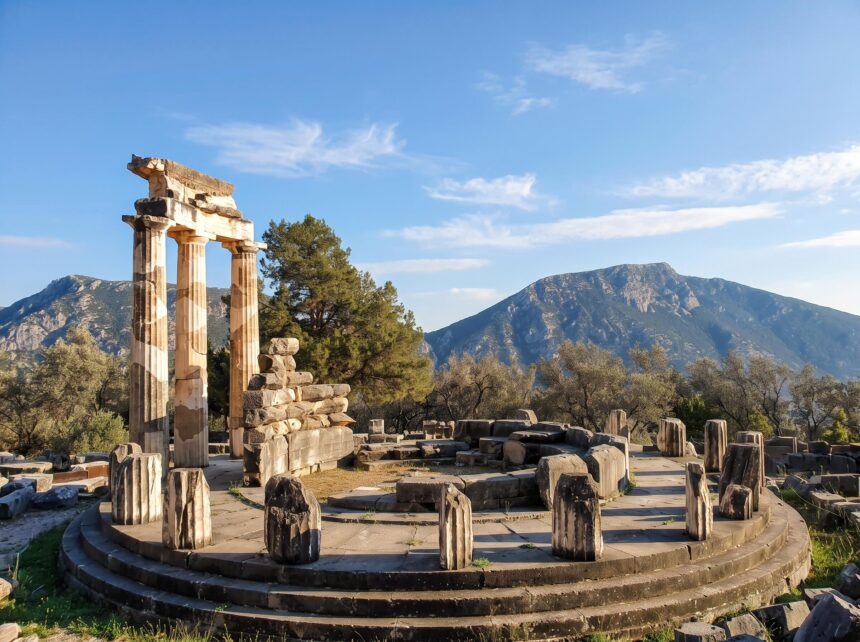
Delphi is a UNESCO-listed sanctuary of Apollo about 180 km northwest of Athens. Allow at least half a day for the site and museum, arrive at opening time, and consider staying overnight in the modern village or in Arachova.
Delphi is the most atmospheric ancient site in mainland Greece and an easy trip from Athens: a sanctuary of Apollo stacked in terraces on the slopes of Mount Parnassus, looking down a gorge to an unbroken sea of olive trees and the Gulf of Corinth. You can see it as a long day trip, but the best way to experience Delphi is to sleep nearby, walk in at opening time and give the excellent museum the attention it deserves.
Quick facts
- Where: about 180 km northwest of Athens, in the region of Phocis, on the southern slopes of Parnassus at around 500 to 600 metres above sea level.
- Getting there: roughly two and a half hours by car from Athens, or around three hours by KTEL intercity bus.
- Tickets: around 20 euros in 2026 for the combined archaeological site and museum ticket; check before you go.
- Hours: in 2026 around 08:00 to 20:00 from April to October and 08:30 to 15:30 from November to March, with last entry 20 minutes before closing.
- Time needed: three to four hours for the site and museum; a full day with the Athena Pronaia sanctuary and a meal.
- Good for: history lovers, families with older children, walkers and anyone combining Athens with the mainland.
Why Delphi matters
For more than a thousand years Delphi was where the Greek world came for answers. According to myth, Zeus released two eagles from opposite ends of the earth and they met here, which made Delphi the omphalos, the navel of the world. Apollo claimed the place by killing the serpent Python, and his priestess, the Pythia, delivered the god’s pronouncements from inside the temple. City states asked whether to go to war or found a colony; private individuals asked about marriage, debt and journeys. The famously ambiguous answers were interpreted by the priests, and the gifts sent in gratitude filled the sanctuary with treasuries, statues and monuments.
Delphi also hosted the Pythian Games, held every four years in honour of Apollo and second only to the Olympic Games in prestige, with musical as well as athletic contests. The sanctuary declined under Roman rule and closed with the end of pagan cults in the late fourth century AD. A village later grew over the ruins, and it was moved to its present position when French archaeologists began the large-scale excavation in the 1890s. The site was inscribed as a UNESCO World Heritage Site in 1987.
The Sanctuary of Apollo
The main site is a single path that zigzags uphill, so the order of the visit is set for you. It is steep, mostly unshaded and paved with uneven ancient stone, which is why the early morning is so much better than midday.

The Sacred Way and the treasuries
You enter at the bottom through the Roman agora and follow the Sacred Way, which was once lined with monuments paid for by rival cities, each trying to outdo the others. The highlight is the Treasury of the Athenians, a small Doric building put back together by French archaeologists in the early twentieth century from its original blocks. Look closely at its walls and you will see inscriptions, including hymns to Apollo with musical notation. Nearby are the Rock of the Sibyl, the Athenian Stoa and the polygonal retaining wall, its stones fitted together like a jigsaw and covered in inscriptions recording the freeing of slaves.
The Temple of Apollo
The sacred path brings you to the Temple of Apollo, the heart of the sanctuary. What you see today are the foundations and a few re-erected columns of the fourth century BC temple, built after earlier versions were destroyed by fire and earthquake. This is where the Pythia sat, and where the maxims “Know thyself” and “Nothing in excess” were said to be inscribed. Visitors are kept to the path around it, but the scale of the platform and the view down the valley explain the sense of awe much better than any reconstruction.
The theatre and the stadium
Above the temple sits the theatre, which seated around 5,000 people for the musical contests of the Pythian Games. Its upper rows are the classic photo spot, with the temple below and the Pleistos valley beyond. Higher still, and a stiff climb away, is the stadium, one of the best preserved in Greece, with stone seating along one side. Access to the upper part of the site has been restricted at times for safety reasons connected with falling rocks, so check on the day whether the stadium path is open.
The Delphi Archaeological Museum
Do not treat the museum as an afterthought. It is one of the best in Greece and is included in the same ticket. The star is the Charioteer of Delphi, a life-size bronze from the fifth century BC that survived because it was buried by a landslide. Its glass and stone eyes, the folds of the robe and the copper eyelashes are still astonishing. Other highlights include the Sphinx of the Naxians on its tall Ionic column, the archaic twin statues known as Kleobis and Biton, the marble omphalos, the Dancers column with its acanthus leaves, the remains of a silver bull and gold and ivory statues, and the polished Roman statue of Antinous.
A sensible plan is to visit the site first while it is cool and the museum afterwards, when the heat makes indoor rooms welcome. If you arrive later in the day, reverse the order.
Athena Pronaia and the Castalian Spring
A short walk east along the road towards Arachova takes you to the Castalian Spring, where pilgrims purified themselves before consulting the oracle. Below the road lies the Sanctuary of Athena Pronaia, home to the tholos, a circular building of the fourth century BC whose three re-erected columns are the most photographed sight at Delphi after the theatre. It is quieter than the main site and best visited in the late afternoon light. Keep to the pavement on the road, which carries fast traffic.


Getting to Delphi
By car, the drive from Athens takes around two and a half hours via the motorway towards Thebes and then the mountain road through Livadia and Arachova. The last section winds but is in good condition. There is parking along the road by the museum and the site, which fills by mid morning in summer. Our guide to renting a car in Greece covers insurance, licences and the rules of the road.
By bus, KTEL services run from the Liosion intercity terminal in Athens to modern Delphi in around three hours, with a handful of departures a day. The bus stops in the village, from where the museum is a ten-minute walk. Timetables change by season, so confirm them with the bus company before you plan a day trip.
Organised day trips from Athens are the easiest option if you do not want to drive, but they arrive in the middle of the day with everyone else. If Delphi is a priority, build it into a few days on the mainland, combining it with a stay in Athens at one end and the monasteries of Meteora further north, which are about four hours’ drive away.
Where to stay
The modern village of Delphi is small and practical, with family-run hotels along two parallel streets, many with balconies overlooking the olive groves and the gulf at Itea. It is quiet in the evening once the coaches have gone, which is exactly the point. Arachova, around 11 km east, is livelier and more upmarket, a stone mountain town that fills with Athenians in winter for the Parnassos ski centre. On the coast, Galaxidi is a handsome former sea captains’ town about 30 km away, good for an evening by the harbour.
Combining Delphi with other sights
The Monastery of Hosios Loukas, another UNESCO site with remarkable eleventh century mosaics, is about an hour’s drive southeast near Distomo and fits well on the way to or from Athens. Walkers can follow old paths on Parnassus, including the route up to the Corycian Cave, sacred to Pan and the nymphs. Heading south, the Rio to Antirrio bridge crosses the Gulf of Corinth into the Peloponnese, which makes Delphi a natural first stop on a route to Ancient Olympia and on to Nafplio. If you have already been to the Acropolis in Athens, Delphi is a fine counterpoint: smaller monuments, a far more dramatic setting.
Practical tips
- Go early: be at the gate for opening time. Day-trip coaches from Athens usually arrive from around 10:30 to 11:00, and the steep climb in midday heat from June to September is hard work.
- Check the season: winter hours apply from 1 November, so in the colder months you have until mid afternoon only. Last entry is 20 minutes before closing.
- Tickets: the combined ticket was around 20 euros in 2026. EU citizens under 25 enter free and some dates in the year are free for all, but rules change, so check the official ticketing site or call the museum before travelling.
- What to wear: shoes with grip, a hat and water. Ancient marble is slippery and there are no cafés inside the site, although there is one at the museum.
- Guides: licensed guides offer tours at the entrance, and an hour with one makes the inscriptions and ruins far easier to read.
- Weather: Delphi is cooler than Athens and Parnassus can see snow in winter. Spring, with wildflowers among the stones, and October are the best months.
Visiting Delphi on a weekday early in the morning, before the crowds arrive and while the light is still soft on the mountain, is one of the great experiences of travelling in Greece. Give it the time and it repays you many times over.
Frequently Asked Questions
How much does it cost to visit Delphi?
In 2026 the combined ticket for the archaeological site and museum was around 20 euros. EU citizens under 25 enter free and there are some free days each year. Prices and concessions change, so check the official ticketing website before you go.
Can you do Delphi as a day trip from Athens?
Yes. It is around two and a half hours each way by car and about three hours by KTEL bus, so a day trip is realistic. Staying one night in Delphi or Arachova lets you visit early or late, when it is cooler and quieter.
How long do you need at Delphi?
Allow three to four hours for the Sanctuary of Apollo and the museum. Add an hour for the Castalian Spring and the Sanctuary of Athena Pronaia with its circular tholos.
What is the best time of day to visit Delphi?
Opening time is best, before the coach tours arrive and before the heat builds. The site is steep and has little shade. Late afternoon is also pleasant in spring and autumn.
Is the Delphi museum worth it?
Absolutely. It is included in the ticket and holds the bronze Charioteer of Delphi, the Sphinx of the Naxians and many finds from the treasuries. Plan at least an hour for it.