


Folegandros is a small, quiet Cycladic island reached only by ferry; stay three to five days for the cliff-top Chora, the Panagia sunset walk, coves like Katergo and the walking paths.
Folegandros is a small, rugged island in the south-western Cyclades, between Milos and Sikinos, with a cliff-top Chora that is among the most beautiful villages in the Aegean. It has no airport, no big resorts and only a handful of roads, which is exactly its appeal. Come for walking, swimming in clear coves reached by path or small boat, slow dinners in the village squares, and sunsets from the church of Panagia. Three to five days is the right length of stay.
Quick facts
- Where: south-western Cyclades, between Milos, Sikinos and Santorini.
- Getting there: ferry only, from Piraeus (roughly 4.5 to 10 hours depending on the boat) or from nearby Cycladic islands.
- Main settlements: Karavostasis (the port), Chora, Ano Meria and the beach village of Agali.
- Time needed: three days for the highlights, five for a proper slow stay with walks.
- Best time: late May to June and September to early October.
- Good for: couples, walkers, island hoppers who want a quiet stop and travellers avoiding big crowds.
Why Folegandros
Folegandros sits close to Santorini and Milos but feels a world away from both. It has fewer than a thousand year-round residents, a dry landscape of terraced hills, stone walls and chapels, and a coastline of high cliffs broken by small bays. There is no airport and little organised tourism, so even in August the island feels busy rather than overwhelmed. It is pretty but not polished, and services are basic outside Chora. If you want lively nightlife, long sandy beaches with water sports or big hotels, look at islands such as Paros or Naxos instead.
Chora and the Kastro
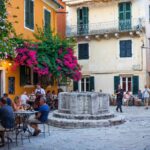
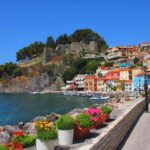
Chora, the main village, stands on the edge of a cliff about 200 metres above the sea. Its centre is a chain of connected squares, the best known being Piatsa, shaded by trees and lined with tavernas, cafés and bougainvillea. In the evening, the whole island seems to gather here.
The oldest part of Chora is the Kastro, a fortified neighbourhood built in the 13th century during the Venetian period to protect the islanders from pirates. The houses were built side by side so that their outer walls formed the defensive wall, with only a few entrances. Inside are narrow lanes and houses with external wooden staircases and balconies, still lived in today. The cliff-side viewpoints at the edge of the village look straight down to the sea.
The church of Panagia
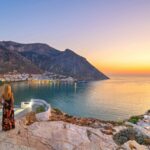
Above Chora, on a rocky hill, stands the church of the Panagia (the Virgin Mary), the island’s largest church. A zigzag stone path climbs to it in about 15 to 20 minutes, and the view back over Chora and the cliffs at sunset is the island’s signature sight. The church is thought to stand on the site of an ancient temple, and ancient fragments are built into it. The climb is worthwhile any evening. Take a torch for the walk down after dark.
Ano Meria
Ano Meria is the island’s farming village, a long string of houses, threshing floors and chapels spread along the ridge in the north-west. It feels very different from Chora: quieter, rural and more lived in. Several tavernas here are known for traditional cooking, and the small folklore museum, housed in a traditional farmhouse, shows how island families lived, with an oven, stable and tools. Opening is seasonal and limited, so check locally. Ano Meria is also the start of several of the island’s best walks.

Beaches
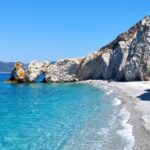
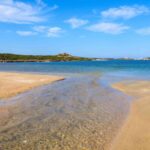
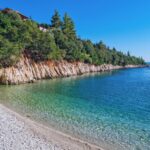
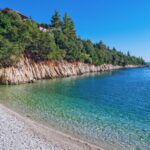
Folegandros’s beaches are mostly small, pebbly and undeveloped, and several can only be reached on foot or by boat. That is part of their charm. Carry water, food and shade, because many have no facilities.
- Katergo: the island’s most famous beach, a pebble bay with very clear water at the south-east tip. Reach it by small boat from Karavostasis or by a hot, exposed walk of 20 to 30 minutes from near Livadi. There is no shade.
- Agali: the island’s beach village, reached by road, with tavernas, rooms and small boats to other beaches.
- Agios Nikolaos: a larger bay with tamarisk trees, reached on foot from Agali along a coastal path in around 15 to 20 minutes, or by boat.
- Galifos: a small pebble cove close to Agali, reached on foot, good for snorkelling.
- Livadaki: a beautiful cove on the north-west coast, reached by boat from Agali or by a steep walk of about an hour from Ano Meria.
- Vardia, Chochlidia and Livadi: easy beaches near the port, useful on arrival or departure days. Vardia is exposed to the north wind.
- Agios Georgios and Ampeli: more remote northern beaches reached by path from Ano Meria.
If you want more choice of beaches nearby, the beaches of Milos are a short ferry hop away and very different: volcanic rock, sand and dramatic colours.
Walking on Folegandros
Walking is one of the best reasons to come. The island has a network of marked trails along old paths, mainly radiating from Chora and Ano Meria. Popular routes include Chora to Agali, Ano Meria to Agali via Agios Nikolaos beach, Ano Meria to the northern beaches, and a loop from Ano Meria past Livadaki to the Aspropounta lighthouse, in operation since 1919. Paths are rocky and largely shadeless: walk early in the morning or late in the afternoon, carry plenty of water and avoid the meltemi days when the wind is fierce on exposed ridges.
Chrysospilia cave
Chrysospilia, the golden cave, is a large sea cave on the north-east coast with ancient inscriptions and finds inside. It can only be approached by sea in calm weather, and visits have been restricted in recent years, so do not plan your trip around getting inside. Boat tours around the island sometimes pass by the entrance.
Food
Folegandros has a strong food identity for a small island. The dish to try is matsata, a handmade fresh pasta served with rooster, rabbit or goat in a tomato sauce, especially in Ano Meria. Another local speciality is kalasouna, a pie of local cheese and onion. Capers, goat, chickpeas slow-cooked in the oven, fava and local cheeses round out the menus. In Chora, an after-dinner rakomelo (raki warmed with honey) in one of the squares is a local habit.
Getting there and around
Ferries arrive at Karavostasis. From Piraeus the journey takes around 4.5 to 10 hours depending on whether you take a fast boat or a conventional ferry with many stops. In summer there are links with Milos, Sifnos, Ios, Santorini and other Cyclades, which makes Folegandros an easy stop on an island-hopping route; see our guide to Greek ferries for how booking works. Out of season, connections are less frequent and can be cancelled in strong winds, so leave a buffer day before an international flight.
On the island, a local bus links the port with Chora, Agali and Ano Meria, timed around ferry arrivals in summer. Taxis are few, so book ahead at busy times. Many visitors rent a scooter, quad or small car for a day or two to reach the north; with walking and the bus you can manage without one.
Where to stay
- Chora: the most atmospheric base, with restaurants and evening life on your doorstep. Some places are on the cliff edge with sea views.
- Karavostasis: practical for ferries and the nearby beaches, quieter in the evening.
- Agali: for a simple beach stay with boats to the western coves.
- Ano Meria: for peace, walking and village tavernas, but you will want transport.
Practical tips
- Book early for summer: accommodation is limited and the island fills up in July and August.
- Bring cash: there are only a few ATMs, and they can run low in high season.
- Pack for the wind: the meltemi blows strongly in July and August; it can cancel small boats to the beaches and fast ferries.
- Carry water on walks and beach trips: many beaches and paths have no shops or shade.
- Combine wisely: Folegandros pairs well with Milos or Santorini. Read our Santorini travel guide if you plan to arrive or leave that way.
Frequently Asked Questions
How many days do you need in Folegandros?
Three days covers Chora, the Panagia walk and a couple of beaches. Five days lets you settle into the slow pace, walk the trails from Ano Meria and visit the boat-access beaches.
How do you get to Folegandros?
Only by ferry, as there is no airport. Boats from Piraeus take roughly 4.5 to 10 hours, and in summer there are connections with Milos, Sifnos, Ios and Santorini.
Do you need a car in Folegandros?
Not necessarily. A bus links the port, Chora, Agali and Ano Meria in summer, and many beaches are reached on foot or by boat. A scooter or car for a day helps to explore the north.
What is the best beach in Folegandros?
Katergo is the most famous, a pebble bay with very clear water reached by boat from Karavostasis or on foot. Agios Nikolaos and Livadaki are also popular and reached by path or boat from Agali.
Is Folegandros good for couples?
Yes. It is quiet, romantic and built around evening walks, sunsets from the Panagia church and dinners in Chora’s squares. It suits couples more than travellers looking for nightlife.