


Paros is best explored over four or five days: Parikia's old town and Ekatontapiliani, Naoussa's harbour, the Byzantine path from Lefkes, the east coast beaches and a day trip to Antiparos.
Paros is one of the easiest and most balanced islands in the Cyclades: a busy but likeable port town in Parikia, a picture-perfect fishing harbour at Naoussa, inland marble villages joined by an old stone path, and a coastline of sandy beaches with some of the best windsurfing in Greece. It is central in the ferry network, well served by buses and less expensive than Mykonos or Santorini, although Naoussa has become fashionable and busy in high summer. Four or five days lets you see it properly and add a day trip to Antiparos.
Quick facts
- Best time: late May to June and September to early October.
- Getting there: ferries from Piraeus, Rafina or Lavrio, roughly 3 hours on fast boats and 4 hours or more on conventional ones; short flights from Athens.
- Time needed: 4 to 5 days, including a day on Antiparos.
- Main bases: Parikia for convenience, Naoussa for atmosphere, the east coast for beaches.
- Good for: first-time island hoppers, families, walkers and windsurfers.
Parikia: the capital and port
Parikia is where most ferries arrive, and many visitors rush straight through. That is a mistake, because the old town behind the waterfront is one of the most attractive in the Cyclades, with marble-paved lanes, flowered balconies and small churches. Its great monument is the Church of Panagia Ekatontapiliani, the Church of a Hundred Doors, a few minutes from the port. Tradition links its foundation to Saint Helen, mother of Constantine the Great, in the 4th century, and it was rebuilt with a dome under the emperor Justinian in the 6th century. Its baptistery, with a cross-shaped font, is considered among the oldest and best preserved in Greece, and a small ecclesiastical museum is attached.
Walk on through the old town to the Kastro, the 13th century castle built by the Venetian rulers of the island. Its surviving wall is a striking patchwork of ancient marble blocks and column drums taken from earlier temples. The Archaeological Museum behind Ekatontapiliani holds finds from ancient Paros, including a fragment of the Parian Chronicle, an inscribed marble chronology of Greek history. In the evening, the waterfront west of the port fills with bars and restaurants facing the sunset.
Naoussa: the postcard harbour
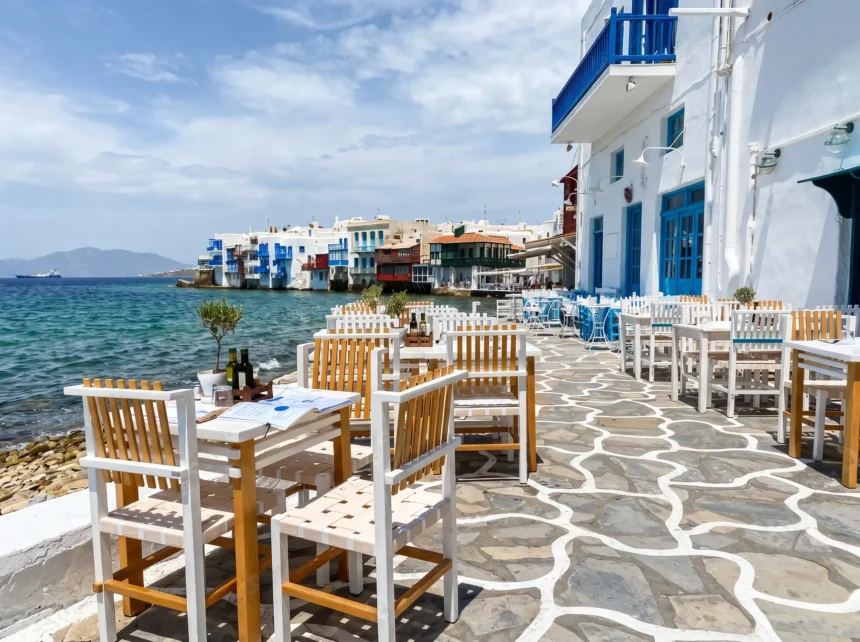
On the north coast, Naoussa grew from a fishing village into the island’s most stylish resort. Its little harbour, with fishing boats moored beneath the half-submerged ruins of a Venetian fortress, is genuinely charming, and the lanes behind are full of good restaurants, cafés and boutiques. In July and August it becomes crowded and prices are high, especially in the evenings, but in June or September it is delightful. Naoussa is also the base for boat trips to the beaches of the north coast.
Nearby beaches include Kolymbithres, known for its smooth, sculpted granite rocks forming small pools, and Monastiri, a sheltered bay below a white chapel. Both are popular and fill up quickly in summer.
The villages and the Byzantine path
Inland Paros is hilly and quiet. Lefkes, the former capital, sits in a green hollow beneath the hills, with marble-paved lanes, an imposing church of Agia Triada, a folk museum and tavernas on its small squares. From the edge of the village, the old Byzantine path, paved with large marble slabs, descends about 3.5 km to Prodromos, a walk of around an hour to an hour and a half. You can continue to Marpissa, perched below the windmills on Kefalos hill, and on to the coast at Piso Livadi. Buses link these villages with Parikia, so you can walk one way and ride back. Start early in summer, as the path has little shade, and wear shoes with grip, since the marble is slippery.
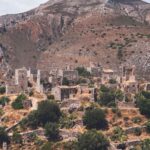
Other villages worth a stop are Marathi, beside the ancient quarries that produced Parian marble, prized by classical sculptors for its translucency; Kostos and Agios Georgios, with their traditional tavernas; and Prodromos itself, a fortified village with narrow lanes and a peaceful atmosphere.
Beaches and water sports
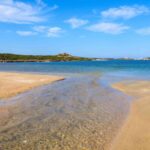
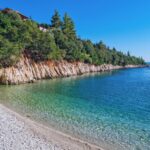
Paros has a beach for most conditions. On the east coast, Golden Beach (Chrysi Akti) and New Golden Beach are long sandy stretches famous for windsurfing in the meltemi season; Logaras and Piso Livadi are calmer and good for families; Molos and Kalogeros are quieter. In the south, Pounda is a centre for kitesurfing and also has a lively beach club, while Santa Maria on the northeast tip is sandy and sheltered on most days. Near Parikia, Krios and Martselo are reached by a small boat across the bay.
The Petaloudes valley, south of Parikia, is a green oasis where, in early summer, thousands of moths gather on the trees. It makes a short stop on the way to the southern beaches.
Day trip to Antiparos
The small island of Antiparos lies just off the west coast. A car ferry crosses from Pounda in around 7 minutes several times a day all year, and in season small passenger boats run from Parikia in about half an hour. Antiparos has a relaxed main village with a little Venetian castle, good beaches and a large cave in the hills, decorated with stalactites and stalagmites, which can be visited in season. Many visitors spend a day; others stay a few nights for a slower pace.
Getting there and getting around
Parikia is one of the busiest ferry ports in the Cyclades, with frequent sailings from Piraeus and Rafina and links to almost every neighbouring island. Naxos, just to the east, is often under an hour away, which makes the two islands easy to combine. busy Mykonos and volcanic Santorini are also direct connections in summer, and the beaches of Milos are reachable on western Cyclades routes. Our Greek ferry guide explains how to choose and book. The island’s airport, in the southwest, about 10 km from Parikia, has flights from Athens; a long-delayed runway extension is intended to allow larger aircraft.
KTEL buses run from Parikia to Naoussa, Lefkes, the east coast beaches and Pounda, with good frequency in summer. A car or scooter is useful for exploring villages and quieter beaches; our article on renting a car in Greece covers licences and insurance. Parking in Naoussa is tight in summer, so use the edge-of-town car parks.
Where to stay
- Parikia: practical, close to the port and bus station, with a real town feel and good-value rooms.
- Naoussa: the most atmospheric base, with the best dining, but busy and more expensive in summer.
- Lefkes and the villages: peaceful, cooler evenings, best with a car.
- Piso Livadi, Logaras and Golden Beach: beach holidays on the east coast, good for windsurfers and families.
Food and drink
Look for gouna (sun-dried mackerel grilled over charcoal), revithada (chickpeas slow-baked in a clay pot), local cheeses such as graviera and xinomizithra, and souma, a local spirit distilled from grape pomace. The island also has a winemaking tradition, with local grape varieties such as Monemvasia and Mandilaria. Fish tavernas line the harbour at Naoussa and the waterfront at Piso Livadi.
Practical tips
- Visit Naoussa in the morning or out of season for a calmer experience; in high summer, book dinner in advance.
- The meltemi wind blows strongly in July and August; choose sheltered beaches on the west and south coasts on windy days.
- Walk the Byzantine path from Lefkes downhill rather than uphill, and check bus times for the return.
- Buy tickets for the Pounda to Antiparos ferry at the port; bring some cash.
- Around 15 August, the island fills for the great festival of Ekatontapiliani, so book ahead if you are visiting then.
Frequently Asked Questions
Is Parikia or Naoussa better to stay in?
Parikia is more practical, with the ferry port, bus station and better-value rooms. Naoussa is prettier, with the best restaurants, but busier and more expensive in summer. With a car, either works well.
How many days do you need in Paros?
Four to five days is ideal for Parikia, Naoussa, the villages, a couple of beach days and a trip to Antiparos. Three days covers the main highlights at a faster pace.
How do you get from Paros to Antiparos?
A car ferry crosses from Pounda, on the west coast, in about 7 minutes several times a day all year. In season, small passenger boats also run from Parikia in about half an hour.
Is Paros good for families?
Yes. The island has many sandy, shallow beaches, frequent buses and a relaxed atmosphere. Logaras, Piso Livadi and Santa Maria are good choices for young children on calmer days.
Can you combine Paros and Naxos?
Easily. The two islands are neighbours with frequent ferries in season, often taking under an hour, and they make one of the best island hopping pairs in the Cyclades.