


Thessaloniki is Greece's second city, with Roman and UNESCO listed Byzantine monuments, an Ottoman upper town and an excellent food scene. Two to three days covers the White Tower, Rotunda, Ano Poli and markets, plus a day trip.
Thessaloniki is Greece’s second city and, for many travellers, its most enjoyable one: a seafront university town with Roman ruins, Byzantine churches listed by UNESCO, an Ottoman upper town and the best food scene in the country. Three days is enough to see the highlights, eat very well and take a day trip to Vergina or the beaches of Halkidiki. It is a real, working city rather than a resort, which is exactly its appeal.
Quick facts
- Where: Central Macedonia, northern Greece, on the Thermaic Gulf.
- Getting there: flights to Thessaloniki Makedonia airport, trains from Athens (around 4 hours 30 minutes in recent years), or a drive of about 500 km on the motorway.
- Time needed: 2 to 3 days in the city, more with day trips.
- Best time: April to June and September to November; summers are hot and humid.
- Good for: food lovers, history and architecture, city breaks, nightlife.
A city of layers
Founded in 315 BC by King Cassander and named after his wife Thessalonike, a half sister of Alexander the Great, the city grew into a major Roman centre on the Via Egnatia and later the second city of the Byzantine Empire. It was Ottoman from 1430 until 1912, and for centuries it was home to one of the largest Sephardic Jewish communities in the world, which arrived after the expulsion from Spain in 1492. Most of that community was deported and murdered in 1943. A great fire in 1917 destroyed much of the centre, which was rebuilt to a plan by the French architect Ernest Hébrard; that is why central Thessaloniki has wide, straight avenues and Aristotelous Square sweeping down to the sea.
You feel all of these layers within a short walk. A Roman palace sits beside a modern bakery, an Ottoman bathhouse faces a 1930s apartment block, and Byzantine churches are tucked between cafés.
What to see
The waterfront and the White Tower
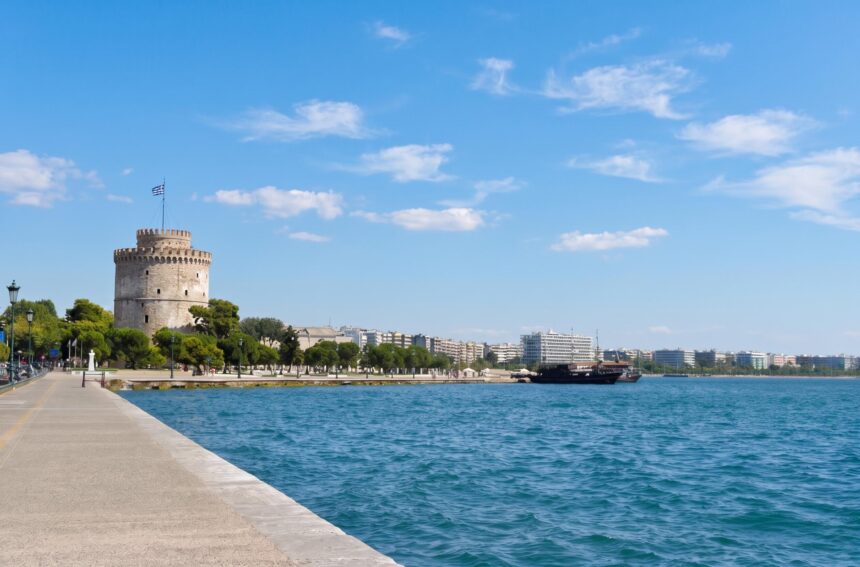
The seafront promenade, the Nea Paralia, runs for several kilometres from the port past the White Tower to the Concert Hall, with gardens, cycle paths and the much photographed Umbrellas sculpture by George Zongolopoulos. The White Tower itself, a 15th century Ottoman fortification that was once a prison, is the city’s symbol and now holds a well designed museum about Thessaloniki’s history. Climb to the top for the view along the bay. In 2026 its opening hours were extended to 21:00 daily from August to the start of November, which makes it a good early evening visit.
Roman Thessaloniki: the Rotunda, the Arch and the Palace
Around 300 AD the Roman emperor Galerius built a palace complex in the heart of the city. Three parts survive. The Arch of Galerius, known locally as the Kamara, is covered in carved reliefs of his campaigns against the Persians and is the city’s favourite meeting point. Just uphill, the Rotunda is a massive round brick building that has been a temple or mausoleum, a church and a mosque (its minaret still stands); inside, fragments of early Christian mosaics glitter in the dome. Downhill, the excavated remains of the Palace of Galerius sit in Navarinou Square among the cafés.
The UNESCO Byzantine churches
Fifteen early Christian and Byzantine monuments in the city are listed together by UNESCO, and several are worth seeking out. Agios Dimitrios, dedicated to the city’s patron saint, is a huge basilica with a crypt built over Roman baths. Agia Sofia, an 8th century church with a superb mosaic of the Ascension in its dome, shares its name with, and loosely echoes, the great church in Istanbul. Smaller gems include Osios David, with a rare early mosaic of Christ, and the 14th century Agios Nikolaos Orfanos with its fine frescoes. Entry to working churches is free; dress modestly.
Ano Poli, the upper town
Ano Poli survived the 1917 fire, so it is the place to see old Thessaloniki: steep cobbled lanes, timber framed houses with overhanging upper floors, and the long Byzantine walls. Walk up to the Heptapyrgio (Yedi Kule), a Byzantine and Ottoman fortress that served as a notorious prison until 1989, then follow the walls to the Trigonion tower for the classic sunset view over the whole city and the gulf. Taxis up and a slow walk down is the easy way to do it.
Museums
The Archaeological Museum is one of the best in Greece, with gold from ancient Macedonian tombs and the Derveni Krater, an extraordinary bronze vessel. Next door, the Museum of Byzantine Culture is beautifully laid out and covers daily life as well as icons. The Jewish Museum on Agiou Mina street tells the story of the Sephardic community, and the house where Mustafa Kemal Atatürk was born in 1881 is open as a museum next to the Turkish consulate.
What to eat
Greeks themselves come to Thessaloniki to eat. Breakfast is bougatsa, flaky filo filled with semolina cream, cheese or minced meat, eaten with a coffee, or a sesame koulouri bought from a street seller. Lunch can be meze and ouzo or tsipouro in Ladadika, the restored warehouse district by the port, or grilled sardines and mussels near the markets. Save room for trigona Panoramatos, cone shaped filo pastries filled with custard cream. Our guide to Thessaloniki food goes into the dishes and the best areas in detail.
The markets
The Kapani market (also called Vlali) between Aristotelous and Venizelou streets is the best place to see the city’s appetite at work: butchers, fishmongers, spice sellers, olive stalls and small ouzeris crammed into the lanes. The neighbouring Modiano market, a covered market built in the 1920s, has been restored and reopened with a mix of food stalls and restaurants.
Nightlife and neighbourhoods
Thessaloniki has a large student population, so evenings start late and run late. Ladadika is lively and somewhat touristy. Valaoritou and the streets around it are where the city’s bars cluster. The Bit Bazaar, a small square of old shops near Agias Sofias, is pleasant for drinks and meze in the evening. For a quieter evening, walk the Nea Paralia at sunset with an ice cream, as half the city does.
Getting around
The centre is compact and walkable, and the main sights lie between the waterfront and Ano Poli. The new metro opened at the end of 2024 and was extended to Kalamaria in August 2026, linking the main railway station with the centre and the eastern districts. City buses (OASTH) cover the rest. From the airport, the X1 bus runs to the centre and the KTEL coach terminal in around 40 to 50 minutes, with a single fare of around 2 euros in 2026; taxis are available around the clock.
Day trips from Thessaloniki
- Vergina (Aigai): about 75 km west, the royal tombs of the Macedonian kings, including that attributed to Philip II, father of Alexander the Great. The underground museum is one of the most powerful archaeological experiences in Greece.
- Pella: the birthplace of Alexander, with fine pebble mosaics and a good museum, about 40 km west.
- Halkidiki: about an hour to the first beaches. See our guide to the best beaches in Halkidiki.
- Mount Olympus and Dion: the ancient sanctuary of Dion lies at the foot of Greece’s highest mountain, about an hour and a half south. Hikers should read our Mount Olympus hike guide.
- Edessa: waterfalls tumbling right through the town, about 90 km west.
Thessaloniki also makes a natural start to a northern loop. Many travellers drive west and south to the Meteora monasteries (around three hours) before heading on to Athens. If you plan to do that, our guide to renting a car in Greece is worth reading first.
Practical tips
- Where to stay: the area between Aristotelous Square and the Arch of Galerius is the most convenient. Ladadika is lively but noisy at night.
- Timing: the city hosts the Thessaloniki International Fair in September and its International Film Festival in November, when hotels fill up.
- Heat: July and August are hot and humid, and many locals leave for Halkidiki. Spring and autumn are better for walking.
- Driving: you do not need a car in the city, and parking is difficult. Rent one only for day trips.
- Prices: eating out is noticeably cheaper than on the islands or in central Athens.
- Coming from Athens: combine both cities; our Athens travel guide covers the other end of the trip.
Thessaloniki asks for a little more curiosity than the islands, but it gives a lot back: centuries of history at street level, a relaxed seafront and food good enough to plan a trip around.
Frequently Asked Questions
How many days do you need in Thessaloniki?
Two full days covers the waterfront, the Roman monuments, the main Byzantine churches, Ano Poli and the markets. Add a third day for a trip to Vergina, Pella or the beaches of Halkidiki.
Is Thessaloniki worth visiting?
Yes, especially for food, history and city life. It feels less touristy than Athens, prices are lower, and its UNESCO listed churches and Roman ruins are spread right through the centre.
How do you get from Thessaloniki airport to the city centre?
The X1 bus runs about every 30 minutes and takes 40 to 50 minutes to the centre, with a fare of around 2 euros in 2026. The N1 runs at night. Taxis wait outside arrivals at all hours.
Does Thessaloniki have a metro?
Yes. The first line opened at the end of 2024 and an extension to Kalamaria opened in August 2026. It links the railway station, the centre and the eastern districts.
Is Thessaloniki a beach destination?
Not really. The city faces the sea, but locals swim in Halkidiki, about an hour away. The nearest beaches around Perea and Agia Triada are fine for a quick dip.