


Knossos is the largest Minoan palace on Crete, 5 km south of Heraklion and reachable by city bus in about 20 minutes. An adult ticket costs around 20 euros in 2026; allow two hours and go early or late in the day.
Knossos is the largest Bronze Age palace on Crete, about 5 km south of central Heraklion, and the place most closely tied to King Minos, the Labyrinth and the Minotaur. Plan around two hours on site, arrive at opening time or in the late afternoon to avoid the heat and the tour groups, and pair it with the Heraklion Archaeological Museum, where the original frescoes and finds are kept. In 2026 an adult ticket costs around 20 euros, with the same price all year since the 2025 pricing reform; check before you go, as prices and hours change.
Quick facts
- Location: Knossos, about 5 km south of Heraklion city centre.
- Tickets: around 20 euros for adults in 2026, with free entry for children and young EU citizens under the national rules; buy on the official e-ticket platform or at the gate.
- Opening hours: long hours in the main season, roughly 08:00 to 20:00 in summer 2026, and shorter hours from November to March.
- Time needed: about 1.5 to 2.5 hours, more with a guide.
- Getting there: city bus from central Heraklion in about 20 minutes, taxi, or car with paid parking near the entrance.
- Good for: history lovers, families with older children, mythology fans.
Why Knossos matters
People lived on the Kefala hill at Knossos from the Neolithic period, thousands of years before the palace. The first palace rose around 1900 BC, was badly damaged around 1700 BC and rebuilt on an even grander scale. At its height it was the administrative, religious and economic heart of a large town, with storerooms, workshops, shrines and grand halls arranged around a central court. The site was finally destroyed in the 14th century BC, after which its memory survived mostly in myth.
In July 2025 Knossos was inscribed on the UNESCO World Heritage List as part of the Minoan Palatial Centres, together with Phaistos, Malia, Zakros, Zominthos and Kydonia. It is the flagship of that group and by far the most visited.
Myth: Minos, Daedalus and the Minotaur
Greek myth places the Labyrinth here. King Minos asked the craftsman Daedalus to build a maze to hold the Minotaur, the half bull, half man son of his queen Pasiphae. Athens had to send young men and women to be fed to it, until Theseus killed the beast with the help of Minos’ daughter Ariadne and her ball of thread. The maze of rooms and corridors at Knossos, and the double axe (labrys) carved on its stones, may explain how the story attached itself to the palace.
Evans and the concrete reconstructions
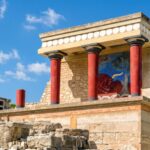
A local merchant, Minos Kalokairinos, made the first trial excavations in 1878. The large-scale dig began in 1900 under the British archaeologist Arthur Evans, who uncovered most of what you see today and coined the term “Minoan”. Evans then rebuilt parts of the palace in reinforced concrete, painting columns and adding replica frescoes. Purists criticise these restorations as guesswork, but they help visitors read the layout in a way that unrestored sites cannot. Simply remember that the brightest, most complete bits are 20th century interpretations.
What to see at Knossos
The site is not huge, but it is confusing, with several levels and many similar rooms. Following a rough loop helps.
The West Court and storage pits
You enter near the West Court, a paved open space crossed by raised walkways. Look for the large round pits, called kouloures, thought to have stored grain or held rubbish.
The South Propylaeum and the Procession fresco
A monumental gateway, partly rebuilt by Evans, with copies of the Procession fresco showing figures carrying vessels. It gives a sense of how the palace looked to visitors in Minoan times.
The Central Court
The heart of the palace, a long rectangular court around which every wing is arranged. Some scholars connect it with ceremonies and possibly the bull leaping shown in Minoan art.
The Throne Room
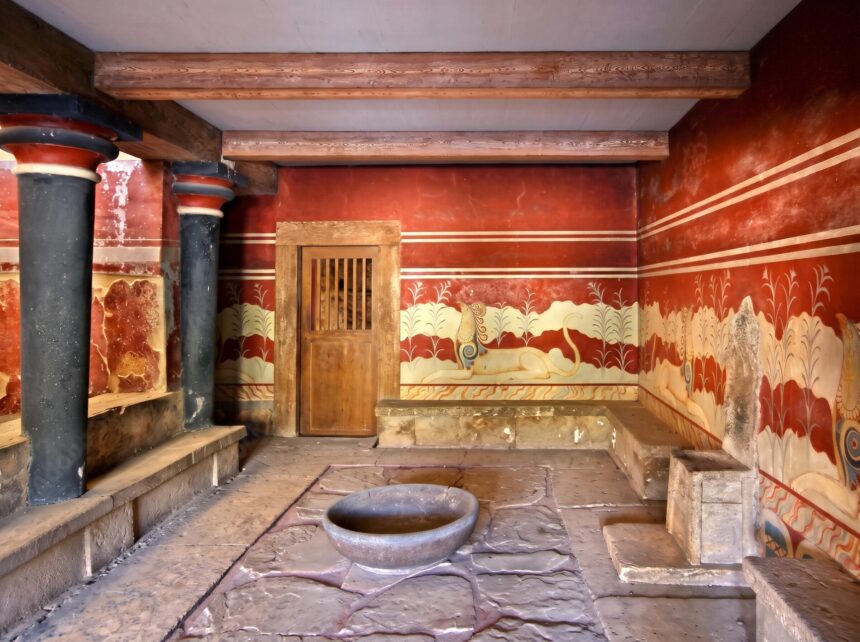
The most famous room at Knossos, with a gypsum throne set against a wall painted with griffins and stone benches along the sides. You view it from a doorway, and queues form here in high season. It is one of the oldest surviving throne rooms in Europe.
The Grand Staircase and the Royal Apartments
On the east side, a well-preserved staircase with light wells descends several storeys to the so-called Hall of the Double Axes and the Queen’s Megaron, decorated with a replica of the Dolphin fresco. Parts of this area may be closed for conservation, so access varies.
Storerooms and giant pithoi
Long magazines on the west side and in the northeast are lined with huge clay storage jars, pithoi, some taller than a person. They held olive oil, wine and grain, and show how wealthy the palace economy was.
The North Entrance and the Charging Bull
Under a reconstructed portico, a replica relief of a charging bull marks the northern entrance. Nearby are the Theatral Area, a set of wide steps, and the Royal Road, often described as one of the oldest paved roads in Europe.
Visit the Heraklion Archaeological Museum too
All the important finds from Knossos, including the original frescoes (the Prince of the Lilies, the Ladies in Blue, the bull leaping scene), the snake goddess figurines and the bull’s head rhyton, are displayed in the Heraklion Archaeological Museum in the city centre. Seeing them gives meaning to the ruins. Many visitors do the museum on the morning of a hot day and Knossos in the late afternoon, or the other way round. A combined ticket has been offered in some seasons, so ask at either ticket desk. Our Heraklion travel guide covers the museum and the rest of the city.
Guided tour, audio guide or on your own?
Knossos is the one site in Crete where a guide genuinely adds value. Licensed guides wait near the entrance and explain the myths, the rooms and the debates around Evans’ work. If you prefer to go alone, an audio guide app or a good printed plan works well. Without either, many visitors leave confused, having seen a lot of walls and not much else.
Getting to Knossos
By bus
City buses run frequently from central Heraklion, including from the area around Eleftherias Square and the port, and stop right outside the entrance. The ride takes about 20 minutes. Buy a ticket from a kiosk or the machine before boarding where possible.
By car or taxi
The site is signposted from the city ring road. There are several paid private car parks along the road by the entrance; arrive early in summer. A taxi from the city centre is quick and affordable for small groups.
Combine it with the wine villages
Knossos sits on the road south towards Archanes and the Peza wine zone, so it is easy to continue to a winery and lunch in a village. See the Cretan wine regions for ideas.
When to visit
Summer heat on the site is intense, and there is little shade apart from a few pine trees. In July and August the coaches arrive mid morning, so either be at the gate when it opens or come for the last two hours before closing. Spring and autumn are ideal: April and May bring wild flowers between the stones, while October is warm but calmer. Winter visits are pleasant on a dry day, with shorter hours and few people.
Practical tips
- Buy online when possible. The official e-ticket platform of the Ministry of Culture lets you skip the ticket queue, though you still pass the entrance check.
- Bring water, a hat and sun cream. There is a small café near the entrance but nothing inside the site.
- Wear comfortable shoes. Surfaces are uneven, polished stone can be slippery and there are steps everywhere.
- Accessibility is limited. Some paths and ramps exist, but much of the palace involves stairs and gravel.
- Travelling with children? The Minotaur story keeps younger visitors interested; our tips on Crete with kids have more ideas for the day.
- Check hours before going. Hours can change at short notice, for example during heatwaves or strikes, and on some public holidays the site is closed.
Knossos fits naturally into a week on the island, and it appears on day one or two of our Crete road trip itinerary. For a broader list of sights, browse our best things to do in Crete.
Frequently Asked Questions
How much is the ticket to Knossos in 2026?
An adult ticket costs around 20 euros in 2026, and since the 2025 reform the price is the same in summer and winter. Children and young EU citizens can enter free with ID under the national rules. Check the official e-ticket platform for the current price.
How long do you need at Knossos?
Allow about 1.5 to 2.5 hours. A guided tour takes longer, and adding the Heraklion Archaeological Museum fills most of a day.
How do you get to Knossos from Heraklion?
City buses run frequently from central Heraklion and stop outside the entrance after about 20 minutes. A taxi is quick, and drivers will find paid car parks along the road by the site.
Is Knossos worth visiting?
Yes, especially combined with the Heraklion Archaeological Museum. The reconstructions are debated, but they make the palace easier to understand, and a guide or audio guide brings the rooms to life.
What is the best time of day to visit Knossos?
Arrive at opening time or in the last two hours before closing. Mid morning in summer is the busiest and hottest time, when most coach tours arrive.