



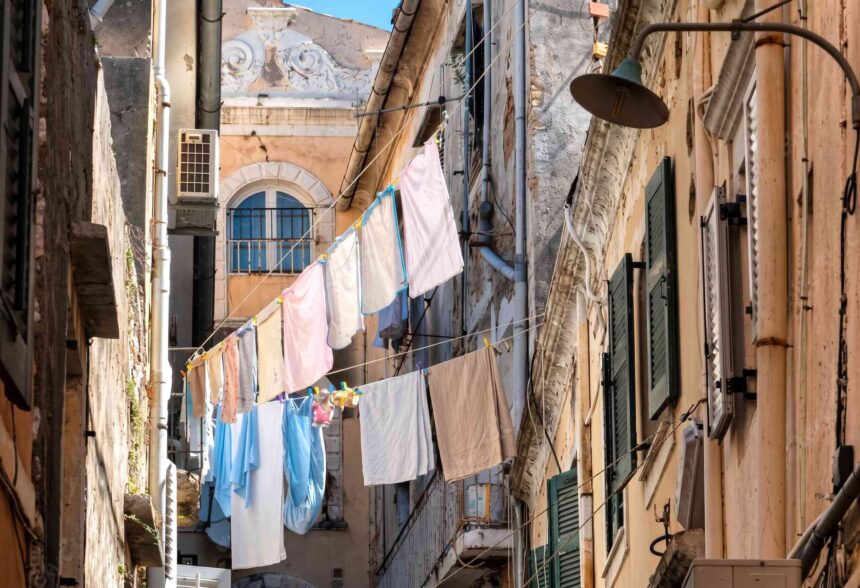
Porta Remounda is the southern quarter of Corfu Old Town, named after a vanished Venetian gate. It is a quieter area of tall houses around Moustoxydou Street, home to the Ionian Parliament and close to the Ionian Academy and the Spianada.
Porta Remounda is the southern quarter of Corfu Old Town, a grid of tall houses between the Spianada and the Town Hall square. It takes its name from a Venetian gate in the town walls that has since disappeared. It is worth a slow walk for the Ionian Parliament, the widest lane in the old town and a calmer, more residential feel than the streets around the Liston.
Quick facts
- Where: south side of Corfu Old Town, between the Spianada, Town Hall Square and the start of Garitsa Bay
- Main street: Moustoxydou Street, known locally as Platy Kantouni
- Key sights: Ionian Parliament, Ionian Academy, Kapodistrias statue, Venetian mansions
- Time needed: 45 minutes to an hour on foot
- Good for: architecture, history, a quieter break from the busy centre
Where the name comes from
Under Venice, Corfu Town was enclosed by walls with a handful of gates. One of them, on the southern side towards Garitsa, was the Porta Raimonda. Corfiots pronounced it Porta Remounda, and the name passed from the gate to the whole neighbourhood behind it. The gate itself has gone, swept away as the town grew beyond its walls, but the name stuck, as it so often does in Corfu.
The old town was built on three low hills: Campiello to the north, Agioi Pateres in the middle and Porta Remounda to the south. Building tall on tight plots within the walls was a defensive necessity, and it is why the lanes here feel like canyons between houses of four storeys and more.
The old gates of Corfu Town
The walls and gates that once closed the town are explained in detail in our article on Corfu’s Venetian fortifications. In short, each gate controlled a route into the town, and each had a different fate:
- Porta Spilia: by the old port, where people and goods arriving by sea came in. It survives, with a wide arch for carriages and a smaller one for people on foot, and you can still walk through it. See our guide to the Spilia quarter.
- Porta San Nicolò: a small gate on the sea side near Faliraki, which also survives below the modern road.
- Porta Reale: the royal gate on the landward side, near today’s San Rocco Square. The town council demolished it in 1893, part of a wave of wall demolitions across Europe at the time. Its outline has since been marked in the paving.
- Porta Raimonda: the southern gate that gave Porta Remounda its name, also lost.
The gates of the New Fortress, above the old port, and the main entrance to the Old Fortress across the Spianada are still in place and give the best idea of what the town gates looked like.
A planned corner of a tangled town
Most of the old town is a maze of narrow kantounia lanes that follow the contours of the hills. Porta Remounda is different. Its streets run mostly in parallel lines from east to west, crossed by few north to south lanes, so it feels more ordered than the tangle of Campiello. Many houses date from the Venetian period, with upper floors added later, and some taller apartment buildings date from British rule.
Platy Kantouni
The spine of the quarter is Moustoxydou Street, named after the 19th century Corfiot scholar Andreas Moustoxydis. Locals still call it Platy Kantouni, the wide lane, and under Venice it was the Strada Larga. Most old town lanes are only 2 to 3 metres wide, so this one stood out. It was wide enough for the Venetian nobility’s giostra, a jousting game held at Carnival in which riders tried to spear a ring at a gallop.
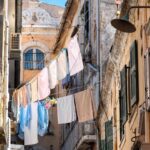
Walk it slowly and look up. Several old mansions keep carved stone details, and the Riki mansion at number 17 has grotesque carved heads, called mourounia, above its arch and balcony. Side lanes off Platy Kantouni are lined with washing lines, plant pots and small family businesses.
The Ionian Parliament
At the corner of Moustoxydou and Zambeli streets stands the Ionian Parliament, a neoclassical building with a Doric porch, designed by Ioannis Chronis in 1855. It housed the assembly of the United States of the Ionian Islands under British protection. In September 1863 its members voted for union with Greece, and the islands became part of the Greek state in May 1864, one of the most important moments in the history of Corfu and of modern Greece. Our article on the French and British in Corfu tells the full story.
The building was damaged in the German bombing of September 1943. It was restored and reopened in 1978 as a museum dedicated to the Ionian Islands’ struggle for union and freedom, and it also hosts exhibitions and cultural events. Opening hours are limited and change by season, so check locally before planning a visit around it.
The Ionian Academy and the Kapodistrias statue
At the southern end of the Spianada, on the edge of the quarter, is the Ionian Academy. Founded in 1824, three years after the start of the Greek War of Independence, under the patronage of Lord Guilford, it was the first university of the modern Greek world. Its building was burned out in the 1943 bombing and rebuilt afterwards. Today it houses the administration of the Ionian University.
Opposite, looking across the Spianada towards the Old Fortress, stands a marble statue of Ioannis Kapodistrias, the Corfiot diplomat who became the first governor of independent Greece. It is the work of the sculptor Leonidas Drosis. The view from here, with the fortress, the sea and the cricket pitch, is one of the best in town; our page on the Liston and Spianada covers the square.
Below the Academy, on the seafront, is the Nautical Club of Corfu (NAOK), which has been based here for generations and runs sailing, rowing and swimming. The road continues south along Garitsa Bay.
Town Hall Square on the edge
On the western edge of the quarter, the land rises to Town Hall Square, one of the most handsome squares in Corfu. The Town Hall itself was built in the 17th century as a loggia for Venetian nobles and later became the San Giacomo theatre, the first opera house in Greece. Opposite stands the Catholic cathedral of Saint James and Saint Christopher, known as the Duomo. From the square, stepped lanes lead back down through Porta Remounda to the Spianada.
A short walk through Porta Remounda
- Start at the Kapodistrias statue at the south end of the Spianada and look at the Ionian Academy.
- Walk west into Moustoxydou Street, stopping at the Ionian Parliament.
- Continue along Platy Kantouni, looking for the carved heads on the Riki mansion.
- Take any of the side lanes to the north to explore the parallel streets.
- Finish uphill at Town Hall Square, with a coffee under the trees.
The route links easily with our Corfu Town walking route, or with a walk north through the lanes to Campiello.
Practical tips
- Best time: morning or late afternoon, when light falls into the lanes and the heat is lower.
- Quiet streets: people live here. Keep voices down and do not photograph into open windows or doorways.
- Footwear: the marble and stone paving is slippery when wet and polished smooth by centuries of feet.
- Food: the quarter has a few tavernas and cafés, especially near Town Hall Square, often less touristy than those on the Liston.
- Access: no cars enter the lanes. The nearest parking is along Garitsa or at the old port.
Frequently Asked Questions
What does Porta Remounda mean?
It is the Corfiot pronunciation of Porta Raimonda, a gate in the southern Venetian walls of Corfu Town. The gate no longer stands, but its name stayed with the neighbourhood.
Can you visit the Ionian Parliament in Corfu?
Yes. The building on Moustoxydou Street was restored in 1978 and works as a museum about the Ionian Islands’ struggle for union with Greece, and also hosts exhibitions. Hours are limited and vary by season, so check locally.
Which old gates of Corfu Town still survive?
Porta Spilia by the old port and the small Porta San Nicolò near Faliraki survive. Porta Reale was demolished in 1893 and Porta Raimonda has also gone. The gates of the Old and New Fortresses are still standing.
What is Platy Kantouni?
It is the local name for Moustoxydou Street, the widest lane in Corfu Old Town. Under Venice it was called the Strada Larga and hosted the nobility’s Carnival jousting.
How long does it take to explore Porta Remounda?
About 45 minutes to an hour on foot, longer if you visit the Ionian Parliament or stop for coffee at Town Hall Square.