





The Corfiot dialect is a form of Greek spoken on Corfu that absorbed thousands of Venetian Italian words during four centuries of Venetian rule. Today you hear it in its sing-song intonation, in place names, food names and everyday words such as kantouni (lane) and volta (stroll).
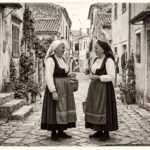
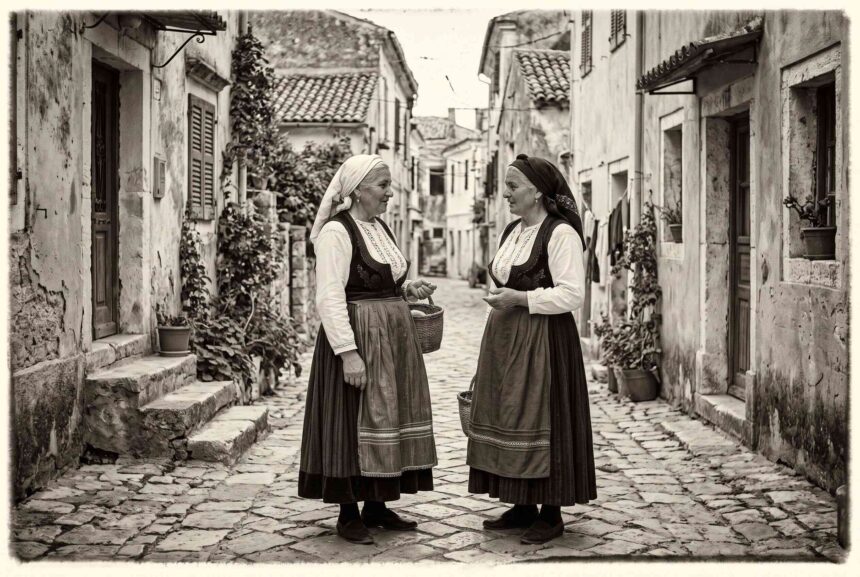
Corfu has its own way of speaking Greek. The Corfiot dialect keeps Greek grammar but is full of words borrowed from Venetian Italian, and it is spoken with a lilting, sing-song melody that other Greeks recognise instantly. Fully dialect speech is now mostly heard among older people, but dozens of its words are still in everyday use, and you will meet them on menus, street signs and in the market without realising it.
Quick facts
- What it is: a regional variety of Greek with a large Italian and Venetian vocabulary.
- Origin: mainly the Venetian period, 1386 to 1797, with earlier Latin contact under the Angevins.
- Where to hear it: the town market, village kafeneia, carnival street theatre and local songs.
- Do visitors need it: no, but a few words help you read menus and street life.
- Good for: travellers curious about how history shows up in daily life.
How Corfu came to speak this way
Corfu has been Greek-speaking since antiquity, but from the late Middle Ages its rulers were mostly Italian. In 1267 the island passed to the Angevins of Naples, who brought Catholic clergy, officials and settlers. In 1386 Corfu placed itself under Venice, and the Republic held it for more than four centuries, longer than anywhere else in Greece. Venetian nobles, merchants, soldiers and administrators lived in the town, Italian was the language of government and law, and educated Corfiots often spoke it fluently alongside Greek.
From the 15th and 16th centuries, as the Peloponnese, Crete and Cyprus fell to the Ottomans, Greek refugees settled on Venetian Corfu. Their arrival strengthened the Greek-speaking population and the Orthodox Church, so Greek remained the language of the people while it absorbed a huge stock of Italian words for daily objects, trades, law, food and the house. The grammar stayed Greek: borrowed nouns took Greek endings and borrowed verbs Greek conjugations. Notarial deeds, letters and books from the Venetian period are full of these hybrid forms, and collections of Corfiot words list several thousand of them.
The French and British periods that followed left surprisingly little trace on the dialect. For the history behind this, see our article on medieval and Venetian Corfu.
Words you will still hear
Many old dialect words have faded, but plenty survive in everyday speech, especially in the town and among older Corfiots. Some of the easiest to spot:
| Corfiot word | Meaning | Italian or Venetian root |
|---|---|---|
| kantouni (plural kantounia) | narrow lane of the old town | cantone, corner |
| volta | an evening stroll | volta, a turn |
| piatsa | square, or the market and business area | piazza |
| sior, siora | sir, madam | Venetian sior, siora |
| nona | grandmother | nonna |
| fanestra | window | finestra |
| portoni | large door or garden gate | portone |
| skanio | chair or stool | scanno |
| avogatos | lawyer | avvocato |
| kanto, kantada | song, serenade | canto, cantata |
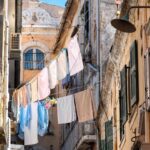
The word kantounia deserves special mention, because it names the thing visitors love most about the town: the maze of narrow stone lanes between tall Venetian houses. Our guide to the kantounia of Corfu explains how to explore them. The volta, meanwhile, is still a daily ritual: every evening families walk slowly up and down the square between the old town and the fortress, described in our article on the Liston and Spianada.

The dialect on your plate
The easiest place for a visitor to meet Corfiot words is the menu. Several of the island’s signature dishes carry Venetian names:
- Pastitsada: beef or rooster slow-cooked in a spiced tomato sauce and served with thick pasta, from the Venetian pastizzada.
- Sofrito: thin slices of veal cooked with garlic, white wine vinegar and parsley.
- Bourdeto: fish, often scorpion fish, in a fiery red pepper sauce, from brodetto.
- Bianco: fish stewed with potatoes, garlic and lemon, “white” because it has no tomato.
- Fogatsa: the sweet Easter bread of Corfu, related to Italian focaccia.
Ask a taverna owner how the dish got its name and you will often get a short history lesson. Our guide to Corfu food covers these dishes and where to try them.
Sound and rhythm
Even when a Corfiot speaks standard Greek, the accent gives them away. Corfiot speech rises and falls in a melodic way that Greeks often compare to singing, and which is usually attributed to the long contact with Italian. The tune varies around the island: town speech differs from the villages of the north, and the south around Lefkimmi has its own accent and expressions. Some villages keep the melody strongly even where the old vocabulary has gone.
The musical quality is easiest to appreciate in the kantades, serenades sung in harmony by small groups of male voices with guitar and mandolin, a tradition directly inherited from Italian song. Many kantades are written in Corfiot Greek and are performed at festivals, in tavernas and at summer events in the town.
Petegoletsa: the dialect on stage
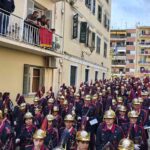
The liveliest place to hear the dialect is the carnival. During the Corfu carnival, usually on Tsiknopempti, the meaty Thursday before Lent, the narrow lanes around the Pinia area of the old town host the petegoletsa. The name comes from the Italian pettegolezzo, gossip. Performers, traditionally men dressed as women, lean out of balconies and windows and trade gossip across the lane in exaggerated Corfiot dialect, mocking neighbours, local events and, above all, politicians. Mayors and MPs are expected to stand in the crowd below and take it with good humour.
The custom dates back to Venetian times and has been revived in recent decades, drawing large crowds. Even if you understand little Greek, the tone, gestures and the crowd’s laughter make it clear what is going on, and Greek speakers beside you will happily translate the best lines.
Dialect in place names
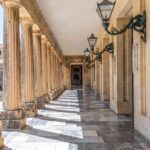
Corfu’s map also carries the dialect. Spianada, the great square of the town, comes from the Italian spianata, a levelled area. Liston, the arcade facing it, is a Venetian word for the main promenade. Many of the old town’s gates, bastions and quarters had Italian names in Venetian times, and a few survive in local use. As you walk the town, notice how often a sign or a name looks Italian but is written in Greek letters. Many Corfiots also share surnames of Italian origin, a further reminder of these centuries. More on the island’s layered past is in our Corfu Old Town guide.
Practical tips for visitors
- Listen in the market: the municipal market near the New Fortress and the kafeneia of the villages are the best places to hear unhurried local speech.
- Use a word or two: asking for the way to a particular kantouni or saying “kali volta” to people out for their evening walk usually earns a smile.
- Read the menu carefully: pastitsada, sofrito and bourdeto are local dishes, so look for them in tavernas that cook traditional food rather than international menus.
- Carnival dates move: the carnival follows the Orthodox calendar, so check the date of Tsiknopempti for the year of your visit and confirm the petegoletsa programme locally.
- Do not expect a different language: everyone also speaks standard Greek, and English is widely spoken in tourist areas.
The Corfiot dialect is no longer what it was a century ago, when townspeople could hold whole conversations that visitors from Athens would barely follow. But it has not disappeared. It survives in the accent, in food, in songs, in carnival satire and in a few hundred words that every Corfiot uses without thinking. Once you start noticing them, the island’s Venetian past turns up in almost every conversation.
Frequently Asked Questions
Is the Corfiot dialect a separate language?
No. It is a regional variety of Modern Greek with Greek grammar and syntax, enriched with a large Italian and Venetian vocabulary and a distinctive intonation. Any Greek speaker understands most of it, though some words puzzle visitors from Athens.
Do young people in Corfu still speak the dialect?
Fully dialect speech is now mostly heard among older people and in villages, but younger Corfiots still use many dialect words naturally and keep the local accent. Words such as kantouni, volta and nona are part of ordinary speech across generations.
Why does Corfiot Greek sound different?
The rising, sing-song melody of Corfiot speech is often attributed to centuries of contact with Italian. The accent varies between the town and the villages of the north and south, and many Greeks can identify a Corfiot within a sentence.
Do I need to learn any dialect words before visiting Corfu?
No. Standard Greek and English are understood everywhere tourists go. Knowing a few words, such as kantouni for a lane or pastitsada on a menu, simply helps you understand what you are seeing and eating.
What are the petegoletsa?
Petegoletsa are satirical street performances during the Corfu carnival in which actors, usually playing gossiping women on balconies, trade jokes about local life and politicians in heavy dialect. The name comes from the Italian word for gossip, and the tradition goes back to Venetian times.