



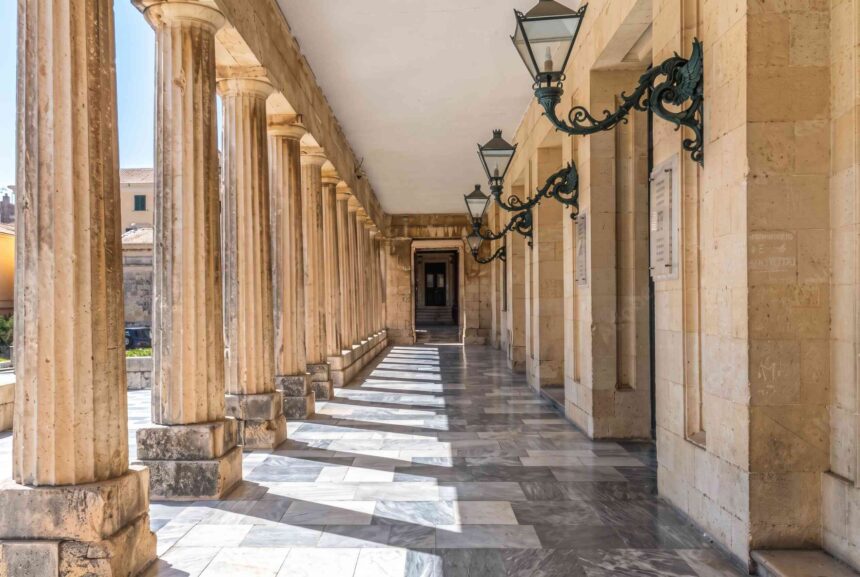
The Palace of St Michael and St George is a neoclassical palace on the north side of Spianada Square in Corfu Town, built from 1819 to 1824 for the British Lord High Commissioner. Today it houses the Museum of Asian Art, and its gardens lead down to the Faliraki swimming spot.
The Palace of St Michael and St George is the grand building that closes the north end of Spianada Square in Corfu Town. The British built it between 1819 and 1824 as the residence of their Lord High Commissioner and the seat of a new order of chivalry, and it is the finest British-era building in Greece. Today it houses the Museum of Asian Art, one of the more unexpected collections in the country, and the gardens behind it lead to a swimming spot below the sea walls.
Quick facts
- Where: north side of Spianada, at the edge of Corfu Old Town.
- Built: 1819 to 1824, designed by George Whitmore of the Royal Engineers.
- Inside: the Museum of Asian Art and restored state rooms.
- Time needed: 1 to 1.5 hours for the museum, plus time for the gardens and Faliraki.
- Good for: rainy days, architecture lovers, anyone tired of beaches.
A palace for the British
After the Napoleonic Wars the Ionian Islands became a British protectorate, the United States of the Ionian Islands, governed from Corfu. The first Lord High Commissioner, Sir Thomas Maitland, wanted a residence that would announce British authority on the island. The foundation stone was laid on St George’s Day, 23 April 1819, and the building was finished in 1824.
The architect was Colonel George Whitmore, a Royal Engineers officer who also designed the Maitland Rotunda on Spianada and, a few years later, the villa of Mon Repos. He chose a Greek Revival style: a long two-storey façade fronted by a Doric colonnade, with a central block and two wings ending in triumphal arches. The stone, a pale limestone, was shipped from Malta, also a British possession, and Maltese masons and sculptors worked on the building alongside Corfiot craftsmen.
The palace served several purposes at once. It was the Lord High Commissioner’s residence, the meeting place of the Ionian Senate, the government of the island state, and the seat of the Order of St Michael and St George, a British order of chivalry founded in 1818 for service in the Ionian Islands and Malta. The order still exists and is today awarded mainly to British diplomats, but its name has stayed with the building. For the wider story of this period, read our article on the French and British in Corfu.
The façade, gates and sculpture
Stand on Spianada and look at the long colonnade. The two arches at either end are the Gate of St Michael and the Gate of St George, both named after the patron saints of the order. They are still used as passages between the square and the streets beyond.
Above the colonnade, a frieze carries emblems of the seven Ionian islands, Corfu, Paxos, Lefkada, Ithaca, Kefalonia, Zakynthos and Kythira, together with the symbols of British power typical of the time. The sculptural work was carried out by the Maltese sculptors Vincenzo and Ferdinando Dimech and by the Corfiot sculptor Pavlos Prosalentis, who also made the bronze statue of Sir Frederick Adam that stands in front of the palace.
From royal residence to ruin and back
When the Ionian Islands joined Greece in 1864, the British left and the palace became a residence of the Greek royal family, used for state occasions when the king stayed at Mon Repos outside town. Through the 20th century it was used for many purposes and was badly neglected. A thorough restoration came in the early 1990s, when Corfu hosted the European Union summit of June 1994 in the palace, and the state rooms were returned to something close to their original appearance.
Inside, look for the grand staircase, the rotunda at the centre of the building, the former throne room and the state dining room, with period furniture, portraits and plasterwork from the British era.
The Museum of Asian Art
The museum is the main reason most people go inside. It began with Gregorios Manos, a Greek diplomat who spent years collecting Chinese, Japanese and Korean art at auctions in Vienna and Paris. In 1919 he gave about 9,500 pieces to the Greek state on the condition that a museum for them be founded in Corfu, and it opened in the palace in 1927 as a museum of Chinese and Japanese art. Later gifts, especially from the diplomat Nikolaos Chatzivasileiou, who added art from India, Pakistan, Tibet and Thailand, broadened it into a museum of Asian art.
The collection now numbers around 11,000 objects, the oldest from the 11th century BC. Highlights include:
- Chinese ceramics spanning thousands of years, from early bronzes and tomb figures to fine Ming and Qing porcelain.
- Japanese art, above all a strong collection of woodblock prints.
- Indian sculpture in stone and bronze, including Hindu and Buddhist deities.
- Himalayan and Southeast Asian works, with Tibetan ritual objects and Thai bronzes.
It is a surprising thing to find in a Greek island town, and well displayed. On a hot afternoon or a rainy day it is one of the best places to spend time in Corfu Town.
The garden and Faliraki
Behind the palace, away from the bustle of the square, lies the old royal garden, now open to the public and known as the People’s Garden. It is a quiet green space with views across the water to the island of Vido, and towards the walls of the Old Fortress of Corfu. A café with an exhibition space operates in the palace grounds.
Below the garden, on the rocks under the sea walls, is Faliraki, a small bathing area with concrete platforms, ladders into deep clear water and a café-restaurant. In summer local people come here for a swim in their lunch break, and it is a pleasant spot for a drink at sunset with the fortress across the bay. It is one of the few places to swim right in the centre of town.
Nearby
The palace is surrounded by the main sights of town. In front is the Liston and Spianada, with their cafés and cricket ground. To the east is the bridge to the Old Fortress. West of the palace, the lanes of the Corfu Old Town lead towards the church of Saint Spyridon and the old port. The southern peninsula, with Kanoni and Mon Repos, is a short ride away and completes the story of the British period.
Practical tips
- Opening hours and tickets: the museum keeps longer hours in summer than in winter and is usually closed on one weekday. Check current times and prices before you go; combined tickets with other state museums and sites in town are sometimes available.
- When to go: mornings are quieter; the museum is a good escape in the hottest hours of the day.
- Photography: generally allowed without flash, but check at the entrance.
- Faliraki: bring swimwear if you plan to combine the museum with a swim; the water is deep from the ladders, so it is better for confident swimmers than for small children.
- Accessibility: the ground floor and garden are relatively easy, but the state rooms are reached by stairs.
- Plan the day: see our list of things to do in Corfu to combine the palace with other sights.
Many visitors photograph the palace from the Liston and move on. Go inside: the building tells the story of Corfu’s British half-century better than anything else on the island, and the Asian art collection is a genuine surprise.
Frequently Asked Questions
What is inside the Palace of St Michael and St George?
The Museum of Asian Art of Corfu, with around 11,000 objects from China, Japan, Korea, India, Tibet and Southeast Asia, plus the restored state rooms of the British period. A café with its own exhibition space occupies part of the complex.
Why is it called St Michael and St George?
It was built as the seat of the Order of St Michael and St George, a British order of chivalry founded in 1818 for service in the Ionian Islands and Malta. The two gates flanking the palace are named after the two saints.
How long do you need for the Museum of Asian Art?
About 1 to 1.5 hours is enough for most visitors, including the state rooms. Allow more if you have a particular interest in Chinese porcelain or Japanese prints.
Can you swim near the palace?
Yes. Behind the palace, below the old sea walls, Faliraki is a small swimming platform with a café and ladders into the sea. It is one of the few places to swim right in Corfu Town.
Is the palace the same as the Achilleion?
No. The Palace of St Michael and St George is in Corfu Town and was built for the British administration in the 1820s. The Achilleion is Empress Elisabeth of Austria’s palace at Gastouri, about 10 km south, built in the 1890s.