
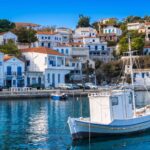
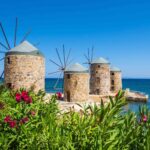


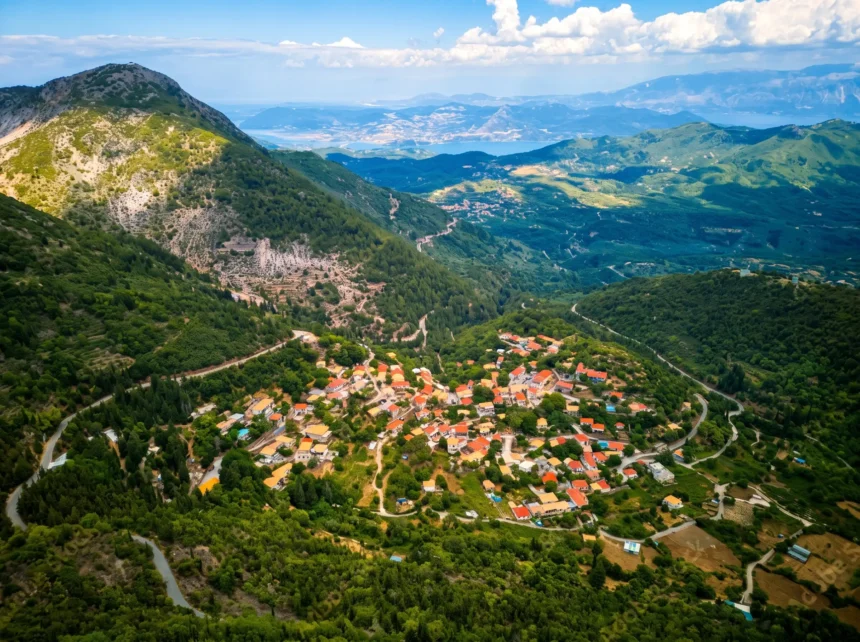
Lefkada is an Ionian island joined to mainland Greece by a causeway and floating bridge, about 20 to 25 minutes from Aktion airport. Spend five days or more with a car to combine west coast beaches, Nidri boat trips and Vassiliki.
Lefkada is the Greek island you can reach without a boat: a causeway and a short floating bridge join it to the mainland near Preveza, and Aktion airport is about 20 to 25 minutes’ drive away. That makes it one of the easiest Ionian islands to visit, and it pays back with some of the most photographed beaches in Greece on its west coast, a busy sailing scene on its east coast and a mountainous interior of old villages. Plan on at least five days and a car, and decide early whether you want beaches, wind or boats, because each side of the island does one of them best.
Quick facts
- Getting there: drive across the causeway and floating bridge, or fly to Aktion (Preveza) airport, about 20 to 25 minutes away.
- Size: about 300 square kilometres, with roughly 22,000 residents in the municipality.
- Main bases: Lefkada Town, Nidri, Vassiliki and Agios Nikitas.
- Time needed: five days to a week to see both coasts and take a boat trip.
- Best time: June and September; July and August bring traffic and full car parks on the west coast.
- Good for: road trips, beach lovers, windsurfers, sailors and families who prefer to drive rather than fly and ferry.
An island with a bridge
Lefkada was once a peninsula. The ancient Corinthians cut a channel across the isthmus in the 7th century BC, and today a long causeway crosses the shallow lagoon to a floating bridge of about 50 metres that swings open at intervals to let yachts through the canal. If you arrive by car from Athens, Ioannina or Igoumenitsa, you simply drive on. The castle of Agia Mavra guards the crossing: its origins are medieval, and the Ottomans rebuilt it in the 1570s as a hexagonal fortress.
The island is mountainous, rising to Stavrota at about 1,158 metres, and most of the interior is a patchwork of terraces, olive groves and small villages. Its two coasts could hardly be more different. The west faces the open Ionian with white cliffs and long sandy beaches that catch the swell and the afternoon wind. The east looks across a sheltered inland sea dotted with islands such as Meganisi, Skorpios and Kalamos, which is why it became a sailing base.
Lefkada Town
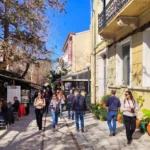
Lefkada Town sits at the northern tip, between the lagoon and the marina. It was levelled by earthquakes more than once, and its houses show it: many have a stone ground floor and light upper floors of timber, often clad in painted metal sheets, a building style meant to survive tremors. The main pedestrian street is lined with cafés, bakeries and shops, and small churches with Ionian-style bell towers stand in the side lanes. The town has an archaeological museum and, on the hill above, the Faneromeni monastery. It is also the island’s most practical base in shoulder season, when coastal resorts close.
Just west of town, Gyra beach runs along the sandspit past old windmills, and the lagoon is a good place for birds. Lefkada was the birthplace of writer Lafcadio Hearn, who was named after the island, and of the poets Aristotelis Valaoritis and Angelos Sikelianos.
The west coast: beaches and cliffs
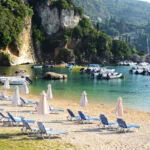
The road south from town along the west coast passes the island’s best-known beaches. Kathisma is long and sandy, with beach bars and water sports. Just north, Agios Nikitas is a small village of whitewashed houses with Mylos beach reachable on foot over the headland or by taxi boat. Pefkoulia is a long stretch with fewer facilities. Further south, Egremni lies below steep cliffs: earthquake damage in 2015 closed the access for years, and the steps were rebuilt and reopened around 2021, but expect a long climb back up. Porto Katsiki, the most famous of all, is a curve of white sand and pebbles under sheer cliffs, reached by steps from a cliff-top car park.
The beaches here are beautiful but exposed. Waves build in the afternoon when the northwest wind rises, and the sea shelves quickly. We compare the two sides in detail in our guide to the beaches of Lefkada.
Cape Lefkatas
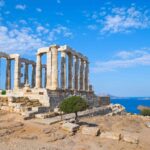
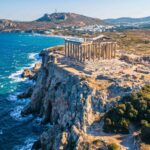
The southwestern tip of the island ends in Cape Lefkatas, white cliffs topped by a lighthouse and the scant remains of a temple of Apollo. Legend says the poet Sappho threw herself from these cliffs out of unrequited love. It is one of the best sunset spots in the Ionian, and the road out is quiet once you pass the turn for Porto Katsiki.
The east coast: Nidri and the islands
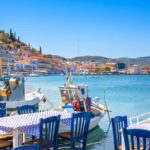
Nidri is the island’s biggest resort, a strip of hotels, bars and quays facing a bay full of moored boats. It is not the most charming village on Lefkada, but it is the hub for excursions. Daily boats leave for Meganisi, for the waters around Skorpios, the private island once owned by Aristotle Onassis, and for Kalamos and Ithaca further afield. A boat trip from Nidri is one of the best days you can spend on the island, and hiring a small boat to potter around the sheltered bays is popular too.
Inland from Nidri, the Dimosari gorge has a path to waterfalls that are lovely in spring and early summer but often reduced to a trickle in August. The German archaeologist Wilhelm Dörpfeld believed Lefkada was Homer’s Ithaca and dug near Nidri looking for the palace of Odysseus; few scholars agree, but his memory is still honoured locally.
Vassiliki and the south
Vassiliki sits at the head of a bay in the south where a thermal wind blows reliably on summer afternoons. Calm mornings suit beginners and the stronger wind later in the day draws experienced riders, which has made it one of Europe’s best-known windsurfing centres. Our guide to windsurfing in Vassiliki covers seasons and schools. Vassiliki also has a seasonal ferry to Fiskardo on Kefalonia, roughly an hour’s crossing, which makes it an easy jumping-off point for a few days on Kefalonia.
Mountain villages and local food
It is worth spending at least one day away from the coast. Karya, high in the centre of the island, has a stone-paved square shaded by plane trees and a long tradition of embroidery. Eglouvi, further up, is known for its small lentils, grown on the plateau around the village. Exanthia and Athani on the west side have views down to the sea, and Athani is known for thyme honey.
Look out for Lefkada salami and sausages, savoro (fried fish marinated in vinegar with rosemary), Eglouvi lentils, the local red wine made from the Vertzami grape, and soumada, an almond syrup. For a full list of what else to do, from walks to museums, see our guide to things to do in Lefkada.
Where to stay
Choose your base by what you want to do. Lefkada Town has the most life year-round and the best food, and is close to the bridge, but the west coast beaches are a 20 to 50 minute drive away. Agios Nikitas is the best base for the western beaches. Nidri is practical for boat trips but busy and built-up. Vassiliki suits windsurfers and anyone planning to continue to Kefalonia. We go through the pros and cons in where to stay in Lefkada.
Practical tips
- Hire a car. Buses link the main towns, but the beaches, cape and mountain villages are much easier to reach by car or scooter.
- Go early to the west coast. In July and August, car parks at Porto Katsiki and the other cliff beaches fill by late morning, and cars end up parked along the road.
- Read the wind. On a windy day the west coast can have big waves; swim on the east coast instead, where the water is sheltered.
- Allow for the bridge. When the floating bridge opens for boats, traffic waits, so leave some margin before a flight from Aktion.
- Carry water and shoes for steps. Several famous beaches involve long staircases, which are hard work in the midday heat.
- Check seasonal ferries. Links to Kefalonia and Ithaca run mainly in summer, and timetables change from year to year.
Lefkada is not a quiet secret, and the west coast can be crowded in high summer. But with a car, a bit of timing and a willingness to explore the mountain villages and the islands to the east, it offers more variety than almost any island of its size.
Frequently Asked Questions
Can you drive to Lefkada?
Yes. Lefkada is joined to the mainland near Preveza by a causeway and a short floating bridge, so you can drive straight onto the island. The bridge swings open at intervals to let boats through the canal, which briefly holds up traffic.
Which airport is closest to Lefkada?
Aktion airport near Preveza is the closest, about 20 to 25 minutes’ drive from Lefkada Town. It handles mainly seasonal and charter flights, so outside summer many visitors fly to Athens and drive.
Which side of Lefkada has the best beaches?
The west coast has the famous ones, including Porto Katsiki, Egremni, Kathisma and Mylos, with white cliffs and bright water. They are exposed to wind and waves, while the east coast is calmer and better for families and boats.
How many days do you need in Lefkada?
Five days to a week lets you see the west coast beaches, Cape Lefkatas, a mountain village or two and take a boat trip from Nidri. With only two or three days, focus on one coast.
Is Lefkada good without a car?
It is possible but limiting. Buses connect the main towns, and boats run from Nidri, but the west coast beaches, viewpoints and inland villages are much easier to reach with a car or scooter.