




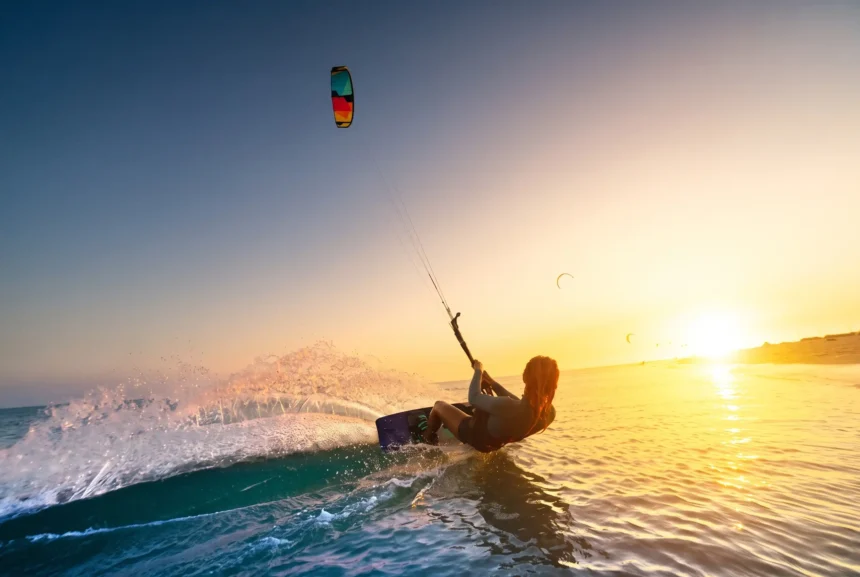
Vassiliki windsurfing is built on a summer afternoon thermal, often 15 to 20 knots and stronger, with light mornings for beginners. The season runs June to September; kitesurfers use Agios Ioannis beach near Lefkada Town.
Vassiliki windsurfing is famous for one reason: a reliable afternoon thermal wind, nicknamed “Eric”, that funnels into the bay on Lefkada’s south coast through the summer, while mornings are usually light and gentle. That daily rhythm makes Vassiliki one of the best places in Europe to learn in the morning and progress in the afternoon. For kitesurfing, Lefkada’s main spot is Agios Ioannis beach near Lefkada Town in the north, which has its own steady afternoon breeze from spring to early autumn.
Quick facts
- Season: the thermal blows mainly from June to September; May and early October are quieter and cooler.
- Wind pattern: light in the morning, often 15 to 20 knots in the afternoon, and 25 knots or more on strong days.
- Levels: beginners in the morning, intermediates and advanced riders in the afternoon.
- Kitesurfing: Agios Ioannis (Milos beach) near Lefkada Town, at the opposite end of the island from Vassiliki.
- Water temperature: around 25°C in high summer; a shorty is usually enough.
- Getting there: Aktion airport near Preveza, then by road over the causeway onto Lefkada.
How the Vassiliki wind works
Vassiliki is a small village of a few hundred residents at the head of a wide bay on the south coast of Lefkada, around 25 km from Lefkada Town. The bay is enclosed by mountains on three sides and opens to the south, towards Kefalonia and Ithaca. On summer mornings the wind is usually light, often a gentle breeze from the south, and the water is flat or lightly choppy. This is when the windsurf centres run beginner lessons and children’s courses.
As the land heats up, the thermal kicks in, typically from around midday, and builds through the afternoon until late in the day. The local sign that it is coming is cloud gathering and spilling over the mountains to the west of the bay. The wind is often 15 to 20 knots, regularly exceeds 25 knots, and on the strongest days goes over 30 knots, with gusts as it drops off the hills. Windsurfers have long called it Eric. On a good afternoon in peak season you can count over a hundred sails in the bay.
It is not guaranteed. Windsurf magazines estimate that the bay has a planing wind on roughly 40 percent of summer days, and locals say the thermal has become a little less reliable in recent years. A week in July or August will almost certainly give you several strong afternoons, but bring a plan for the calm days too.
Who Vassiliki suits
Beginners
Vassiliki is an excellent place to learn. The light morning wind, flat water near the beach and the shape of the bay, which keeps you from drifting into open sea, make the first sessions much less stressful than on an exposed coast. The windsurf centres on the beach run structured courses with rescue boats, and most beginners can be sailing back and forth on their own within a few days. In the afternoons, beginners usually come off the water or watch from the beach as the wind builds.
Intermediate and advanced
The afternoons are made for planing, carving gybes and blasting across the bay. The wind is gusty because it falls off the mountains, so you need solid technique and a well chosen sail size. Freestyle sailors use the flat water in the lee areas, while bump and jump fans head further out where the chop builds. Ponti, at the western end of the bay, is the quieter corner of Vassiliki, with its own beach and accommodation.


Families
Vassiliki works well for families who want one or two people sailing while others swim or explore. Morning children’s courses are common, the beach is right in front of the village, and the afternoon thermal leaves the mornings free for swimming and boat trips. Our guide to where to stay in Lefkada compares Vassiliki with Nidri and Lefkada Town if you are deciding on a base.
Kitesurfing on Lefkada: Agios Ioannis
Vassiliki bay is a windsurfing arena, and launching a kite among dozens of sails is not a good idea. Kitesurfers on Lefkada head instead to Agios Ioannis, the long beach at the northern tip of the island just outside Lefkada Town, also known as Milos beach and close to the old windmills on the Gyra spit. Here the thermal wind usually builds from late morning or the afternoon and averages around 15 to 20 knots, blowing on most days from roughly April or May to September. A forecast of 8 to 12 knots from the west can easily turn into 12 to 20 knots on the water between midday and evening.
The beach is long and open, so conditions are different from Vassiliki: more swell on windy days, and a northwesterly or northerly wind linked to low pressure over southern Italy can push the wind above 25 knots with waves of 1 to 2 m. Kiters gather at the northern end of the beach, while the southern end is kept free of kites and is used by windsurfers, so respect the zoning. Agios Ioannis also suits windsurfers looking for wave and freeride conditions, and beginners on the lighter days.
Other spots on and near Lefkada
- Milos and the north coast: beyond Agios Ioannis, the beaches running south along the west coast are wild and exposed. They are spectacular but often too rough for anything other than expert wave sailing; see our guide to Lefkada’s beaches for which ones to swim at.
- Kathisma: a long, open beach on the west coast, better known for swimming than for sailing, and often wavy when the wind is up.
- Lake Amvrakia: an inland lake on the mainland, about 4 km long, where advanced windsurfers sometimes go for flat water on northerly days.
When to go
June to September is the core windsurfing season in Vassiliki, with July and August giving the most consistent thermal and the busiest beach. June and September are many sailors’ favourites: the sea is warm, the wind is still frequent, and the village is calmer. May and October are good for lessons and light wind sailing, and kitesurfing at Agios Ioannis can work from May. In the shoulder months a 4/3 long wetsuit is advisable, while in high summer a shorty or rash vest is usually enough, with water around 25°C and air temperatures about 30°C.

Beyond the water
Vassiliki has more to offer than sails. In the evenings the waterfront fills with tavernas and bars, and the village keeps a relaxed, sporty feel without big nightlife. On no wind days, drive west to the cliffs and beaches around Porto Katsiki, take a boat trip from the harbour, or head into the mountain villages of the interior. Our list of things to do in Lefkada has plenty of ideas, and a day out on the water to Meganisi and Skorpios is covered in our Lefkada boat trip guide.
Practical tips
- Book lessons and kit in advance in July and August, when the centres are at their busiest; in June and September you can usually arrange things on arrival.
- Bring your own harness lines, booties and sunglasses with a strap if you have them; hire centres provide boards, sails and wetsuits.
- Insurance: check that your travel insurance covers windsurfing or kitesurfing, and ask whether the centre’s rental includes damage cover.
- Sun: afternoons on the water mean hours of reflected sun. Use high factor sunscreen, a hat or cap with a leash, and drink plenty of water.
- Car: a hire car makes it easy to switch between Vassiliki and Agios Ioannis depending on the forecast, and to explore on calm days.
- Planning a wider trip: Lefkada combines well with Kefalonia and Ithaca on an Ionian island hopping trip; our Lefkada travel guide explains how to reach and get around the island.
Is Vassiliki worth it for windsurfers?
Yes. Few places in the Mediterranean offer such a reliable daily cycle: gentle mornings to learn and strong afternoons to push your limits, all in a sheltered bay with warm water and a lively village behind it. Expert sailors who want big waves may prefer more exposed coasts, and anyone looking for a quiet beach holiday should know that the bay belongs to the sails in the afternoon. For everyone else, from first timers to seasoned freeriders, Vassiliki remains one of the classic windsurfing destinations of Europe, and Agios Ioannis gives kitesurfers a strong alternative on the same island.
Frequently Asked Questions
When is the wind best in Vassiliki?
The thermal wind usually builds from around midday and blows through the afternoon, often at 15 to 20 knots and sometimes over 25. Mornings are typically light, which is when beginners learn. The main season runs from June to September.
Is Vassiliki good for beginner windsurfers?
Yes. Light morning winds, flat water near the beach and a bay enclosed on three sides make it one of the best places in Europe to learn. Beginners usually sail in the morning and watch the experts in the afternoon.
Can you kitesurf in Vassiliki?
The bay is dominated by windsurfers, so kitesurfers on Lefkada usually go to Agios Ioannis beach near Lefkada Town. The kite zone there is at the northern end of the beach, and the thermal wind blows on most days from spring to September.
What is the Eric wind in Vassiliki?
Eric is the nickname windsurfers give to the afternoon thermal wind in Vassiliki bay. It forms as the land heats up, and clouds spilling over the mountains to the west are the sign that it is on its way.
Do I need a wetsuit in Vassiliki?
In high summer the water is around 25°C and a shorty or rash vest is enough. In May, early June or late September a 4/3 long wetsuit is more comfortable, especially for longer sessions.