


Paxos is a small, green Ionian island about 15 km south of Corfu, reached by ferry from Corfu or Igoumenitsa. Stay three to five nights in Gaios, Loggos or Lakka and add a boat trip to Antipaxos.
Paxos is the smallest of the main Ionian islands, a ridge of olive groves about 10 km long that lies roughly 15 km south of Corfu. It suits travellers who want harbour villages, clear pebble coves and quiet walks rather than big resorts or nightlife. Base yourself in Gaios, Loggos or Lakka, give it at least three nights, and add a boat day to Antipaxos. If you only have one day, a Paxos day cruise from Corfu shows you the highlights, but the island really opens up once the excursion boats have left.
Quick facts
- Size: about 25 square kilometres, roughly 10 km long and up to 3 km wide, with around 2,500 residents.
- Getting there: no airport; fly to Corfu, then ferry or hydrofoil, or take the year-round ferry from Igoumenitsa (about 1.5 hours).
- Main villages: Gaios (the port and capital), Lakka in the north, Loggos on the east coast in between.
- Time needed: three to five nights for walks, beaches and a day on Antipaxos.
- Best time: late May, June and September; August is busy with yachts and day visitors.
- Good for: couples, walkers, swimmers and anyone who likes small harbours more than large resorts.
Why Paxos is different
Paxos has no big sandy beaches, no airport and no high-rise hotels. What it does have is an almost unbroken cover of old olive trees, dry-stone terraces, small chapels, and three harbour villages that each have their own character. The east coast is gentle and lined with pebble coves. The west coast is the opposite: limestone cliffs drop straight into deep water, cut by sea caves and arches that are best seen from a boat.
Local legend says Poseidon made the island by striking the southern tip of Corfu with his trident, so that he and his wife Amphitrite could have somewhere quiet. History is less romantic but just as visible. Venice took control at the end of the 14th century, the British arrived in 1814 and the Ionian Islands joined Greece in 1864. Olive oil was the island’s economy for centuries, and you will see old presses, storage buildings and terraced groves everywhere you walk.
The three villages
Gaios
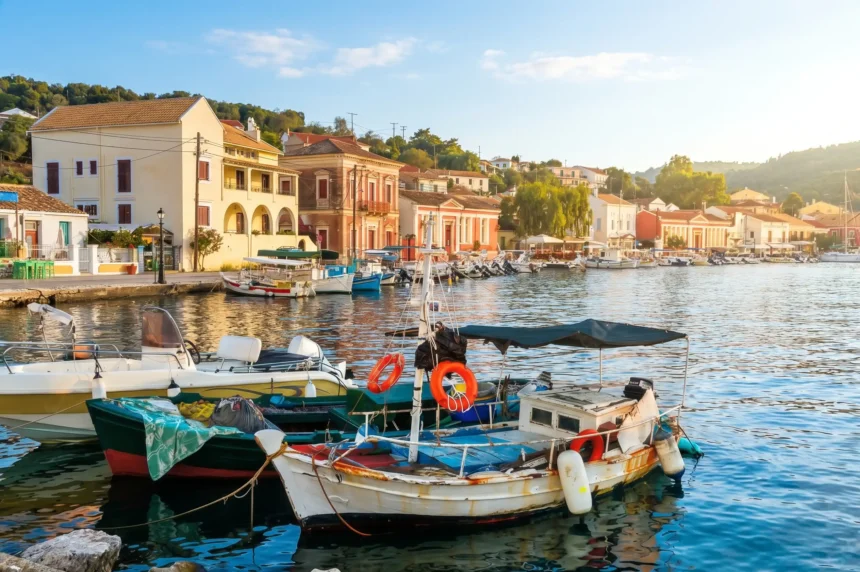
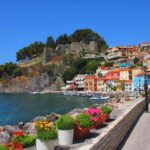
Gaios is the capital and the busiest place on the island, built around a long, narrow harbour that feels more like a canal. Two islets shelter it from the sea. Agios Nikolaos holds the remains of a Venetian fortress, while Panagia has a monastery whose feast on 15 August is one of the biggest church festivals in the Ionian, with boats ferrying pilgrims across from the waterfront. The town itself has a small square, pastel houses, a folklore museum in a neoclassical building, and the island’s widest choice of shops, cafés and tavernas.
Gaios is the most practical base: ferries, sea taxis to Antipaxos, boat hire and car hire are all here, and the beaches of the south (Mongonisi, Kaki Lagada, Balos) are a short drive away. The trade-off is noise and traffic in July and August, when yachts moor stern-to along the quay and day-trip boats arrive from Corfu late in the morning.
Loggos
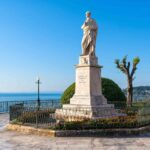
Loggos is the smallest and prettiest of the three, a horseshoe of houses around a tiny harbour about 5 km north of Gaios. Its waterfront tavernas are known for fish and seafood, and the old Anemogiannis soap factory on the edge of the bay is now used for exhibitions and events. Loggos is quiet by day and pleasant in the evening, and there are several pebble coves within walking distance, including Levrechio and Marmari. Kipiadi, the largest beach on the island, is nearby but has little shade.
Lakka
Lakka sits at the head of a sheltered, almost circular bay in the north. The water inside the bay is shallow and calm, with Harami beach on one side and olive trees almost reaching the sea, which makes it the easiest place on Paxos for families with small children. Lakka is also the best starting point for the island’s walking trails, including the path past the 19th-century stone lighthouse and the track down to Orkos beach.
What to see and do
The west coast cliffs and sea caves
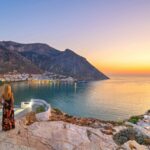
The western side of Paxos is the most dramatic part of the island. Erimitis, a white cliff face that collapsed in a landslide, is now one of the island’s favourite sunset spots, with a café above the drop. Further north, the Tripitos arch is a rock bridge standing off the cliffs. From the sea you can see the Ypapanti cave and other caverns along this coast; sunlight reaches into Ypapanti shortly after midday. Boats from Gaios and Loggos run cave trips in the season, and a guided sea kayaking tour around Paxos is the most intimate way to explore the coves, conditions permitting.
Olive groves and the interior
The interior is a maze of narrow lanes, walled groves and hamlets such as Magazia, which was the capital when the coast was exposed to pirate raids. In Magazia an 18th-century olive press has been turned into a small museum of olive and oil production. Walking is the best way to see this side of Paxos: most of the trails are on old mule tracks and are fairly flat, though stony underfoot.
Mongonisi and the southern coves
At the southern tip, Mongonisi is a tiny islet joined to Paxos by a short bridge. It has shallow, sandy water that suits children and a café by the sea. On the way, Kaki Lagada and Kamini are good swimming spots close to Gaios. Most east coast beaches are small and pebbly, and the water over white pebbles is a vivid turquoise.
Antipaxos
Antipaxos lies about 5 km south of Paxos, a sparsely populated island of vineyards and a handful of houses. Its beaches, above all Voutoumi and Vrika, have the brightest water in the area, and sea taxis cross from Gaios in a few minutes during the season. Our guide to Voutoumi, Vrika and the other Antipaxos beaches covers timing and what to bring.
Where to stay
Accommodation on Paxos is mostly in small apartments, rooms and villas, many of them scattered through the olive groves with sea views. There are only a few hotels. If you do not plan to hire a car, stay in or next to one of the three villages so you can walk to tavernas. Villas in the interior are lovely but you will depend on wheels for everything.
- Gaios: best for convenience, ferries and first-time visitors.
- Loggos: best for a quiet, picturesque stay with good fish tavernas.
- Lakka: best for families, calm water and walking trails.
Eating on Paxos
Food on Paxos leans on fish, local olive oil and Corfiot-style dishes such as sofrito and pastitsada. Waterfront tavernas in Loggos and Lakka are the most atmospheric, but some of the best meals are in simple places up in the villages. Prices are higher than on the mainland because almost everything arrives by boat. For names, see our guide to where to eat in Paxos.
Getting there and around
Paxos has no airport, so most visitors fly to Corfu and continue by sea. In the season hydrofoils and passenger ferries link Corfu Town with Gaios in roughly one to two hours, while car ferries run all year from Igoumenitsa on the mainland in about an hour and a half. Outside summer the Corfu connections are infrequent and can be cancelled in rough weather, so leave a buffer day before an international flight. Our page on how to get to Paxos goes through the options in detail.
On the island, a small hire car or scooter is the easiest way to get between villages. The main road runs along the spine of the island, with narrow branches down to the coves. Hiring a small motorboat for a day is popular and lets you reach west coast caves and beaches that have no road access. Taxis exist but are few, so book ahead for early ferries.
Practical tips
- Book early for July and August. Paxos has limited accommodation and many villas are booked by returning visitors.
- Carry cash. Most places take cards, but some small cafés, sea taxis and beach sunbed operators still prefer cash.
- Go early or late in Gaios. Day-trip boats from Corfu fill the harbour around midday; mornings and evenings are calmer.
- Watch the wind. West coast boat trips and cave visits depend on calm water. If the sea is up, switch to an east coast day.
- Bring water shoes. Most beaches are pebble or rock, and many coves have no facilities, so carry water and snacks.
- Check the season. From November to April many tavernas and rooms close and ferry links thin out, though walking is excellent in spring.
Paxos rewards slowness. Spend the mornings walking or swimming, the afternoons on a boat, and the evenings in a harbour taverna, and the island makes far more sense than it does from the deck of a day cruise.
Frequently Asked Questions
How many days do you need on Paxos?
Three to five nights is ideal. That gives you time for a boat day on Antipaxos, a walk or two through the olive groves, and evenings in each of the three villages. A single day trip from Corfu only shows you the harbours and the coast from the water.
Which is the best village to stay in on Paxos?
Gaios is the most convenient for ferries and services, Loggos is the smallest and most picturesque, and Lakka has the calmest bay for families and the best access to walking trails. Without a car, choose a place within walking distance of one of the three.
Do you need a car on Paxos?
Not if you stay in a village and are happy to walk and use sea taxis. A small car or scooter makes it much easier to reach beaches and the west coast viewpoints, and a hired motorboat is the best way to see the sea caves.
How do you get to Paxos?
There is no airport. Most visitors fly to Corfu and take a hydrofoil or ferry to Gaios, which runs mainly in the summer season. Car ferries also sail all year from Igoumenitsa on the mainland in about an hour and a half.
Are the beaches on Paxos sandy?
Mostly not. Paxos beaches are small and made of white pebbles or rock, which is why the water looks so clear. The sandiest shallow water is at Mongonisi and Harami in Lakka, and the Antipaxos beaches have finer sand.