


Beyond the beaches, the best things to do in Lefkada are exploring Lefkada Town and Agia Mavra castle, visiting Faneromeni Monastery, driving up to Karya and Englouvi, walking to the Dimosari waterfalls and watching sunset at Cape Lefkatas.
The best things to do in Lefkada beyond the beaches are a slow walk through Lefkada Town and the Agia Mavra castle, a drive up to Faneromeni Monastery and the mountain villages of Karya and Englouvi, a short walk to the Dimosari waterfalls above Nidri, and sunset at the lighthouse on Cape Lefkatas. Add a boat day to Meganisi and Kalamos, a windsurfing lesson in Vassiliki and an evening at the August folklore festival, and Lefkada fills a week easily even if you never unroll a towel. This guide picks out what is worth the drive and what is better skipped.
- Quick facts
- Lefkada Town: the capital that most visitors drive through
- Agia Mavra Castle
- Faneromeni Monastery and the view over the lagoon
- Gyra, the lagoon and the windmills
- The mountain villages: Karya, Englouvi and the inland plateau
- The Dimosari waterfalls above Nidri
- Nidri, Dörpfeld and the Homeric question
- Cape Lefkatas: lighthouse, legend and sunset
- On and around the water, without lying on a beach
- Festivals and events
- What to skip, or approach with care
- Practical tips
- Frequently Asked Questions
Quick facts
- Best time: May, June and September for village drives and walks; August for festivals and the busiest evenings.
- Getting around: a car or scooter is close to essential; inland roads are narrow and winding.
- Time needed: three to four days covers the main sights away from the coast.
- Good for: travellers who like history, mountain villages, short walks and sunsets.
- Base: Lefkada Town for culture, Nidri for boat trips, Vassiliki for the south.
Lefkada Town: the capital that most visitors drive through
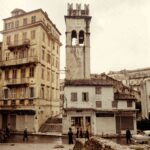
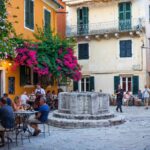
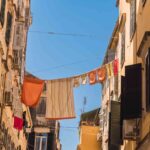
Most people cross the causeway and the floating bridge from the mainland, glance at Lefkada Town and keep going to the beaches. That is a mistake. The town is small, flat and easy to walk, and it has a character unlike any other Ionian capital. Earthquakes have shaped it: many houses have a stone ground floor and upper storeys built with light timber frames, often clad in painted corrugated metal sheets, a style designed to sway rather than collapse. The result is a patchwork of pastel facades along the main pedestrian street and the lanes that branch off it.
Walk the market street in the early evening, when shops reopen and families come out, then drift down to the marina and the lagoon edge. The churches of the old town are small, many with separate bell towers built in metal frames for the same seismic reasons as the houses.
Museums worth an hour
The town has several small museums, none of which needs more than an hour, and together they make a good plan for a hot or windy afternoon.
- Archaeological Museum: finds from the Palaeolithic to the Roman period, plus a room on the excavations of the German archaeologist Wilhelm Dörpfeld, who believed Lefkada was Homer’s Ithaca.
- Phonograph Museum: a private collection of around 50 gramophones and phonographs, records and the first radio brought to the island, founded in 1990.
- Sikelianos Museum: in the family house of the poet Angelos Sikelianos, covering his life and work along with costumes, embroidery and tools of rural island life.
- Philharmonic Museum: a small display inside the building of the town’s Philharmonic, founded in 1850.
Opening hours are short and change through the year, so check locally before you set out, especially outside July and August.
Agia Mavra Castle
The castle of Agia Mavra, also known as Santa Maura, guards the narrow channel between Lefkada and the mainland, right beside the bridge. A first fortress was probably built around 1300 by John I Orsini, who had received the island as a dowry. The Ottomans took Lefkada in 1479 and rebuilt the castle on a larger scale in the 1570s; the Venetians captured it in 1684 under Francesco Morosini, after which the capital moved to the site of today’s town. The French, Russians and British all held it before the Ionian Islands joined Greece in 1864.
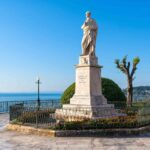
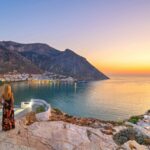
Much of the interior was demolished in the twentieth century, so do not expect a complete fortress. What remains is the scale: thick walls, gates, and views over the lagoon, the canal and the mountains of Epirus. It is a quick and worthwhile stop on arrival or departure. Visiting arrangements vary, so check whether it is open when you pass.
Faneromeni Monastery and the view over the lagoon
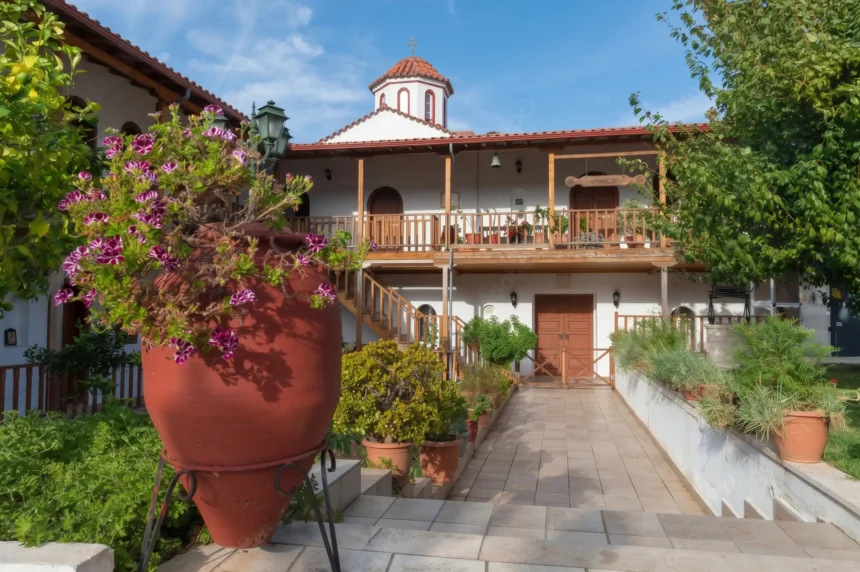
Above the town, in the area of Frini, the Monastery of Panagia Faneromeni sits on a wooded hill. Tradition dates the first monastery to the seventeenth century, on the site of an older temple; fires destroyed earlier buildings and the present complex was rebuilt in the late nineteenth century. There is a small ecclesiastical museum with icons and manuscripts.
Most visitors come for the view as much as the church: the lagoon, the long sand spit of Gyra and the mainland coast spread out below. Dress modestly (shoulders and knees covered) and keep voices low; it is a working religious site.
Gyra, the lagoon and the windmills
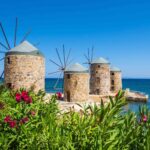
North of the town, a road runs along the long strip of sand that separates the lagoon from the open sea. The lagoon is shallow and attracts water birds outside the summer months, and the strip itself is a good place for a flat walk or bike ride at dusk. At the far end, the beach of Agios Ioannis is lined with old stone windmills and catches the northerly wind, which is why kitesurfers favour it. It is the easiest sunset spot from town, ten minutes or so by car.
The mountain villages: Karya, Englouvi and the inland plateau
Lefkada has a high, green interior that many beach visitors never see. Drive up from the east or west coast and the air cools, the olive groves give way to oaks and cypresses, and villages sit on the slopes around small farmed plateaus.
Karya
Karya is one of the largest mountain villages, built around a square shaded by big plane trees and lined with cafes and tavernas. It is known for its embroidery, the so-called karsaniko style, associated with a local woman, Maria Koutsochero, whose work was in demand around 1900. The village folklore museum shows textiles, household objects and everyday tools of mountain life. Come for lunch, sit under the trees and take your time.
Englouvi
Higher up, Englouvi is a stone village known for its small lentils, grown in fields on the plateau around it. Walkers use it as a base for trails to the chapel of Agios Donatos and the ridges of the Elati massif, which approach 900 metres in this area. Even if you do not walk, the drive between Karya and Englouvi, with views towards both coasts, is one of the best on the island.
The Dimosari waterfalls above Nidri
A short drive inland from Nidri towards the village of Rachi leads to the Dimosari gorge. From the parking area by a cafe, a path of about 15 minutes follows the stream through plane trees to a pool and a waterfall roughly 12 metres high. It is a cool, shady escape on a hot day and suits families.
Be realistic about the water: by late summer the falls are often reduced to a trickle. Spring and early summer, or any time after rain, are the moments to see them properly. Wear shoes with grip, as the rocks near the pool are slippery.
Nidri, Dörpfeld and the Homeric question
Nidri is the busiest resort on the east coast and the main port for boat trips, but it has a curious historical footnote. Wilhelm Dörpfeld, who had worked with Heinrich Schliemann at Troy, excavated in the plain around Nidri and argued that Lefkada, not modern Ithaca, was the island of Odysseus. His theory is not accepted today, but he loved the island, died here in 1940 and asked to be buried here. His grave lies on the Vlychos peninsula across the bay, above the small church of Agia Kyriaki. From the Nidri waterfront you look straight across the bay to the peninsula.
Cape Lefkatas: lighthouse, legend and sunset
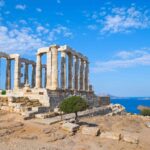
The southwestern tip of Lefkada ends at Cape Lefkatas, also called Doukato, where white cliffs drop straight into the sea. A lighthouse built in 1890 stands on the site of an ancient temple of Apollo. Legend says the poet Sappho threw herself from these cliffs out of unrequited love, and in antiquity the leap was linked to a ritual for those seeking release from love.
The road out to the cape crosses bare, windswept hills above Porto Katsiki. At sunset the cliffs glow and the sea turns deep blue on both sides. Stay well back from the edge: there are no barriers and the wind can be strong. Combine it with an afternoon at one of the west coast beaches, described in our guide to Lefkada’s west and east coasts.
On and around the water, without lying on a beach
Boat trips to the satellite islands
Nidri faces a small archipelago: Madouri, the private island of Skorpios, Meganisi with its villages of Spartochori and Katomeri, and further out Kalamos and Kastos. A day on the water, either on a group excursion or a small hired boat, is one of the highlights of any stay. Our Lefkada boat trip guide covers routes and what to expect.
Windsurfing in Vassiliki
The bay of Vassiliki in the south has a reliable afternoon wind in summer and calmer mornings, a combination that has made it one of the best known windsurfing spots in Europe. Beginners take lessons in the morning; experienced riders go out when the wind fills in. See our guide to windsurfing in Vassiliki for the details.
Festivals and events
Lefkada’s International Folklore Festival, founded in 1962, is held in August in Lefkada Town and brings dance and music groups from Greece and abroad for a week of performances. It is one of the longest running cultural events of its kind in Greece. Villages also hold their own summer panigyria (saint’s day feasts) with music, dancing and grilled meat, usually around 15 August and on other local feast days. Ask at your accommodation which villages are celebrating during your stay.
What to skip, or approach with care
- Driving the whole island in one day: distances look short but the roads are slow. Split the island into north, west and south, and the interior.
- Dimosari in August: the walk is pleasant, but do not expect a powerful waterfall.
- Nidri’s main strip at midday: busy and traffic-heavy; go early for boat trips, then leave.
Practical tips
- Hire a car with enough power for the mountain roads; small engines struggle on the climbs to Englouvi and the west coast.
- Fill up with fuel before heading into the interior or the far southwest, where petrol stations are scarce.
- Carry cash for village cafes and small museums.
- Plan inland days for the hottest or windiest days, when the west coast beaches are least pleasant.
- For where to base yourself, read where to stay in Lefkada; for an overview of the island, start with our Lefkada travel guide.
- If you are combining islands, Lefkada links well with Kefalonia and Ithaca to the south; see Ionian island hopping routes.
Frequently Asked Questions
What is there to do in Lefkada apart from beaches?
Lefkada Town has small museums, colourful earthquake-resistant houses and the Agia Mavra castle nearby. Inland you can visit Faneromeni Monastery and the mountain villages of Karya and Englouvi, walk to the Dimosari waterfalls and watch sunset at Cape Lefkatas.
Are the Dimosari waterfalls worth visiting?
They are worth it for a short, shady walk of about 15 minutes from the parking area near Rachi, above Nidri. In late summer the flow is often weak, so spring, early summer or a visit after rain gives the best experience.
Can you visit Agia Mavra castle in Lefkada?
The castle stands right by the bridge to the mainland and its walls and gates can be seen easily. Much of the interior was demolished in the twentieth century and access arrangements vary, so check locally whether it is open during your visit.
Where is the best sunset in Lefkada?
Cape Lefkatas, at the southwestern tip of the island, is the most dramatic, with a lighthouse on white cliffs. Closer to town, Agios Ioannis beach and the windmills at Gyra are an easy sunset spot.
Do I need a car in Lefkada?
For sights away from the main resorts, yes. Buses link the main towns, but the mountain villages, the waterfalls and Cape Lefkatas are much easier to reach by car or scooter.