


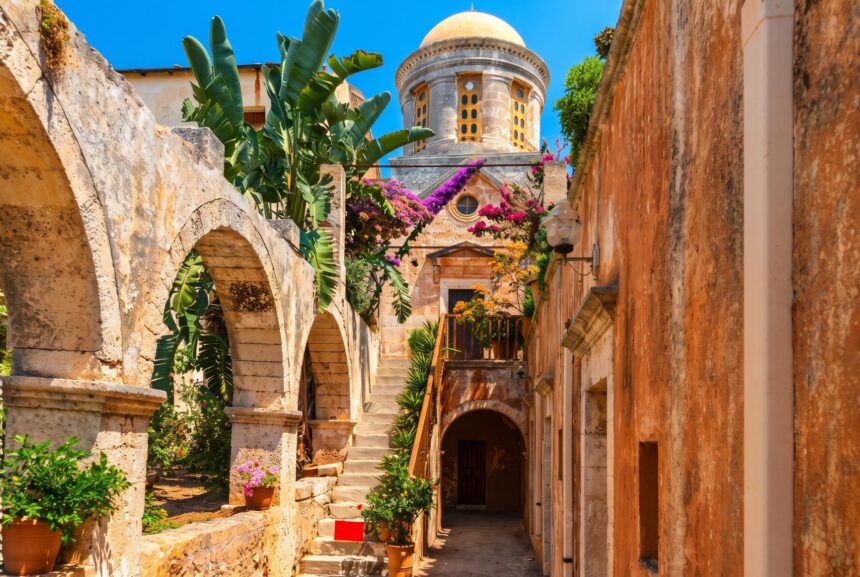
Chania is Crete's most attractive town and the best base for the west: spend two days in the Venetian old town, then use a car for Balos, Falassarna, Elafonisi and the Samaria Gorge.
Chania is the most attractive town on Crete and the best base for the west of the island. Its Venetian harbour and old quarters are worth two or three days on their own, and within a couple of hours’ drive you have some of Greece’s most famous beaches, including Balos, Falassarna and Elafonisi, and the walk through the Samaria Gorge. Stay in or near the old town, hire a car for the day trips, and plan at least four or five nights.
Quick facts
- Where: the north coast of western Crete, capital of the Chania regional unit.
- Getting there: Chania airport on the Akrotiri peninsula, about 15 km from town; ferries from Piraeus arrive at Souda port, around 7 km east.
- Time needed: two days for the town, four to seven days including beaches and gorges.
- Best time: May, June, September and October; the Samaria Gorge is usually open from May to October.
- Good for: old town wandering, food, beach days, hiking and couples.
The old town and Venetian harbour
Chania was founded on the site of ancient Kydonia and grew into an important city under the Venetians, who ruled Crete from the early 13th century until the Ottoman conquest in the 17th. Chania itself fell to the Ottomans in 1645. Both periods left their mark, and the old town is a tight maze of stone lanes, small squares, Venetian mansions, Ottoman wooden balconies and churches.
The harbour front
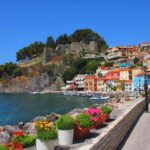
The curved outer harbour is the image everyone knows. At its western end the Firkas fortress guards the entrance and houses the Maritime Museum of Crete, with ship models and displays on the island’s naval history. Walk the long breakwater to the lighthouse at the harbour mouth; the walk takes about 20 minutes each way and is best at sunset, when the town glows behind you. The domed building on the waterfront is the Küçük Hasan Mosque, also called the Yiali Mosque, built in the 17th century and now used for exhibitions. Further east, the vaulted Venetian shipyards (the Neoria) line the inner harbour.
The harbour restaurants have the views but are generally the weakest places to eat in town. Enjoy a drink or an ice cream on the waterfront, then head a few streets back to eat.
Topanas, Splantzia and the backstreets
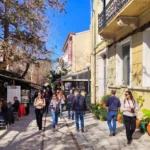
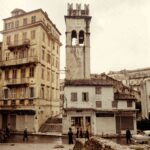
Topanas, behind the western side of the harbour, was the old Venetian quarter, and its lanes such as Theotokopoulou street are full of restored houses, guesthouses and small shops. Splantzia, to the east, has a more local feel: its plane-shaded square is lined with cafés, and the church of Agios Nikolaos there has both a bell tower and a minaret, a reminder that it served as a mosque. Nearby, Etz Hayyim is the restored synagogue of the old Jewish quarter (Evraiki). Look also for the short street of knife makers off the market, where a few workshops still make traditional Cretan knives.
The market and museums
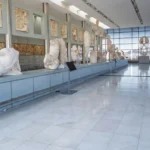
The large cross-shaped Municipal Market (the Agora), built in 1913, has been closed for a long restoration. In autumn 2026 the municipality was aiming to reopen it in December 2026, with restored shops and stalls, but dates have slipped several times, so check before you plan around it. The Archaeological Museum of Chania has moved to a modern building in the Halepa district east of the centre, with Minoan and later finds from across the region. Halepa itself, with its neoclassical mansions and the former residence of Eleftherios Venizelos, makes a pleasant walk away from the crowds.
Beaches near Chania town
The closest swimming is at Nea Chora, a sandy town beach a short walk west of the harbour, with tavernas behind it. A few kilometres further west, the coves of Agioi Apostoli and Kalamaki are sheltered and good for families. The long strip of resorts from Platanias to Agia Marina has organised beaches with sunbeds and watersports, plus lively nightlife in season.
The Akrotiri peninsula, between the town and the airport, has its own good swimming. Stavros is a shallow, sandy bay under a steep mountain, and Marathi has two small beaches and fish tavernas. Seitan Limania is a dramatic narrow inlet between cliffs, reached by a steep path; it is striking but small, crowded in summer and not for anyone unsteady on their feet.
Day trips from Chania
Balos and Gramvousa
At the far northwest tip of Crete, Balos is a shallow lagoon of turquoise water and white sand below the Gramvousa peninsula. You can drive the last stretch on a rough dirt road and walk down, or take a boat from Kissamos port that also stops at the island of Imeri Gramvousa with its Venetian fortress. See our guide to Balos lagoon for the pros and cons of each.
Falassarna
On the west coast, Falassarna is a long, wide sandy beach facing the sunset, with room to spread out even in summer. Waves can be big when the wind blows from the west. There are remains of an ancient harbour city at the northern end.
Elafonisi
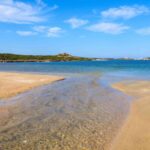
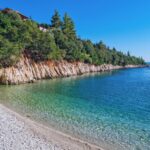
In the southwest corner, Elafonisi is famous for shallow lagoons and patches of pink sand. It is a protected Natura 2000 area and becomes very crowded in July and August, so go early or late in the day. Our Elafonisi beach tips explain how to get the most from a visit. The drive takes around 1.5 hours each way through mountain villages.
The Samaria Gorge
The Samaria Gorge is the classic Chania excursion: a walk of around 16 km from the Omalos plateau at Xyloskalo down to Agia Roumeli on the south coast, where you take a ferry to Sfakia or Sougia and a bus back. It is a long, rocky downhill day, and the park opens only in the warmer months, usually from May to October, and can close at short notice in bad weather. Our Samaria Gorge hiking guide covers timings, transport and what to wear.
Sfakia, Loutro and the south coast
If Samaria is too much, the Imbros gorge near Chora Sfakion is shorter and gentler. Sfakia is a region of proud mountain villages and seafood tavernas, and from Chora Sfakion boats run along the coast to Loutro, a small car-free village of white houses on a bay. Frangokastello, a lonely Venetian castle beside a shallow sandy beach, is a short drive east. Paleochora further west is a laid-back small town with beaches on both sides.
Lake Kournas and the eastern villages
On the way towards Rethymno, Lake Kournas is the island’s only sizeable natural freshwater lake, with pedal boats and tavernas. Nearby villages such as Vamos and Gavalochori in the Apokoronas area have stone houses and a slower pace. From there it is an easy continuation to the old town of Rethymno, about an hour away.
Food in Chania
Chania has some of the best eating on Crete. Look for boureki (a baked dish of courgette, potato and mizithra cheese), Sfakian pies (thin pies with soft cheese, drizzled with honey), kalitsounia, snails, slow-cooked lamb and fresh fish. Many of the more authentic tavernas and mezedopoleia are in Splantzia and the streets around the market rather than on the harbour. In the villages around the town, a meal often ends with raki and a small dessert offered by the house.
Where to stay
- Old town (Topanas, Splantzia): atmosphere and walking distance to everything; rooms are often in restored buildings with steep stairs, and parking is difficult.
- Nea Chora and Halepa: quieter, close to the town beach or the museum, still walkable to the harbour.
- Platanias and Agia Marina: beach resorts west of town, good for families and nightlife.
- Kissamos: a practical base for Balos and Falassarna.
- Apokoronas villages: villas and quiet stays east of town, ideal if you have a car.
Practical tips
- Park outside the old town walls and walk in; the centre has limited traffic access and few spaces.
- Hire a car for at least part of your stay, since the best beaches and villages are spread out; our article on renting a car in Greece has the essentials.
- Start day trips to Balos and Elafonisi early, before the coaches arrive.
- Book Samaria transport the day before in peak season, and check the official park announcements for closures.
- For the bigger picture of the island and how Chania fits into a longer trip, see our Crete travel guide.
Frequently Asked Questions
How many days do you need in Chania?
Two days are enough for the old town and harbour. To add Balos, Elafonisi, the Samaria Gorge and the south coast, plan five to seven days with a car.
Is Chania or Heraklion better to stay in?
Chania is far more attractive and relaxed, with a beautiful old town and the west’s best beaches nearby. Heraklion is better for Knossos, the Archaeological Museum and the east, but most travellers prefer to stay in Chania.
Can you swim in Chania town?
Yes. Nea Chora is a sandy town beach a short walk from the harbour, and Agioi Apostoli and Kalamaki are a few kilometres west. The Akrotiri peninsula has Stavros and Marathi within a short drive.
Is the Chania market open?
The historic Municipal Market has been closed for restoration for several years. The aim in 2026 was to reopen it towards the end of the year, but dates have changed repeatedly, so check locally before visiting.
Do you need a car in Chania?
Not for the town itself, which is best explored on foot. For beaches such as Balos, Falassarna and Elafonisi and for the villages, a car is by far the most practical option.