


The Samaria Gorge is a 16 km, 5 to 7 hour hike from Xyloskalo on the Omalos plateau to Agia Roumeli on the south coast of Crete. It opens from May into October when weather allows (19 May in 2026), tickets cost around €10, and you return by ferry and bus.
The Samaria Gorge is a 16 km walk through the White Mountains of western Crete, starting at Xyloskalo on the Omalos plateau and ending at the village of Agia Roumeli on the Libyan Sea. It is a long, downhill hike of around 5 to 7 hours, open only in the warmer months and only when the weather allows. There is no road out at the bottom, so planning the return by ferry and bus is as important as the walk itself.
Quick facts
- Distance: about 13 km inside the national park, plus 2 to 3 km to Agia Roumeli village
- Time needed: 5 to 7 hours for the full crossing, plus travel at both ends
- Season: normally from May into October; in 2026 the gorge opened on 19 May
- Entry ticket: around €10 for adults in 2026 (unchanged since 2025), with free entry for several categories
- Difficulty: moderate but long, steep and rocky in the first section
- Good for: fit walkers aged roughly ten and up with proper footwear
What the gorge is like
The gorge lies inside the Samaria National Park, created in 1962 to protect the landscape and the kri-kri, the wild Cretan goat. The area is also recognised as a biosphere reserve. The walk begins at Xyloskalo, at about 1,250 metres, where a wooden-railed path zigzags steeply down through pine and cypress forest. This first stretch drops quickly and is the hardest on the knees.
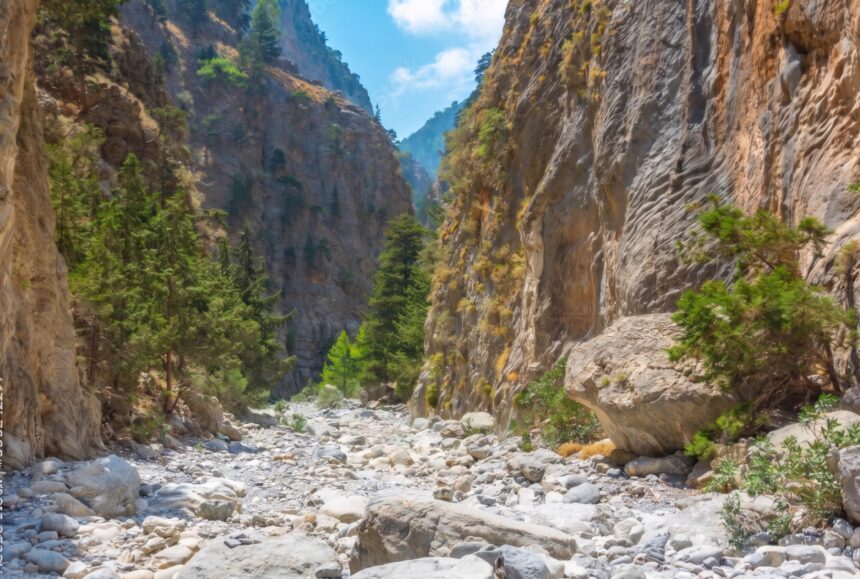
Lower down the path follows a mostly dry riverbed, crossing it several times on stepping stones and small bridges. Halfway through you reach the abandoned village of Samaria, whose last residents left when the park was created. Its restored buildings now serve as a rest area. Further south the walls close in until, at the famous Portes (the Gates), they are only around 4 metres apart and rise nearly 300 metres overhead. Soon after, the gorge opens out, you pass the southern park gate, and the path continues to Agia Roumeli, a small village of tavernas and rooms with a pebble beach.
Along the way there are rest areas with fresh spring water, toilets and first-aid points. Wardens patrol the route, and mules are on hand to carry out anyone who cannot continue.
Wildlife and plants
Protecting the kri-kri was one of the main reasons for creating the park, and walkers occasionally see these sure-footed goats on the slopes, most often early in the morning near the quieter stretches. The gorge and the surrounding White Mountains are also home to many plants found only on Crete, and in late spring the path is lined with flowers. Birds of prey circle above the cliffs. Leave animals unfed and plants where they grow: this is a protected area.
How fit do you need to be?
The walk is not technical, but it is long and the first hour is a steep descent of several hundred metres on uneven steps and stones, which is hard on knees and ankles. Anyone who walks regularly and can manage several hours on their feet should be fine. People with knee problems should bring walking poles. The lower half is flatter but stony underfoot, and the heat builds through the day, so pacing yourself in the morning pays off later.
The 2026 season: what changed
The gorge usually opens on or around 1 May. In 2026, damage from severe winter storms and high water near the Portes delayed the opening while repairs and geological inspections were carried out. The national park’s management body, the Natural Environment and Climate Change Agency (NECCA), reopened the full route from both entrances on 19 May 2026.
Safety has received more attention since a fatal rockfall in September 2024. For the 2026 season NECCA continued using a short-range weather warning system for critical points in the gorge, placed medical staff on site from the first day, and offered free helmets at both entrances. Wearing one is optional but strongly recommended. Visitors enter at their own risk and must follow the park regulations and instructions from staff.
The gorge also closes on individual days when forecasts show heavy rain, strong winds or very high fire risk. In 2026 it closed, for example, on 31 July because of strong winds and a very high fire danger rating, and on 24 September because of forecast rain. Decisions are announced the evening before or early that morning. When this guide was updated in late October 2026, the official ticket website showed the gorge closed at both entrances until further notice, so check the current status before planning a late-season visit.
Tickets and opening hours
Since the 2025 season the standard ticket costs €10, with reduced rates for groups of ten or more (€8 each) and family tickets. Entry is free for several categories, including children, people over 65, EU students and people with disabilities, so carry ID. Tickets are electronic, valid only for the date chosen, and can be bought on the official NECCA ticket website or at the Xyloskalo and Agia Roumeli gates. Keep your ticket until you leave the park, as it may be checked.
Under the visiting rules in force in 2025, entry for the full crossing was allowed from 07:00 to 13:00 at either end. After 13:00, visitors could only walk the first 2 km from Xyloskalo (entry until 15:00) or from Agia Roumeli (entry until 16:00), and everyone had to leave the park by 18:00. Check the 2026 hours on the official site before you go, as both times and prices can change from year to year.
How to do the walk
The full crossing, north to south
Most people walk from Xyloskalo down to Agia Roumeli. Start early: the first buses from Chania reach Omalos in the morning, and setting off by 08:00 gives you time to walk at your own pace and still catch an afternoon boat. From Agia Roumeli, ferries run east to Loutro and Chora Sfakion and west to Sougia and Paleochora. Buses to Chania meet the boats at Chora Sfakion and Sougia. Ferry and bus times change every season, so confirm them the day before.
With a hire car
Driving to Omalos is easy, but a car parked at Xyloskalo leaves you at the wrong end. Options include parking at Chora Sfakion or Sougia and taking an early bus or taxi up to Omalos, or simply using the organised coach tours from Chania, Rethymno and the north coast resorts, which handle all the transport. Our guide to driving in Crete covers the mountain roads to Omalos and Sfakia.
The easy way from Agia Roumeli
If the full walk is too much, you can reach Agia Roumeli by ferry and walk up into the gorge from the south as far as the Portes and back. It is mostly gentle and includes the narrowest, most dramatic part of the gorge. Boat tours sold as Samaria the lazy way do exactly this.
Is it worth it?
For reasonably fit walkers, yes. The scenery is superb and the sense of crossing a mountain range on foot, then swimming in the Libyan Sea at the end, is memorable. Be realistic, though. It is crowded in July and August, with a steady procession of walkers on the path, and the long descent on loose stones is tiring. If you dislike crowds, go in late May, June or September, or consider a quieter gorge such as Imbros, near Chora Sfakion, which is shorter and also ends near the south coast. Our month-by-month guide to the best time to visit Crete helps with timing.
Practical tips
- Footwear: wear broken-in walking shoes or boots with good grip; sandals and new shoes cause trouble on the stones.
- Water and food: carry at least one bottle to refill at the springs, plus snacks; there is nowhere to buy food inside the park.
- Sun and heat: bring a hat and sun cream; the lower gorge can be very hot in the afternoon.
- Helmet: take one of the free helmets at the entrance, especially after rain.
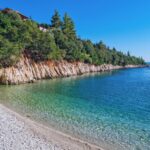
- Swimwear: the beach at Agia Roumeli is the reward at the end, and the water is usually clear and calm.
- Respect the park: stay on the path, take your rubbish with you and follow staff instructions.
- Base: Chania is the most convenient base; see our Chania travel guide for where to stay.
Samaria fits well into a week in western Crete alongside the beaches of the south-west, which are covered in our guide to the best beaches in Crete. For more ideas, see our things to do in Crete and the one-week Crete itinerary.
Frequently Asked Questions
How long does it take to walk the Samaria Gorge?
Most people take 5 to 7 hours to walk from Xyloskalo to Agia Roumeli, including breaks. Fast walkers can do it in about 4 hours, but there is no advantage in rushing since the boats leave in the afternoon.
How much is the Samaria Gorge ticket?
Since 2025 the standard ticket costs €10, with lower group and family rates and free entry for categories such as children, over-65s and EU students. Check the official NECCA ticket website for current prices.
When is the Samaria Gorge open?
It normally opens from early May into October, weather permitting. In 2026 it opened on 19 May after storm damage repairs, and it closes on individual days when rain, wind or fire risk is forecast.
How do you get back from Agia Roumeli?
There is no road. Take a ferry east to Loutro and Chora Sfakion or west to Sougia and Paleochora, then a bus to Chania. Organised tours include all transport.
Is the Samaria Gorge suitable for children?
Fit children of around ten and older who are used to walking usually manage it. For younger children, the shorter walk up from Agia Roumeli to the Portes is a better choice.
Do you need a helmet in the Samaria Gorge?
Helmets are optional, but they are offered free at both entrances and park authorities strongly recommend wearing one because of the risk of falling stones.