



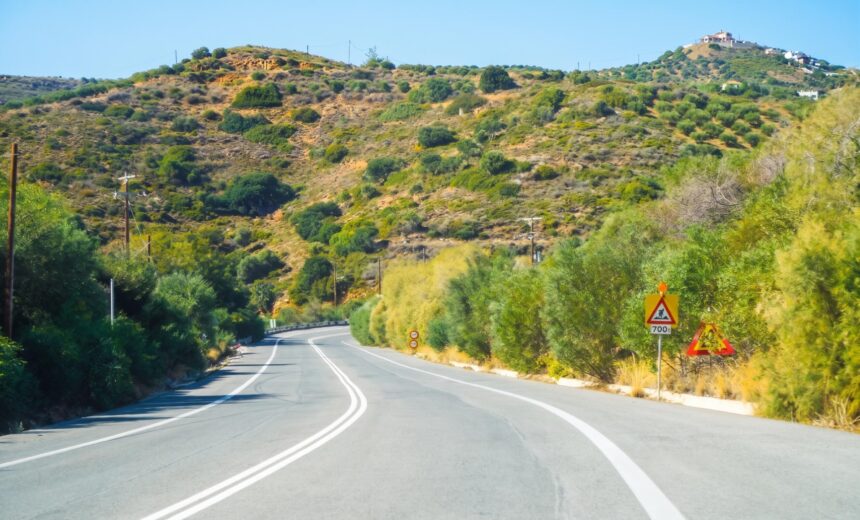
Driving in Crete is the best way to explore the island and is fine for confident drivers. Expect a busy north coast road with BOAK motorway works in 2026, narrow mountain roads, strict fines and slower journeys than maps suggest.
Driving in Crete is the best way to see the island, and it is manageable for any confident driver who adjusts to local habits. The main north coast highway is busy and in places dangerous, mountain and south coast roads are narrow and slow, and the big new motorway (BOAK) is under construction, so expect roadworks and diversions in 2026. Plan shorter days than the map suggests, drive defensively and choose rental insurance carefully.
Quick facts
- Drive on: the right; overtaking on the left.
- Main road: the New National Road (VOAK/BOAK) along the north coast, from Kissamos to Agios Nikolaos and on to Sitia.
- Speed limits (2026): 30 km/h on most urban streets, 90 km/h on open roads, 110 km/h on expressways, unless signs say otherwise.
- Tolls: none on Crete as of October 2026.
- Emergency number: 112.
- Typical drive times: Chania to Heraklion around 2 hours; Heraklion to Agios Nikolaos around 1 hour.
Do you need a car in Crete?
For most visitors, yes. Buses (KTEL) link the main towns along the north coast and reach popular places such as Elafonisi, Omalos for the Samaria Gorge and Matala, but often only once or twice a day. The best beaches, mountain villages, monasteries and gorges are far easier with your own wheels. If you are staying in Chania, Rethymno or Heraklion and plan only a couple of trips, buses and organised excursions can work. For a road trip, a car is close to essential. Our general guide to renting a car in Greece covers licences, age limits and insurance rules that apply here too.
The roads you will use
The New National Road (north coast)
Almost every trip in Crete uses the national road along the north coast, known in Greek as VOAK (often written BOAK, the Northern Road Axis of Crete). Some stretches are dual carriageway, particularly around Heraklion and towards Hersonissos, but long sections between Chania and Heraklion still have one lane in each direction with wide hard shoulders, junctions at road level and sharp bends through the hills.
Local custom on these single-lane sections is that slower vehicles drive half on the hard shoulder so faster cars can overtake down the middle. You will see it constantly, and it is wise to move right when someone sits on your bumper, but do it only when the shoulder is clear: tractors, parked vehicles, cyclists and rockfall can appear suddenly. The road has long had one of the worst accident records in Greece, mostly from speeding and risky overtaking. Never overtake across a solid line, and be especially careful at junctions where traffic joins from side roads.
Mountain and south coast roads
Roads crossing the island to the south coast climb through mountains and are narrow, twisting and slow. Routes such as Chania to Chora Sfakion through the Askyfou plateau, Rethymno to Plakias through the Kotsifou or Kourtaliotiko gorge, and the south coast road east of Paleochora are spectacular but tiring. Distances look small: 30 km can easily take 45 minutes. Watch for goats and sheep on the road, fallen stones after rain, and missing barriers on drops.
Dirt roads
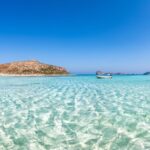
Some famous places are reached on unpaved tracks, notably the road from Kalyviani to the car park above Balos lagoon, around 9 km of dusty, rutted track. Many rental contracts exclude damage to tyres and the underside of the car, and some exclude unpaved roads entirely. Read your contract, drive slowly, and consider the boat from Kissamos instead.
BOAK motorway works: status in 2026
The biggest change to driving in Crete for decades is under way. The plan is to replace the old national road with a modern motorway of roughly 300 km from Kissamos to Sitia, with two lanes in each direction, a central barrier and no level junctions. Here is where things stood as of October 2026, based on announcements made during the year.
- Chania to Heraklion (concession section): the contract was signed in May 2025 and the concession formally started in early February 2026, with a five-year construction period. The section is about 157 km, extended by around 30 km with the Chania to Kissamos option. By spring 2026 work was under way on the Chania, Rethymno and Heraklion bypasses and at the first tunnel between Souda and Vryses. Completion is expected around 2030 to 2031.
- Hersonissos to Neapoli: being built as a public-private partnership, including a twin-bore tunnel at Selinari. Works were in progress in 2026.
- Neapoli to Agios Nikolaos: the most advanced section, about 14.5 km of four-lane road with three interchanges. In late May 2026 the Ministry of Infrastructure said the first 10 km would be completed during the summer and opened to traffic in the following months.
- Agios Nikolaos to Sitia: an eastward extension was under study in 2026, with no construction date.
- Tolls: the new motorway will be tolled once sections are finished, a first for Crete. Temporary toll stations may operate on completed parts before a distance-based electronic system replaces them. No tolls were charged as of October 2026.
What this means for you: expect work zones, lane narrowing, lower temporary speed limits and changed junctions, especially around Chania, Rethymno, Heraklion and between Neapoli and Agios Nikolaos. Signage at diversions is sometimes only in Greek or easy to miss, so slow down early. Use a navigation app with live traffic and allow extra time for airport runs. A new airport at Kastelli, south-east of Heraklion, is due to open in 2028 with its own motorway link.
Rules of the road and fines
Greece introduced a stricter traffic code in 2025, and lower urban speed limits took effect on 1 January 2026. Police checks are common in Crete, particularly for speed, alcohol, helmets and phone use. Fines for visitors are the same as for locals.
- Speed: 30 km/h is now the default on most urban streets, with 50 km/h on larger roads in towns; 90 km/h on ordinary roads outside towns; 110 km/h on expressways; 130 km/h on motorways. Speeding fines start at €150.
- Alcohol: the limit is 0.5 g/l (lower for drivers with under two years’ experience). Fines start around €350 with licence suspension, and higher readings can bring prosecution.
- Phones: using a handheld phone while driving costs €350 and a licence suspension for a first offence.
- Seatbelts and helmets: compulsory for everyone, including rear passengers and on quad bikes and scooters.
- Headlights: a car flashing its lights at you usually means “I am coming through”, not “go ahead”.
Renting a car in Crete
Crete has a huge choice of rental companies, from international brands at Heraklion and Chania airports to small family firms in every resort. Local companies often include full insurance with zero excess in the price, while some international brokers show a low headline price with a large excess and expensive add-ons at the desk. Compare the total cost.
- Pick a small car for village streets and tight parking; a little more power helps on mountain climbs with four people.
- Check exclusions: tyres, glass, the underside and unpaved roads are often excluded unless you pay for extra cover.
- Take photos of the car, including the wheels and the fuel gauge, before you drive away.
- Book automatics early: they are fewer and cost more, especially in July and August.
- Ferries: most companies do not allow their cars on ferries to other islands without written permission.
Realistic driving times
| Route | Approximate time |
|---|---|
| Chania to Rethymno | 1 hour |
| Rethymno to Heraklion | 1 hour 15 minutes |
| Heraklion to Agios Nikolaos | 1 hour |
| Agios Nikolaos to Sitia | 1 hour 15 minutes |
| Chania to Elafonisi | 1 hour 45 minutes to 2 hours |
| Chania to Chora Sfakion | 1 hour 15 minutes |
| Heraklion to Matala | 1 hour 15 minutes |
These times assume normal traffic. In July and August, with roadworks and slow vehicles, add 20 to 30 per cent. The road to Elafonisi beach in particular is narrow and very busy in high season.
Parking, fuel and night driving
Parking in Chania and Rethymno old towns is the hardest part of driving in Crete. Use the paid car parks around the walls rather than circling narrow lanes. In Heraklion, central streets are often controlled parking. At popular beaches and gorges, arrive before 10:00 in summer to find a space.
Fuel stations are frequent along the north coast and in larger villages, but sparse in the mountains and on the south coast, and many close in the evening or on Sundays in rural areas. Fill up before heading south. Most stations are attended, so you stay in the car and say how much you want.
Avoid long drives on mountain roads at night if you can. Bends are poorly lit, animals wander onto the road and some drivers return late from village festivals. If you are tackling the Samaria Gorge with a car, remember the gorge is one way: most hikers leave the car near Chania and take a bus to Omalos, then a ferry and bus back.
Practical tips
- Download offline maps before heading into the mountains; signal can drop out.
- Do not trust every shortcut a navigation app suggests: some are unpaved farm tracks.
- Keep water and a hat in the car in summer in case of a breakdown on a quiet road.
- Plan one long drive per day at most; our one-week Crete itinerary is built around that rule.
- Read the start of our Crete travel guide if you are still deciding where to base yourself.
- Check roadwork news close to your trip, as BOAK diversions change through the year.
Frequently Asked Questions
Is it safe to drive in Crete?
Yes, for confident drivers who stay alert. The north coast national road has a poor accident record because of speeding and overtaking, and mountain roads are narrow with animals and rockfall. Drive defensively, avoid night driving in the mountains and never drink and drive.
Are there toll roads in Crete?
As of October 2026 there are no tolls in Crete. The new BOAK motorway will be tolled once sections are completed, with temporary toll stations possible before an electronic system is introduced. The old roads will remain free.
When will the new Crete motorway be finished?
The Chania to Heraklion section started construction in February 2026 with a five-year build period, so completion is expected around 2030 to 2031. The short Neapoli to Agios Nikolaos section is much further ahead, with the first 10 km expected to open in 2026.
Why do cars drive on the hard shoulder in Crete?
On single-lane sections of the national road, slower drivers move partly onto the wide shoulder so faster cars can pass. It is common practice, but only do it when the shoulder is clear and you can see ahead.
Do I need an International Driving Permit in Crete?
EU, EEA and UK photocard licences are accepted on their own. Most other non-EU licences, including US and Canadian ones, should be accompanied by an International Driving Permit. Rental companies may refuse a car without one.