


Zakynthos is the southernmost main Ionian island, known for Navagio beach (closed to landings in 2026, visible from the clifftop), turtles in Laganas Bay, the Blue Caves and Keri. Stay five to seven days and hire a car.
Zakynthos (Zante) is much more than the Shipwreck beach on its postcards. The southernmost of the main Ionian Islands has loggerhead turtles nesting in Laganas Bay, sea caves and white cliffs on its wild west and north coasts, hill villages that have barely changed in decades, and a rebuilt Venetian style capital with a proud musical and literary past. With Navagio beach itself closed to visitors through 2026, the smart plan is to see the bay from above and spend the rest of your time on everything else.
Quick facts
- Where: Ionian Sea, south of Kefalonia and west of the Peloponnese.
- Getting there: direct flights to Zakynthos airport in summer, or the ferry from Kyllini in the Peloponnese, which takes around one hour.
- Time needed: 5 to 7 days to explore beyond the resorts.
- Best time: late May to June and September to early October.
- Good for: boat trips, turtles, beaches, families in the quieter resorts, nightlife in Laganas.
- Navagio in 2026: beach and surrounding waters closed until 31 October 2026; the clifftop viewpoint remains the way to see it.
Navagio in 2026: what you can and cannot do
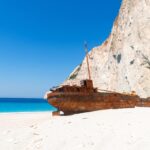
The Shipwreck beach, Navagio, has been closed to landings since rockfall studies found a high risk of further collapses from the surrounding cliffs. For 2026 a ministerial decision extended the restrictions until 31 October: no one may land on the beach, swimming is banned across the cove, and boats must stay at least 50 metres from the shore. Visitors can still look down on the bay from the upper viewing area on the cliffs above, reached by road from the Anafonitria area. Plans have been announced to extend the beach seaward with gravel to protect the eroding wreck, which ran aground in 1980. Our dedicated guide to Navagio Shipwreck beach has the details on the viewpoint and the rules.
Be wary of boat trips still advertised as visiting Navagio. In 2026 they could at most pass by outside the exclusion zone; confirm exactly what is included before you book.
The regions of Zakynthos
The south: Laganas Bay and Vasilikos
Laganas Bay is the heart of the National Marine Park of Zakynthos, created in 1999 to protect the nesting beaches of the loggerhead turtle (Caretta caretta). Beaches such as Gerakas, Daphni and Kalamaki are nesting sites, with rules to match: no access at night, umbrellas only near the waterline, and no digging in the dry sand. Sekania, the most important nesting beach, is closed to the public altogether. Out in the bay, the islet of Marathonisi, often called Turtle Island, has a small beach and sea caves; boats operate under speed limits in the park, so choose operators who respect the rules and keep their distance from turtles.
The Vasilikos peninsula on the eastern side of the bay is the greenest part of the island, with olive groves, pines and beaches such as Agios Nikolaos, Porto Zoro and the long sandy Banana beach. Gerakas, at its southern tip, is a beautiful sandy crescent backed by clay cliffs. Laganas town itself is the island’s party strip, loud and young in high summer; Kalamaki next door is calmer.
The southwest: Keri
Keri village is a quiet hill village with a Venetian era church, and nearby is the Keri lighthouse, on the cliffs at the island’s southwestern tip. It is one of the island’s classic sunset spots, with views down to the rock arches of the Mizithres. Boats from Keri harbour (Limni Keriou) visit the sea caves along the south coast.

The west coast
The west of Zakynthos is all high limestone cliffs and almost no beaches, which keeps it wonderfully undeveloped. Porto Limnionas is a narrow rocky inlet with startlingly clear water and a taverna above; there is no sand, so you swim from flat rocks. Porto Roxa, a little to the north, is similar. Kampi, on the cliffs above the western sea, is known for its huge cross and its sunset tavernas. The villages of the interior, such as Agios Leon, Exo Chora and Kiliomenos, are good places to stop for coffee and to see the island’s stone architecture.
The north: Blue Caves and Volimes
At Cape Skinari, the northern tip of the island, the Blue Caves are a series of sea caves where the water glows bright blue in the morning light. Small boats leave from the little port of Agios Nikolaos (not to be confused with the beach of the same name in Vasilikos) and from Cape Skinari itself, and the trip is short and good value. In 2026 some operators also offered trips that passed the Navagio cliffs from the sea, outside the exclusion zone. Nearby, the village of Volimes is known for its honey, cheeses and woven textiles, and the Anafonitria monastery is linked to Saint Dionysios, the island’s patron saint.
The east: Zakynthos Town and Tsilivi
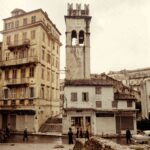
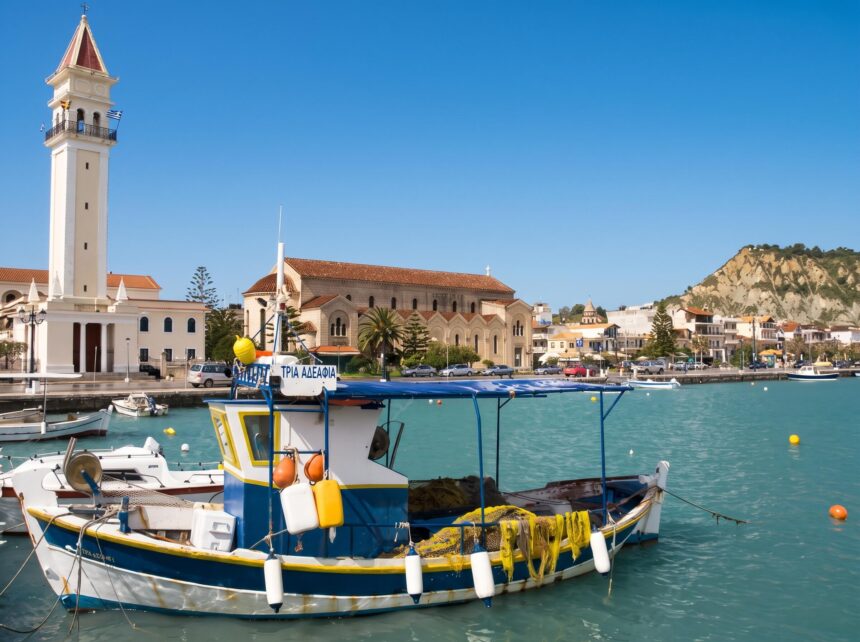
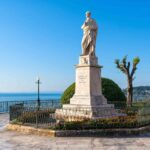
Zakynthos Town was almost entirely destroyed by the earthquake of 1953 and rebuilt with arcaded streets that echo its earlier Venetian look. Solomos Square on the waterfront honours Dionysios Solomos, the Zakynthian poet who wrote the Hymn to Liberty, whose first stanzas became the Greek national anthem; his museum is on the neighbouring square. The church of Agios Dionysios, at the southern end of the harbour, holds the relics of the patron saint and is busy with pilgrims. Above the town, Bochali hill has a Venetian castle in pine woods and cafés with views over the harbour, best in the evening. North of town, Tsilivi and Alykes are family friendly resorts with long sandy beaches and shallow water.
Food and local culture
Zakynthian cooking leans on meat and cheese more than many islands. Look for sartsa (beef in a tomato and garlic sauce), rabbit stifado, ladotyri (a sharp cheese aged in olive oil) and mantolato, a white almond nougat sold all over the island. The island’s own wine speciality is verdea, a traditional white that is often aged and has a slightly sherry like character. In the evenings in the villages and in some town tavernas you may hear kantades, Italian influenced serenades sung in harmony with guitars, a living tradition of the island.
Getting there and around
In summer, many charter and low cost flights land at Zakynthos airport, a few kilometres from both Zakynthos Town and Laganas. The rest of the year you will usually connect through Athens. By sea, ferries cross from Kyllini on the Peloponnese coast to Zakynthos Town in around an hour, several times a day in season; there is also a seasonal service from Pessada in Kefalonia to Agios Nikolaos in the north. Our guide to Greek ferries explains booking and timetables.
A car or scooter is close to essential if you want to see the west and north; buses connect the main resorts with town but not much else. Read our advice on renting a car in Greece before you go, and drive carefully on the narrow mountain roads.
Where to base yourself
- Vasilikos: green, quieter, near good beaches. Best for couples and nature lovers.
- Tsilivi and Alykes: sandy beaches and plenty of facilities. Best for families.
- Zakynthos Town: year round life, good food, central for exploring. Best without a beach habit.
- Laganas: nightlife and bars. Not the place for a quiet holiday.
- Keri and the west: villas and peace, with a car essential.
Combining Zakynthos with other islands
Zakynthos links easily with Kefalonia via the seasonal Agios Nikolaos to Pessada ferry. Our Kefalonia travel guide covers the next island north, and our Ionian island hopping guide sets out routes that continue to Lefkada and Corfu.
Practical tips
- Turtle etiquette: never chase, touch or feed turtles, and avoid boat operators who do. Respect closed and fenced nests on the beaches.
- Navagio: check the latest rules before booking anything that mentions the Shipwreck; restrictions are reviewed regularly.
- Blue Caves: go in the morning for the best light and calmer seas.
- Heat and crowds: July and August are busy and hot; the south coast resorts are crowded, while the west stays quieter.
- Off season: most resorts close from November to April, but Zakynthos Town stays open.
Treat the Shipwreck as one viewpoint among many, not the reason for the trip, and Zakynthos rewards you with a far more varied island than its famous postcard suggests.
Frequently Asked Questions
Is Navagio beach open in 2026?
No. Landing on the beach and swimming in the cove are banned until 31 October 2026 because of rockfall risk, and boats must stay 50 metres from the shore. You can still see the bay from the clifftop viewpoint.
Where can you see turtles on Zakynthos?
Loggerhead turtles live in Laganas Bay, within the National Marine Park. You often see them from boats around Marathonisi or in Laganas and Keri harbours. Never chase or feed them, and choose operators that respect the park rules.
Where is the best place to stay on Zakynthos?
Vasilikos suits couples and nature lovers, Tsilivi and Alykes suit families, Zakynthos Town is good for food and year round life, and Laganas is for nightlife. A car makes any base work.
How do you get to Zakynthos?
Fly direct to Zakynthos airport in summer, or via Athens. By sea, ferries cross from Kyllini in the Peloponnese in around one hour, and a seasonal ferry links the north of the island with Kefalonia.
How many days do you need in Zakynthos?
Five to seven days lets you see the Blue Caves, Keri, the west coast villages, Zakynthos Town and the beaches of Vasilikos at an easy pace.