


Stay in Corfu Town for culture and car-free travel, on the north-east coast (Kalami to Kassiopi) for calm water and villas, in Acharavi or the north-west bays for families, and in Paleokastritsa or Pelekas for scenery and sunsets.
The best area to stay in Corfu depends on what you want from the trip. Corfu Town is the best base for culture, food and car-free travel; the north-east coast (Kalami to Kassiopi) for calm clear water and a quieter, upmarket feel; the north and north-west (Acharavi, Arillas, Agios Georgios Pagon) for families and long sandy beaches; Paleokastritsa and the west coast (Pelekas, Glyfada) for scenery and sunsets; and the south for space, dunes and lower prices.
- Quick facts
- How to choose: the big picture
- Corfu Town
- Just north of town: Kontokali, Gouvia and Dassia
- Ipsos and Barbati
- North-east coast: Nissaki, Kalami, Agios Stefanos Sinion and Kassiopi
- North coast: Acharavi, Roda and Sidari
- North-west: Arillas, Agios Stefanos and Agios Georgios Pagon
- Paleokastritsa
- West coast: Pelekas, Glyfada and Agios Gordios
- South-east: Benitses, Moraitika and Messonghi
- The far south: Agios Georgios South, Lefkimmi and Kavos
- Comparison at a glance
- Practical tips
- Frequently Asked Questions
Quick facts
- Island size: about 64 km long and up to 32 km wide, so most areas are 30 to 75 minutes’ drive from Corfu Town
- Airport: just south of Corfu Town, a short taxi ride from the centre
- Best for no car: Corfu Town, or resorts on the bus routes such as Dassia, Ipsos, Benitses, Kassiopi and Sidari
- Best for families: Acharavi, Roda, Agios Georgios Pagon, Arillas, Agios Stefanos (north-west)
- Best for couples: Corfu Town, Kalami, Agios Stefanos Sinion, Pelekas, Paleokastritsa
How to choose: the big picture
Corfu divides fairly neatly by coast. The east coast faces the Greek and Albanian mainland across a narrow strait: the sea is usually calm and the beaches are mostly pebble. The west coast faces the open Ionian: the beaches are sandier and the sunsets better, but waves and wind are more common. The north has the island’s longest flat sandy strips, and the south is flatter, quieter and more agricultural. Corfu Town sits midway down the east coast and is the hub for buses, ferries and the airport.
Distances look short on a map, but roads are narrow and winding, so a 35 km drive can take an hour. If you plan to explore a lot without a car, stay in or near town. If you plan to drive, pick the coast that suits your beach style and accept a longer trip for a day in town.
Corfu Town
Best for: first-time visitors, culture, food, short stays, travellers without a car.
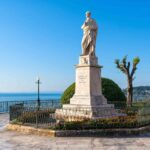
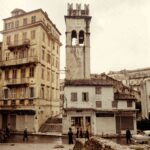
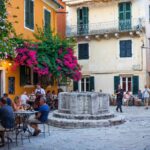
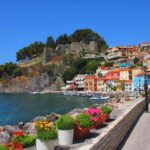
Staying in the UNESCO-listed Old Town means waking up within walking distance of the Liston, the fortresses, museums and the best restaurants on the island. Accommodation ranges from boutique hotels in restored mansions to simple rooms and apartments in the lanes of Campiello. Buses leave from town to most resorts, and ferries go to Paxos, Albania and the mainland. The downsides: no beach on the doorstep (the nearest swimming spots are at Mon Repos and the lido areas south of the centre), noise from bars and mopeds in summer, and difficult parking if you do hire a car. Stays in the Garitsa and Anemomylos areas, along the bay south of the Old Town, are slightly quieter and still walkable.
Just north of town: Kontokali, Gouvia and Dassia
Best for: travellers who want resort facilities within easy reach of town.

This stretch of coast, 7 to 12 km north of Corfu Town, is heavily developed with large hotels, apartments and a big marina at Gouvia, where the ruins of a Venetian shipyard still stand. Beaches are narrow and shingly, and many hotels have their own lidos and pools. Dassia is known for watersports. It is practical, well served by buses and good value, but it lacks the scenery and village character of the north-east or west.
Ipsos and Barbati
Best for: lively holidays (Ipsos); quiet beach stays below the mountain (Barbati).
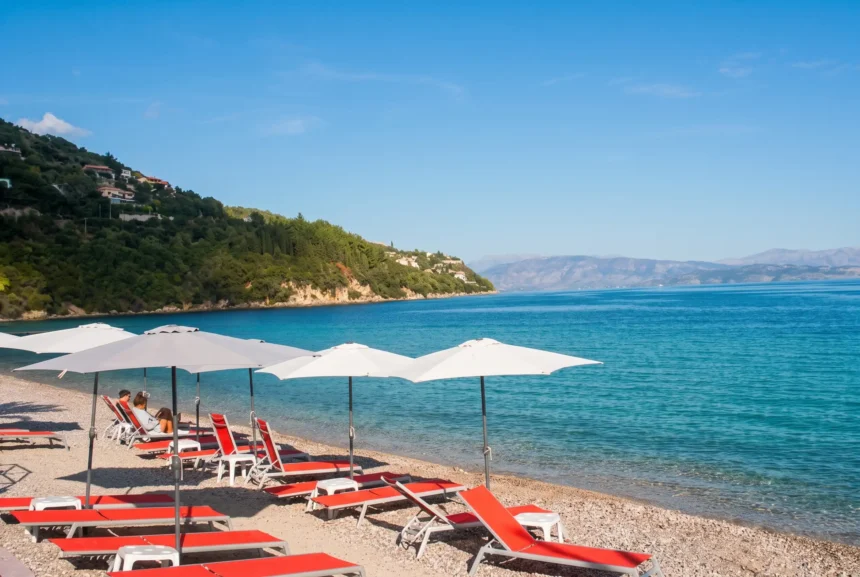
Ipsos has a long, thin beach running beside the main road and a strip of bars and clubs that make it one of the island’s livelier resorts. A few kilometres further north, Barbati is calmer, with a long white-pebble beach backed by the slopes of Mount Pantokrator and clear water. Both are about 15 to 20 km from town.
North-east coast: Nissaki, Kalami, Agios Stefanos Sinion and Kassiopi
Best for: couples, villas, swimming and snorkelling, boat trips, a refined feel.
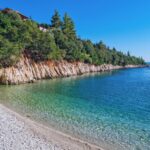
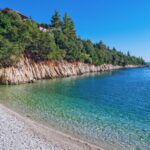
This is the most sought-after stretch of Corfu and has long been popular with British villa owners. The coast road winds above coves of white pebbles and very clear water, with Albania just across the strait. Kalami is where Lawrence Durrell lived in the 1930s; Agios Stefanos Sinion is a small, upmarket harbour village; Kassiopi is the largest settlement, with a harbour, a ruined castle and plenty of tavernas and shops. Accommodation is mostly villas and small apartment complexes, often on slopes with stairs. Beaches are pebbly, so families with toddlers may prefer the north coast. This is also the best area for hiring a small boat and exploring by sea.
North coast: Acharavi, Roda and Sidari
Best for: families, long sandy beaches, budget-friendly stays.
Acharavi and Roda share a long, shallow beach of sand and fine shingle, flat streets that are easy with buggies, and a relaxed resort feel. Acharavi is generally considered the more pleasant of the two. Further west, Sidari is one of the island’s busiest package resorts, known for its sandstone formations and the Canal d’Amour; it is lively and convenient but can feel crowded in August. The north coast is about an hour from the airport.
North-west: Arillas, Agios Stefanos and Agios Georgios Pagon
Best for: families, sunsets, a quieter base with sandy beaches.
The north-west corner has three bays with plenty of sand and a slower pace. Arillas is small and laid-back, Agios Stefanos (not to be confused with its north-east namesake) has a wide beach and a good range of rooms, and Agios Georgios Pagon is a sweeping sandy bay below green hills. The hilltop village of Afionas, between the last two, is the start of the path to Porto Timoni. Roads to the rest of the island are slow, so this suits travellers who plan to stay put.
Paleokastritsa
Best for: scenery, couples, boat trips to sea caves, swimming in cool clear water.
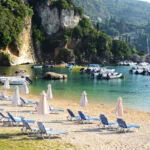
Paleokastritsa’s cluster of small coves below forested cliffs and the hilltop monastery is the postcard image of Corfu. Hotels and apartments spread along the road down to the bays and up the hillsides, many with sea views. The water is noticeably cooler than elsewhere, the beaches are small and get crowded with day-trippers in high season, and there is little nightlife. It is around 25 km from town, so day trips are easy.
West coast: Pelekas, Glyfada and Agios Gordios
Best for: sunsets, sandy beaches, walkers, a mix of village and beach life.
Pelekas is an inland hill village known for its sunset viewpoint, with small tavernas and rooms, and access to the beaches below. Glyfada has one of the island’s best sandy beaches, though accommodation there is limited. Agios Gordios is a beach resort in a dramatic bay framed by cliffs and a rock stack offshore. All three are around 15 to 20 km from town, and the west coast can be windy in the afternoon.
South-east: Benitses, Moraitika and Messonghi
Best for: value, easy access to town and the airport, older travellers.
Benitses is a former fishing village with a small harbour and a seafront promenade, 12 km south of town and on a good bus route. Moraitika and Messonghi, further south, have long narrow beaches, flat walks and plenty of mid-range hotels. The area is unpretentious and good value, and the Achilleion palace is close by.
The far south: Agios Georgios South, Lefkimmi and Kavos
Best for: space, dunes and quiet (Agios Georgios and Issos); party holidays (Kavos).
The south is flatter, with olive groves, vineyards and the Korission Lagoon. Agios Georgios South has a vast sandy beach that runs towards the dunes at Issos, with simple accommodation and a peaceful feel outside August. Lefkimmi is a working town with ferry links to the mainland. Kavos, at the southern tip, is a party resort aimed at young travellers and best avoided if that is not your scene. The far south is roughly an hour from town.
Comparison at a glance
| Area | Beaches | Vibe | Best for |
|---|---|---|---|
| Corfu Town | None in town | Historic, busy | Culture, food, no car |
| Gouvia, Dassia | Narrow shingle | Resort | Value near town |
| North-east (Kalami to Kassiopi) | Pebble, very clear | Quiet, upmarket | Couples, villas, boats |
| Acharavi, Roda | Long, shallow sand | Relaxed | Families |
| North-west bays | Wide sand | Laid-back | Families, sunsets |
| Paleokastritsa | Small coves | Scenic | Couples, sightseeing |
| Pelekas, Glyfada | Sand, some surf | Village and beach | Sunsets, walkers |
| Benitses to Messonghi | Narrow shingle | Easy-going | Value, older travellers |
| Far south | Big sandy beaches | Quiet (Kavos: party) | Space, nightlife |
Practical tips
- Book early for July and August: the north-east villas and Old Town boutique hotels fill first.
- Check the access: many properties on the north-east coast and in Paleokastritsa are reached by steep roads or steps. Ask before booking if anyone has limited mobility.
- Consider a split stay: two or three nights in Corfu Town followed by a beach week elsewhere works well for longer trips.
- Shoulder season: in May, June, September and early October prices fall and the whole island is calmer. Some resorts, especially in the north and south, close from November to April.
- Car or no car: outside town and the main bus corridors, a car or scooter is close to essential. Parking in the Old Town is difficult; ask your accommodation about options.
Frequently Asked Questions
What is the best area to stay in Corfu for first-timers?
Corfu Town is the best first base: it has the sights, the best food, and bus and ferry links across the island. If you prefer a beach holiday, the north-east coast or Paleokastritsa give the most classic Corfu scenery.
Which part of Corfu is best for families?
The north coast (Acharavi, Roda) and the north-west bays (Arillas, Agios Stefanos, Agios Georgios Pagon) have long sandy beaches with shallow water. Agios Georgios South is another good option with more space.
Where should I stay in Corfu without a car?
Corfu Town is the easiest choice, since buses to most resorts start there and the airport is close by. Resorts along main bus routes, such as Dassia, Ipsos, Benitses, Kassiopi and Sidari, also work without a car.
Is the north or south of Corfu better?
The north is greener and more dramatic, with the best-known coves and the widest choice of accommodation. The south is flatter, quieter and often cheaper, with large sandy beaches, apart from the party resort of Kavos.
Where is the quietest place to stay in Corfu?
Look at the smaller villages of the north-east such as Agios Stefanos Sinion and Kalami, the north-west village of Arillas, or Agios Georgios South outside August. Hill villages such as Pelekas are also peaceful at night.