


The Boschetto is a small formal garden on the east side of the Spianada in Corfu Town, between the church of Panagia Mandrakina and the entrance to the Old Fortress. It is free, shady, has a playground, and holds statues of figures who shaped modern Corfu.
The Boschetto is a small, formal garden on the eastern edge of the Spianada in Corfu Town, facing the moat of the Old Fortress. Its name is Italian for “little wood”, and with its symmetrical beds, trimmed shrubs and shady trees it does recall, on a modest scale, the gardens of Renaissance Italy. It is free, open, has a playground for children, and doubles as an outdoor gallery of statues of people who shaped the island’s history. Most visitors walk straight past it on the way to the Old Fortress; it is worth twenty minutes of your time.
Quick facts
- Where: east side of the Spianada (Lower Square), between the church of Panagia Mandrakina and the bridge to the Old Fortress.
- Cost: free.
- Time needed: 20 to 30 minutes, longer with children using the playground.
- Best time: morning or late afternoon, when the shade is most welcome and the light is softer on the statues.
- Good for: families, history lovers, Durrell readers, anyone needing a shady bench in town.
From battlefield to garden
The whole Spianada began life as a military space. The Venetians kept a wide area clear of buildings between the town and the Old Fortress so that defenders on the walls had an open field of fire against any enemy that broke into the town. As artillery and siege warfare changed, that empty ground lost its military purpose, and from the 19th century it became the town’s promenade. Corfiots took to strolling between the old town and the Contrafossa, the sea moat that cuts the Old Fortress off from the mainland, and part of that open space was laid out as a garden. You can read more about the square itself in our guide to the Liston and Spianada.
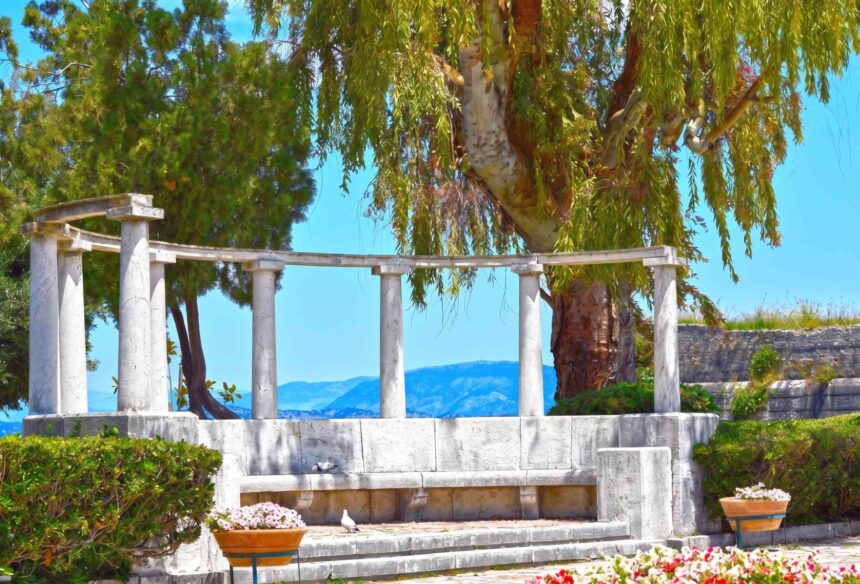
Today the Boschetto is fenced, with neat paths, flower beds, fountains and small trees, and its northern end has a playground that is popular with local families. Two marble semicircular colonnades, each with eight Ionic columns, give it a classical frame.
The statues
The garden’s real interest lies in who is commemorated here. Together the statues give a compact lesson in Corfu’s history, from Venetian defence to British philhellenism and the island’s literary life.
Lord Guilford
At the centre, framed by the colonnades and looking towards the Contrafossa, stands the statue of Frederick North, 5th Earl of Guilford (1766 to 1827). An Englishman who converted to Orthodoxy and loved all things Greek, he founded the Ionian Academy in Corfu in 1824, the first institution of higher education in modern Greece, while the island was under British protection. The statue dates from the 1880s, and it was the first of the monuments here; the garden as a statue park grew around it.
Lorenzos Mavilis
A bust near the entrance commemorates Lorenzos Mavilis (1860 to 1912), a Corfiot poet of Spanish descent and one of the finest writers of the sonnet in the Greek language. He was also a patriot of the old school: he fought as a volunteer in the Cretan uprising of 1896 to 1897 and in the Greco Turkish War of 1897, and he was killed in the Balkan Wars in 1912 at Driskos in Epirus, at the age of 52.
Konstantinos Theotokis
Facing him is a bust of Konstantinos Theotokis (1872 to 1923), the Corfiot novelist and short story writer whose books depict the harsh social reality of the island’s villages. A leading figure of the later Ionian School of literature, he also translated major European works into Greek, including Shakespeare, Goethe and Kalidasa. The two men were close friends who fell out late in Mavilis’s life over politics, Theotokis having become a committed socialist; their busts now stand on either side of the same path.
The Durrell brothers
In 2006 the garden was renamed the Durrell Boschetto in honour of Lawrence and Gerald Durrell, the writer and the naturalist who lived on Corfu with their family from 1935 to 1939. Lawrence wrote about the island in Prospero’s Cell; Gerald turned his childhood there into My Family and Other Animals, the book that has brought more British visitors to Corfu than any brochure. Busts of both brothers stand along the paths near the southern entrance, and they are among the most photographed statues on the island. Durrell fans heading north should also see our Corfu historical figures guide for the wider cast of characters.
Schulenburg, just outside
The largest and oldest statue in the area stands just beyond the southern end of the garden, in front of the bridge to the Old Fortress. It portrays Count Johann Matthias von der Schulenburg, the German soldier who commanded the Venetian defence of Corfu during the great Ottoman siege of 1716. The siege lasted several weeks in the summer of that year and ended in August when the Ottoman army withdrew, a deliverance Corfiots also credit to Saint Spyridon. Schulenburg afterwards oversaw the strengthening of the town’s outer defences.
Venice was so grateful that it commissioned the sculptor Antonio Corradini to carve this marble statue in 1718, while Schulenburg was still alive and serving the Republic. Statues of living commanders were very rarely granted by Venice, which makes this one unusual. For more on the siege and the walls he reinforced, read our guide to Corfu’s Venetian fortifications.
Panagia Mandrakina
At the northern end of the garden, close to the Palace of St Michael and St George, stands the small church of Panagia Mandrakina. Its name comes from Mandraki, the little harbour tucked under the north side of the Old Fortress, and local tradition says an icon of the Virgin was found in the sea nearby. The church was badly damaged in the Second World War and owes its present form to post war repairs. It is a working Orthodox church, and you may find it open for a quick look.
Combining the Boschetto with nearby sights
The garden sits at a crossroads of the town’s best sights, so it fits easily into a morning. Walk over the bridge from the Schulenburg statue into the Old Fortress, then come back across the Spianada for coffee under the arcades of the Liston. The Palace of St Michael and St George, home to the Museum of Asian Art, is five minutes north. If you are planning a longer stroll, the Boschetto makes a good shady start or finish to our Corfu Town walking route.
Practical tips
- Opening: the garden is fenced but generally open during the day; gates may close at night.
- With children: the playground at the northern end is small but shaded, a useful break between sights. See our Corfu with kids guide for more ideas.
- Cricket: on the far side of the Spianada, cricket matches are played on summer weekends, a British era tradition worth watching from the shade.
- Toilets and water: there are no reliable public facilities in the garden itself; use the cafes of the Liston.
- Photography: the garden is busiest in late morning; for empty paths and soft light on the marble, come early.
Frequently Asked Questions
Where is the Boschetto in Corfu?
It is on the east side of the Spianada in Corfu Town, between the church of Panagia Mandrakina and the bridge to the Old Fortress. It is a two minute walk from the Liston.
Is the Boschetto free to visit?
Yes. It is a public municipal garden with no entrance fee. It is fenced and the gates may be closed at night.
Why is it called the Durrell Boschetto?
In 2006 the garden was dedicated to Lawrence and Gerald Durrell, who lived on Corfu from 1935 to 1939 and wrote about the island. Busts of both brothers stand in the garden.
Who is the statue in front of the Old Fortress?
It is Count Johann Matthias von der Schulenburg, who led the Venetian defence of Corfu in the Ottoman siege of 1716. Venice commissioned the statue from Antonio Corradini in 1718, while he was still alive.
Is the Boschetto good for children?
Yes. It has a small shaded playground at its northern end, and the open Spianada next door gives children space to run. It is a good break between the Old Fortress and the old town lanes.